Logo

American Heart Association

  22
  0


Final ID: Su2113

Pathway between Food Access and Stroke: Targets for Intervention

Abstract Body (Do not enter title and authors here): Background: Food insecurity is associated with chronic disease and remains a key focus for population health interventions. Most research has focused on food insecurity at an individual level, without recognizing the role the food environment in an individual’s neighborhood plays in development of chronic disease. This study examined the pathway between food access measured at a census tract level and stroke prevalence to identify targets for interventions and inform policy efforts at the population level.

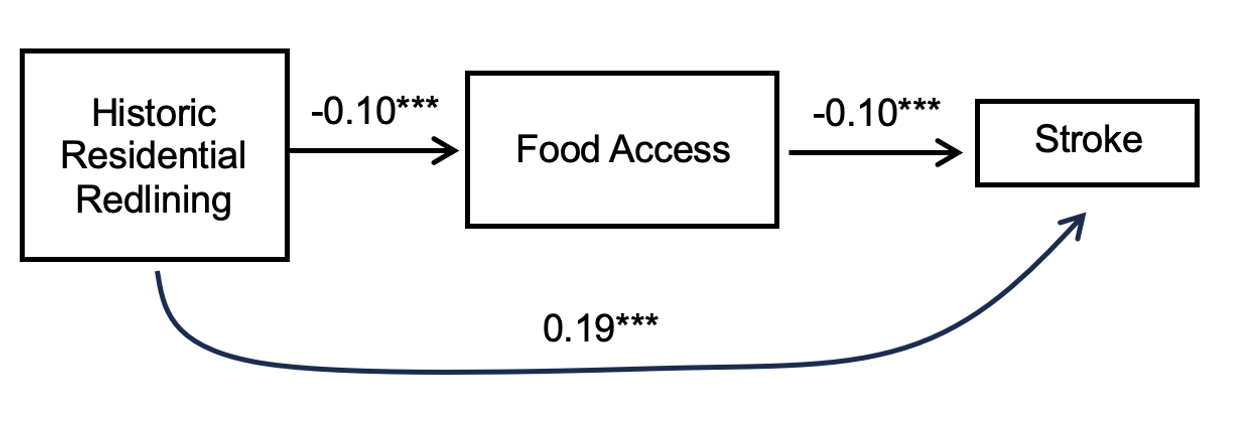
Methods: Census tract level data were combined to create a final analytic dataset of 11,457 census tracts. Structural racism was defined as historic residential redlining using Home Owners’ Loan Corporation (HOLC) residential security maps from the Mapping Inequality project (score between 1=best to 4=redlined). Food access was defined using the modified retail food environment index (mRFEI) calculated as the number of healthy food retailers divided by the number of healthy and less healthy food retailers per census tract. Prevalence of stroke in each census tract was based on CDC PLACES data. Direct and indirect relationships between redlining and stroke via food access was investigated using structural equation modeling run in Stata v17, controlling for population of each census tract.

Results: Mean prevalence of stroke was 31.8%. Redlining (0.19, 95%CI 0.17, 0.21, p<0.001) and lower food access (-0.10, 95%CI -0.12, -0.09, p<0.001) were directly associated with higher prevalence of stroke. Redlining was also indirectly associated with stroke via lower food access within a census tract (-0.10, 95%CI -0.12, -0.08, p<0.001). See Figure 1.

Conclusions: Structural racism measured using historical redlining was directly and indirectly associated with the prevalence of stroke via food access in a census tract. Based on these results, interventions to improve access to healthy food options at the community level may help address the impact of structural racism on the health of individuals, particularly those at risk for stroke living in historically redlined neighborhoods.
  • Walker, Rebekah  ( University at Buffalo , Buffalo , New York , United States )
  • Campbell, Jennifer  ( University at Buffalo , Buffalo , New York , United States )
  • Egede, Leonard  ( UBMD Internal Medicine , Buffalo , New York , United States )
  • Author Disclosures:
    Rebekah Walker: DO NOT have relevant financial relationships | Jennifer Campbell: DO NOT have relevant financial relationships | Leonard Egede: DO NOT have relevant financial relationships
Meeting Info:

Scientific Sessions 2025

2025

New Orleans, Louisiana

Session Info:

Food Insecurity & Cardiometabolic Health: From Evidence to Interventions

Sunday, 11/09/2025 , 11:30AM - 12:30PM

Abstract Poster Board Session

More abstracts on this topic:
Association between dietary inflammatory index and mortality in adults with hyperlipidemia: An analysis from the NHANES study

Wu Shuang, Zheng Li-hui

A ChatGLM-based stroke diagnosis and prediction tool

Song Xiaowei, Wang Jiayi, Ma Weizhi, Wu Jian, Wang Yueming, Gao Ceshu, Wei Chenming, Pi Jingtao

More abstracts from these authors:
You have to be authorized to contact abstract author. Please, Login
Not Available