Healthcare Expenditure on Cardiovascular-Kidney-Metabolic Health in Young Adults Aged 20 to 44 from 2010 to 2019
Abstract Body (Do not enter title and authors here): Background: Cardiovascular-kidney-metabolic (CKM) syndrome comprises interconnected conditions such as heart disease, kidney disease, diabetes, and obesity. These conditions often begin early in life and now affect a significant portion of young adults. As CKM becomes more common in this age group, its long-term health and economic consequences are increasingly concerning. This study aimed to estimate trends in U.S. healthcare expenditures related to CKM among young adults from 2010 to 2019.
Methods: National healthcare spending on CKM from 2010 through 2019 was estimated using data from the Institute for Health Metrics and Evaluation (IHME). The Disease Expenditure Project (DEX) at IHME provides spending estimates across 3,110 U.S. counties, categorized by condition, payer, age group, and type of care. This analysis utilized over 40 billion administrative insurance claims and nearly 1 billion facility records, capturing expenditures from Medicare, Medicaid, private insurance, and out-of-pocket payments.
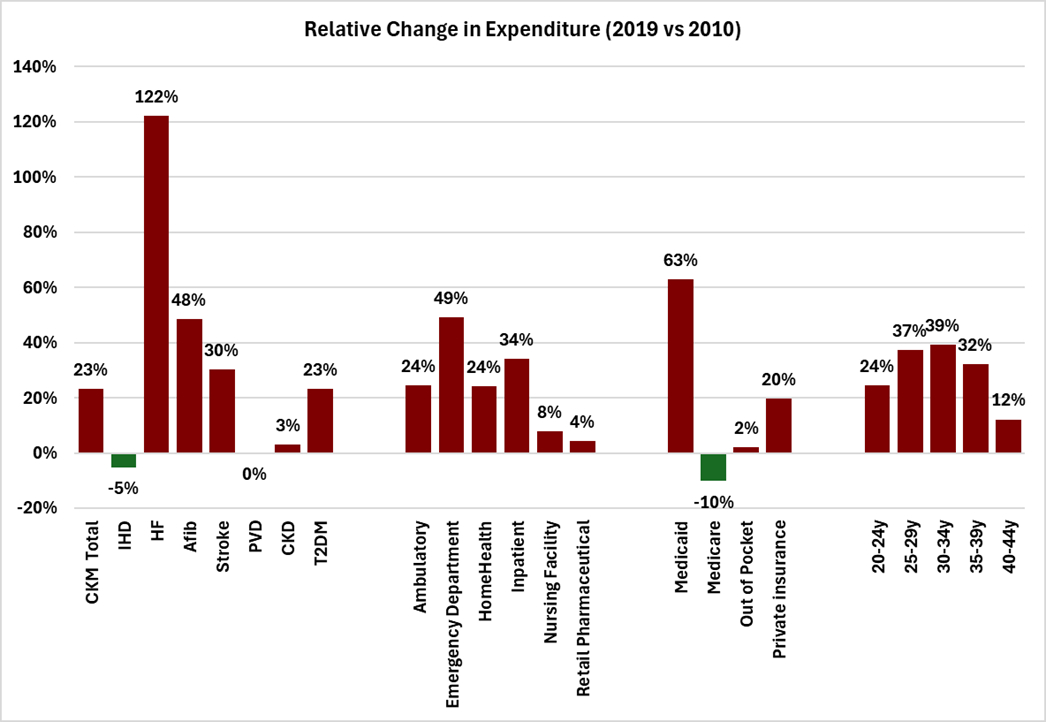
Results: Between 2010 and 2019, total healthcare spending for CKM in young adults increased by 23%, from approximately $14 billion to $18 billion. Heart failure expenditures showed the largest relative increase (122%), followed by atrial fibrillation (48%), stroke (30%), and type 2 diabetes (23%). Spending for ischemic heart disease declined by 5%, while expenditures for peripheral vascular disease remained stable. Across all years, type 2 diabetes accounted for the greatest share of total spending among CKM components. Spending increased across all types of care, with the largest growth seen in emergency department services (49%), inpatient care (34%), and ambulatory care (24%). In 2019, $4.6 billion in expenditures were attributed to Medicaid and $10.4 billion to private insurance. Over the study period, Medicaid spending increased by 63%, private insurance by 20%, and Medicare spending declined by 10%. Expenditure growth varied by age group, with the highest relative increases observed in adults aged 30 to 34 years (39%) and 25 to 29 years (37%).
Conclusion: CKM syndrome imposes a growing health and economic burden on young adults in the United States. This study demonstrates a steady rise in healthcare spending across all CKM conditions, particularly for heart failure and emergency care. The findings underscore the need for early prevention efforts and targeted strategies to mitigate disparities and reduce long-term costs.
Rajan, Tanuja
(
University of North Carolina Health Southeastern
, Lumberton , North Carolina , United States )
Shahid, Izza
(
Houston Methodist Academic Institut
, Houston , Texas , United States )
Javed, Zulqarnain
(
Houston Methodist
, Houston , Texas , United States )
Dong, Weichuan
(
Houston Methodist
, Houston , Texas , United States )
Mossialos, Elias
(
London School of Economics
, London , United Kingdom )
Al-kindi, Sadeer
(
Houston Methodist Academic Institut
, Houston , Texas , United States )
Author Disclosures:
Tanuja Rajan:No Answer
| Izza Shahid:DO NOT have relevant financial relationships
| Zulqarnain Javed:DO NOT have relevant financial relationships
| Weichuan Dong:DO NOT have relevant financial relationships
| Elias Mossialos:DO NOT have relevant financial relationships
| Sadeer Al-Kindi:No Answer