Disaggregating Cardiovascular-Kidney-Metabolic Mortality among Asian Subgroups in the United States
Abstract Body (Do not enter title and authors here): Background: Cardiovascular-Kidney-Metabolic (CKM) syndrome is a growing cause of mortality, shaped by both biological and social determinants of health. Given the heterogeneity within Asian populations in the U.S., we sought to disaggregate CKM-related mortality across Asian subgroups and compare trends with non-Asian populations.
Methods: We analyzed multiple cause-of-death data from the CDC WONDER database (2018–2023) to estimate proportionate mortality due to CKM, defined as deaths where CKM-related conditions were listed among multiple causes, across Asian subgroups (Chinese, Filipino, Japanese, Korean, Vietnamese, Other Asian) and non-Asians (White, Black). Proportionate mortality was calculated as the number of CKM-related deaths divided by total deaths. Analyses were stratified by sex, and prevalence ratios comparing each group to White individuals were computed.
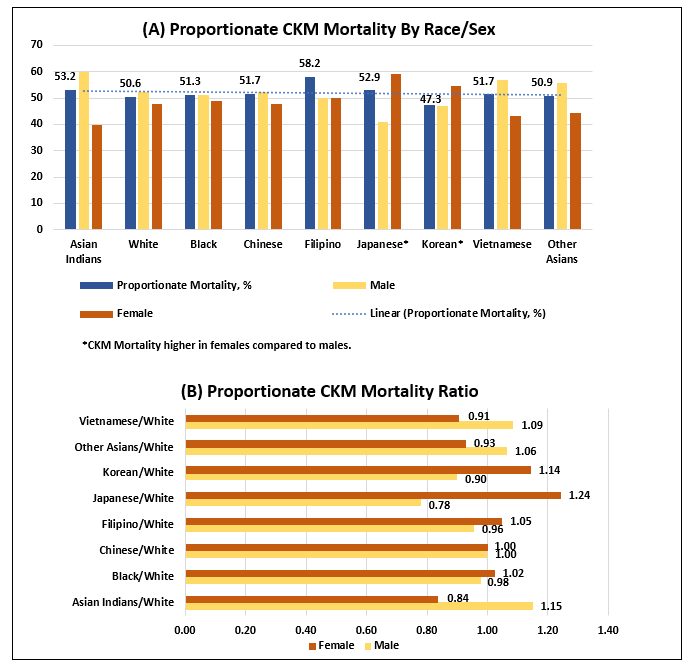
Results: Among 18.9 million total deaths, 9.6 million (50.7%) were CKM-related (267,360 occurring in Asians). Filipinos had the highest proportionate CKM mortality (58.2%), followed by Asian Indians (53.2%), Japanese (52.9%), Chinese and Vietnamese (51.7%), Other Asians (50.9%), Black (51.3%), and White (50.6%). Koreans had the lowest among Asians (47.3%). Gender disparities were notable: Japanese and Korean women had higher CKM mortality than men (55% vs. 47% and 59% vs. 41%, respectively). CKM-related deaths spiked in 2020 and peaked in 2021, corresponding to the COVID-19 pandemic. Asian Indian men and Japanese women had the highest CKM-related proportionate mortality ratios (1.15 and 1.24, respectively) compared to their White counterparts.
Conclusion: CKM-related mortality is disproportionately higher in several Asian subgroups, with marked variation by sex and race. The pandemic amplified these disparities, underscoring the urgent need for targeted prevention through culturally sensitive interventions in high-risk Asian populations.
Saleem, Hira
(
Houston Methodist Hospital
, Houston , Texas , United States )
Shahid, Izza
(
Houston Methodist Hospital
, Houston , Texas , United States )
Dong, Weichuan
(
Houston Methodist Hospital
, Houston , Texas , United States )
Nasir, Khurram
(
Houston Methodist Hospital
, Houston , Texas , United States )
Al-kindi, Sadeer
(
Houston Methodist Hospital
, Houston , Texas , United States )
Author Disclosures:
Hira Saleem:DO NOT have relevant financial relationships
| Izza Shahid:No Answer
| Weichuan Dong:DO NOT have relevant financial relationships
| Khurram Nasir:No Answer
| Sadeer Al-Kindi:No Answer