Logo

American Heart Association

  16
  0


Final ID: Mo1032

Cardiogenic Shock due to Flecainide Toxicity: No substitute for time.

Abstract Body (Do not enter title and authors here): Flecainide has a narrow therapeutic index, and at toxic levels can induce a dangerous wide complex rhythm. Here we describe a refractory case of cardiogenic shock due to flecainide toxicity and how the most effective treatment was time.
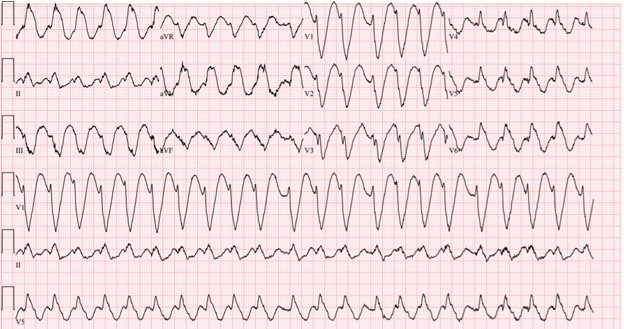
A 77-year-old male with history of tachy-brady syndrome status post dual chamber pacemaker, heart failure with mildly reduced ejection fraction (45%), and paroxysmal atrial fibrillation presented with dyspnea and abdominal pain in the setting of a recent diarrheal illness. He was started on flecainide 100mg twice daily two weeks prior to presentation. On arrival, patient was hypotensive and tachycardic with physical exam remarkable for peripheral edema and mottled extremities. EKG showed a wide complex tachycardia with QRS duration of 190 milliseconds. Labs were notable for an acute kidney injury. Flecainide level was elevated at 1.27mcg/ml. Echocardiogram showed severe interventricular dyssynchrony with an ejection fraction of 30%. Right heart catheterization revealed a cardiac index of 1.12. Treatment of flecainide toxicity included sodium bicarbonate boluses, anti-tachycardia pacing, synchronized cardioversion, and amiodarone infusion. None of these therapies terminated the wide complex tachycardia. Cardiogenic shock was managed with bumetanide infusion and placement of an intra-aortic balloon pump. Lipid emulsion therapy was not pursued due to improvement in shock state. The patient did not tolerate milrinone due to hypotension and tachycardia. The most successful treatment proved to be time. His QRS returned to normal duration on the 7th day of admission.
In this case, flecainide toxicity resulted in cardiogenic shock secondary to severe interventricular dyssynchrony and wide complex tachycardia. None of the antiarrhythmic strategies were immediately successful at restoring sinus rhythm. Ultimately, the most successful strategy was tincture of time to allow for flecainide clearance and the patient recovered.
  • Mcnaught, Jeremy  ( Geisinger Medical Center , Danville , Pennsylvania , United States )
  • Shuey, Timothy  ( Geisinger Medical Center , Danville , Pennsylvania , United States )
  • Caplan, Alex  ( Geisinger Medical Center , Danville , Pennsylvania , United States )
  • Vogt, Cody  ( Geisinger Medical Center , Danville , Pennsylvania , United States )
  • Pfirman, Kristopher  ( Geisinger Medical Center , Danville , Pennsylvania , United States )
  • Author Disclosures:
    Jeremy McNaught: DO NOT have relevant financial relationships | Timothy Shuey: DO NOT have relevant financial relationships | Alex Caplan: DO NOT have relevant financial relationships | Cody Vogt: DO NOT have relevant financial relationships | Kristopher Pfirman: DO NOT have relevant financial relationships
Meeting Info:

Scientific Sessions 2025

2025

New Orleans, Louisiana

Session Info:

Echocardiography Research and Case Reports

Monday, 11/10/2025 , 01:00PM - 02:00PM

Abstract Poster Board Session

More abstracts on this topic:
A recombinant protein oxygen carrier with reduced nitric oxide scavenging as a blood substitute for resuscitation

Xu Qinzi, Rochon Elizabeth, Bocian Kaitlin, Huang Xue, Poropatich Ronald, Gladwin Mark, Tejero Jesus, Rose Jason, Rodriguez Deborah, Hwang Hyon, Turner Bryan, Hunt Thomas, Dent Matthew, Demartino Anthony, Abdelghany Youmna, Chen Xiukai

A Case of Myocardial Infarction with Non-obstructive Coronary Arteries (MINOCA) Complicated by a Ventricular Septal Defect (VSD)

Thai Theresa, Lipinski Jerry, Sola Michael, El Rafei Abdelghani, Desai Aken, Sailer Christine

More abstracts from these authors:
You have to be authorized to contact abstract author. Please, Login
Not Available