Logo

American Heart Association

  13
  0


Final ID: MP2386

Efficacy of Obicetrapib on Lipid Parameters: A Meta-Analysis of Randomized Controlled Trials

Abstract Body (Do not enter title and authors here): Background:
Cholesteryl ester transfer protein (CETP) inhibition has re-emerged as a promising strategy in lipid management, particularly in patients with residual atherogenic risk despite statin therapy. Obicetrapib is a selective CETP inhibitor recently evaluated in multiple randomized trials. Atherosclerotic cardiovascular disease (ASCVD) remains a leading cause of morbidity and mortality worldwide, with elevated low-density lipoprotein cholesterol (LDL-C) being a major modifiable risk factor; necessitating the development of additional lipid-lowering agents.

Objective:
This meta-analysis aimed to assess the lipid-modifying efficacy of obicetrapib across key atherogenic and protective lipid markers.
Methods:
We searched the Cochrane Central Registry of Controlled Trials, PubMed, Embase, Web of Science, and clinicalTrials.gov databases for all randomized controlled trials (RCTs) published up to May 2025 comparing sotatercept to placebo .Lipid outcomes evaluated included low-density lipoprotein cholesterol (LDL-C), non–high-density lipoprotein cholesterol (non–HDL-C), high-density lipoprotein cholesterol (HDL-C), and triglycerides. Standardized mean differences (SMD) with 95% confidence intervals (CIs) were calculated using a random-effects model. Heterogeneity was assessed using the I squared statistic.

Results:
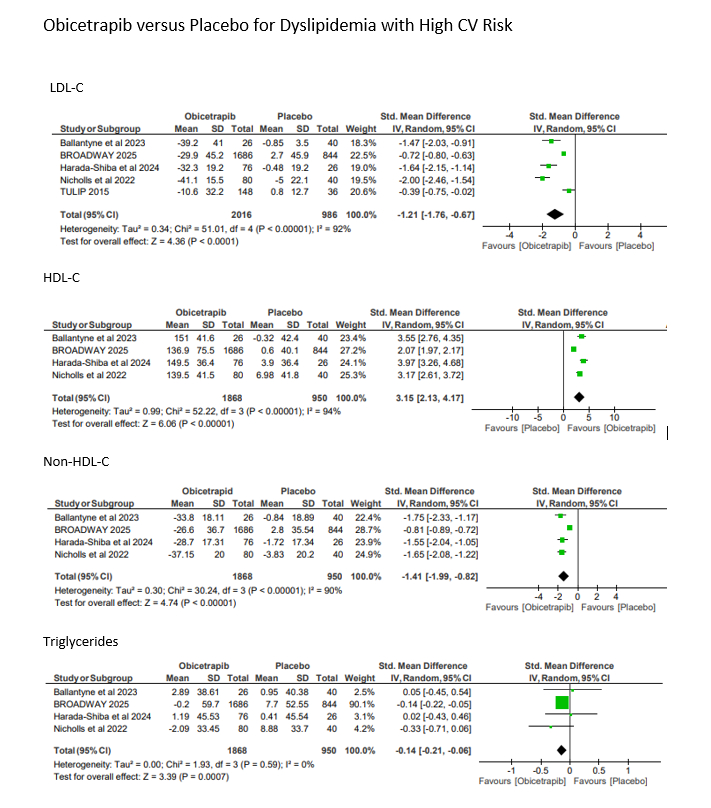
Five randomized controlled trials were included with a population of 3002 Obicetrapib, n = 2016; placebo, n=986) with mean age of 64.4 years. Obicetrapib significantly reduced LDL-C (SMD: –1.21; 95% CI: –1.76 to –0.67) and non–HDL-C (SMD: –1.41; 95% CI: –1.99 to –0.82) compared with placebo. HDL-C levels were significantly increased (SMD: +3.15; 95% CI: 2.13 to 4.17). A modest reduction in triglycerides was also observed (SMD: –0.14; 95% CI: –0.21 to –0.06). Heterogeneity was high for LDL-C, HDL-C, and non–HDL-C outcomes (I squared > 90%) but negligible for triglycerides (I squared = 0%).

Conclusion:
Obicetrapib significantly improves atherogenic lipid profiles, including marked reductions in LDL-C and non–HDL-C, as well as a substantial increase in HDL-C. These findings support obicetrapib as a potent adjunctive therapy in patients with dyslipidemia.
  • Chaparala, Swethapriya  ( AU/UGA Piedmont Athens Regional , Athens , Georgia , United States )
  • Ibrahim, Sammudeen  ( AU/UGA Piedmont Athens Regional , Athens , Georgia , United States )
  • Chinnatambi, Christopher  ( Piedmont Athens Regional , Athens , Georgia , United States )
  • Berchie, Patrick  ( Piedmont Athens Regional Medical Ce , Athens , Georgia , United States )
  • Njobe, Brice  ( Piedmont Athens Regional Med Ctr , Athens , Georgia , United States )
  • Sakowski, Louise  ( Piedmont Macon Medical Center , Macon , Georgia , United States )
  • Malik, Bary  ( Howard University Hospital , Silver Spring , District of Columbia , United States )
  • Otchere, Baffour  ( Piedmont Athens Regional , Athens , Georgia , United States )
  • Author Disclosures:
    Swethapriya Chaparala: DO NOT have relevant financial relationships | Sammudeen Ibrahim: No Answer | Christopher Chinnatambi: DO NOT have relevant financial relationships | Patrick Berchie: DO NOT have relevant financial relationships | Brice Njobe: DO NOT have relevant financial relationships | Louise Sakowski: DO NOT have relevant financial relationships | Bary Malik: DO NOT have relevant financial relationships | Baffour Otchere: DO NOT have relevant financial relationships
Meeting Info:

Scientific Sessions 2025

2025

New Orleans, Louisiana

Session Info:

Closing the LDL Gap: Innovations, Access, and Adherence in Lipid-Lowering Therapy

Monday, 11/10/2025 , 01:45PM - 02:55PM

Moderated Digital Poster Session

More abstracts on this topic:
A 3-Year, Pre-Trial, Real-world Data Analysis of Patients Enrolled in VICTORION-INITIATE: Insights Using Tokenization

Rodriguez Fatima, Cosmatos Irene, Desai Nihar, Wright R, Ross Elsie, Ali Yousuf, Kumar Biswajit, Han Guangyang, Cai Beilei, Abbas Cheryl, Ryan Amy

Acculturation and Cardiovascular-Kidney-Metabolic Syndrome: a Study of Immigrant Adults From the National Health and Nutrition Examination Survey

Chakrabarti Amit, Le Austin, Elfassy Tali, Yang Eugene

More abstracts from these authors:
Impact of GLP-1 Agonists on Cardiovascular Outcomes in Patients with Heart failure with Preserved Ejection Fraction: Analysis of Real-world studies

Ottun Abdul-rahaman, Adusei Poku Frank, Njobe Brice, Mensah Mary, Pimentel Jorge, Okorigba Efeturi, Chinnatambi Christopher, Nwaezeapu Karldon, Omeludike Eunice, Tabowei Godfrey, Akinmeji Ayodeji, Berchie Patrick, Otchere Baffour

Efficacy of GLP-1 Receptor Agonists VS SGLT2 Inhibitors on Cardiovascular Outcomes in Women with Type 2 Diabetes and Premature Coronary Artery Disease: A Propensity Score Matched Analysis

Ottun Abdul-rahaman, Ibraheem Olamide, Okorigba Efeturi, Chinnatambi Christopher, Nwaezeapu Karldon, Berchie Patrick, Bampoh Rita, Akinmeji Ayodeji, Skuk Moatamn, Otchere Baffour

You have to be authorized to contact abstract author. Please, Login
Not Available