Point-of-care Non-invasive Classification of Elevated Intracardiac Filling Pressures for Congestion Assessment
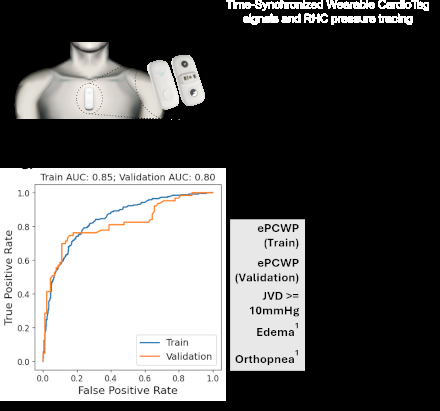
Abstract Body (Do not enter title and authors here): Background: Pulmonary capillary wedge pressure (PCWP) provides an objective assessment of congestion status in heart failure (HF) patients, but its use is limited by the need for an invasive procedure, trained personnel, and specialized equipment to obtain a measurement. Cardiosense (Chicago, IL) has developed a machine learning (ML) algorithm that detects elevated PCWP non-invasively from data acquired by a chest-worn wearable device (CardioTag). We present data for a potential in-clinic point-of-care tool that improves the identification of hemodynamic congestion, with a focus on outpatient and low-acuity settings. Methods: The ePCWP System is a ML model developed to identify elevated PCWP (>18 mmHg) using non-invasive physiological biosignals from the CardioTag device, which simultaneously collects electrocardiogram, seismocardiogram, and photoplethysmogram data. Concurrent CardioTag and right-heart catheterization (RHC) data were collected prospectively in an observational study across 15 US sites from 1,116 patients undergoing standard-of-care RHC. Patients were either diagnosed with HFrEF, HFpEF, HFmrEF, or were suspected of HF before the RHC procedure. Standard of care physical examination, used to evaluate congestion status, was captured and used for comparative analysis. The training dataset contained 726 subjects and the validation dataset contained 153 subjects. Results: Five-fold cross-validation of the training dataset showed an overall accuracy of 0.79, sensitivity of 0.75 (CI: [0.69, 0.80]), and a specificity of 0.81 (CI: [0.77, 0.85]). The validation dataset showed an overall accuracy of 0.81, sensitivity of 0.76 (CI: [0.63, 0.86]), and a specificity of 0.82 (CI: [0.72, 0.89]). Figure 1 shows the overall classification performance of the ePCWP System (left) and a comparison to standard-of-care physical exam (right). Conclusion: We developed a non-invasive point-of-care tool that is capable of providing rapid, accurate assessments of congestion for patients with HF. This tool might be used to support convenient, frequent inpatient monitoring to augment discharge decisions and guide post-discharge follow-up care towards timely interventions and improvements in patient outcomes.
Desai, Nihar
(
Yale School of Medicine
, New Haven , Connecticut , United States )
Lin, David
(
Cardiosense Inc.
, Chicago , Illinois , United States )
Fudim, Marat
(
DUKE MEDICAL CENTER
, Durham , North Carolina , United States )
Gordon, Robert
(
NorthShore University HealthSystem
, Evanston , Illinois , United States )
Tibrewala, Anjan
(
Northwestern University
, Chicago , Illinois , United States )
Hernandez-montfort, Jaime
(
Baylor Scott and White
, Temple , Texas , United States )
Mccann, Patrick
(
PRISMA Health
, Columbia , South Carolina , United States )
Inan, Omer
(
Georgia Institute of Technology
, Marietta , Georgia , United States )
Carek, Andrew
(
Cardiosense Inc.
, Chicago , Illinois , United States )
Klein, Liviu
(
UNIVERSITY OF CALIFORNIA
, San Francisco , California , United States )