
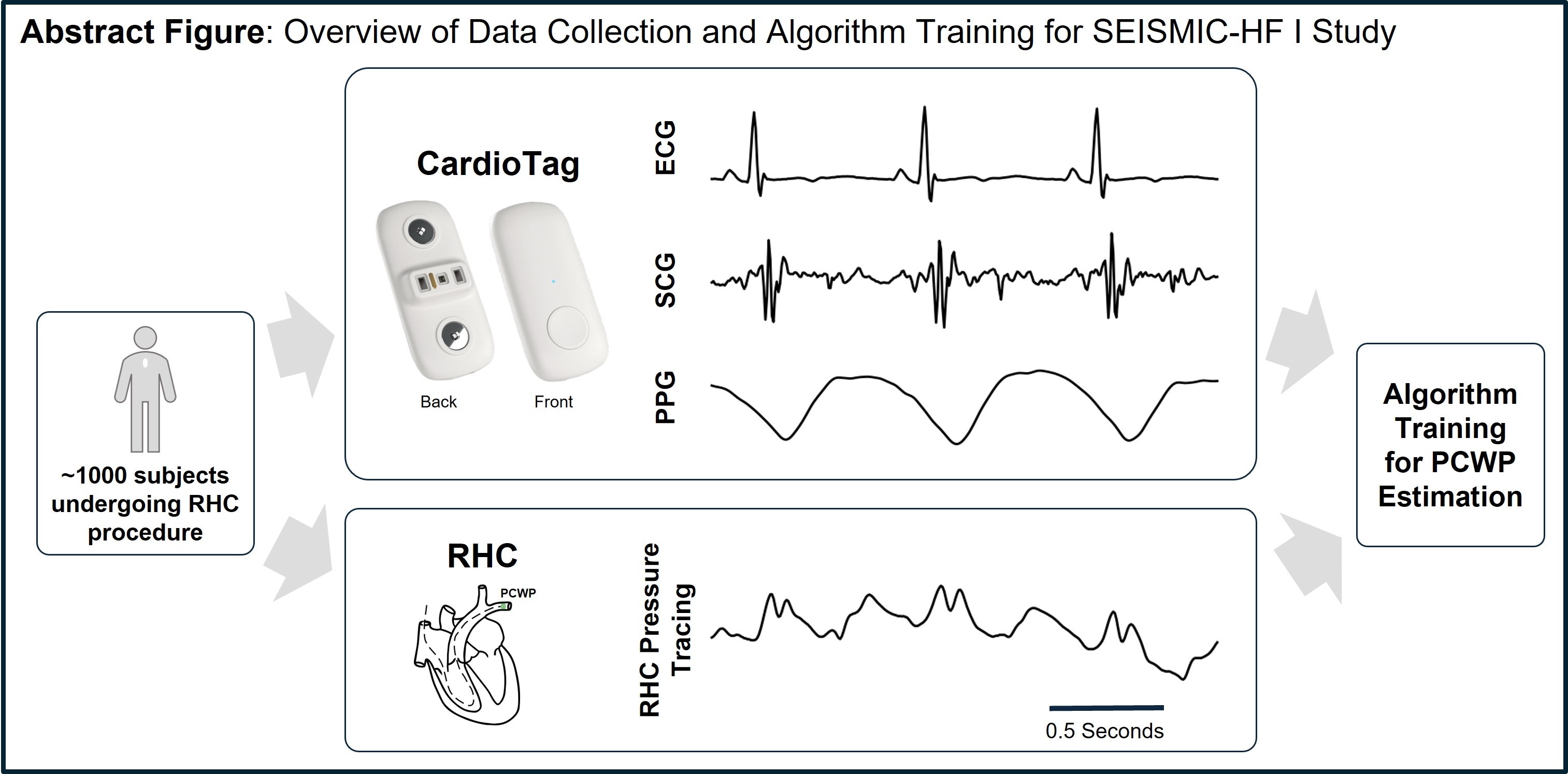
Novel AI to Assess Intracardiac Filling Pressure: The Non-invasive SEISMocardiogram In Cardiovascular Monitoring for Heart Failure I (SEISMIC-HF I) Study
Abstract Body (Do not enter title and authors here): Background: Remote hemodynamic-guided management of heart failure (HF) with implantable sensors measuring pulmonary artery pressures has been shown to improve quality of life and reduce risk of HF hospitalizations. However, clinical adoption is limited by the procedure's invasiveness and reimbursement challenges. Cardiosense (Chicago, IL) is developing a non-invasive technology and machine learning (ML) algorithm for estimating intracardiac filling pressures in HF patients. This study aimed to develop a ML algorithm to estimate pulmonary capillary wedge pressure (PCWP) in a diverse HF population, using signals captured by a non-invasive device (CardioTag; Cardiosense) and to compare the output with right heart catheterization (RHC) measurements, the current clinical gold-standard. Method: This is a prospective, multi-site, observational, data collection study for further development of a ML algorithm for non-invasive PCWP measurement in a HF population. Approximately 1,000 participants scheduled to undergo a routine RHC were enrolled at 15 sites across the US. CardioTag sensor (FDA Breakthrough Device Designation in 2022) collected electrocardiography, seismocardiography and photoplethysmography data. CardioTag signals and RHC pressure tracing data were collected simultaneously. Blinded core-lab adjudicated RHC PCWP tracings were used as the gold standard. Data were randomly separated into training and hold-out sets to evaluate model performance. Result: From July 2023 through June 2024, 943 subjects were enrolled at 15 US centers with a mean age of 63 ± 14 years; 58% were male, 55% were White, 27% were African American, 88% had a HF diagnosis (39% with LVEF ≤40%), and 90% were classified as NYHA functional class II-IV. Mean RHC measured pulmonary artery pressures were systolic 42.6 ± 18.0 mmHG and diastolic 18.4 ± 9.4 mmHg. Mean RHC measured PCWP was 15.8 ± 9.1 mmHg. Model performance comparing the hold-out dataset to gold standard, simulating performance validation showed a mean error of 1.04 ± 5.57 mmHg. Conclusion: Analysis of the ML algorithm’s performance in a racially and geographically diverse population suggests this novel non-invasive HF technology may offer comparable accuracy to existing invasive methods. This technology could become a novel adjunctive tool for hemodynamic-guided clinical management of HF patients. Enrollment has completed and analysis of the ML algorithm performance will be presented.
Klein, Liviu
(
UNIVERSITY OF CALIFORNIA
, San Francisco , California , United States )
Carek, Andrew
(
Cardiosense, Inc.
, Chicago , Illinois , United States )
Fudim, Marat
(
Duke University Medical Center
, Durham , North Carolina , United States )
Gordon, Robert
(
NorthShore University HealthSystem
, Evanston , Illinois , United States )
Tibrewala, Anjan
(
Northwestern University
, CHICAGO , Illinois , United States )
Hernandez-montfort, Jaime
(
Baylor Scott & White Health
, Temple , Texas , United States )
Mccann, Patrick
(
PRISMA Health
, Columbia , South Carolina , United States )
Inan, Omer
(
Georgia Institute of Technology
, Atlanta , Georgia , United States )