Artificial Intelligence Intervention versus Standard Care in Cardiovascular Disease Outcomes: A Rapid Systematic Review
Abstract Body (Do not enter title and authors here): Introduction Cardiovascular disease (CVD) continues to be one of the leading causes of death worldwide. Early detection is crucial for identifying effective ways to improve CVD outcomes. Artificial Intelligence (AI) tools can support clinicians in more effective management of CVD and improved patient outcomes.
Hypothesis We hypothesize that Al tools can contribute to improving CVD outcomes, specifically reducing CVD events and CVD mortality.
Methods We conducted a systematic review to evaluate the effectiveness of Al-supported interventions in CVD management compared to standard clinical practice. A literature search was performed across multiple databases to identify studies that analyze AI detection in CVD. Studies that met the following criteria were included: (1) adult participants (≥ age 18) with diagnosed CVD, (2) Al-driven interventions for CVD detection, monitoring, or management, (3) control groups receiving standard clinical care, and (4) reported outcomes including blood pressure control, myocardial infarction, stroke, or mortality. Data extraction focused on clinical effectiveness and process improvements, which were synthesized using descriptive techniques.
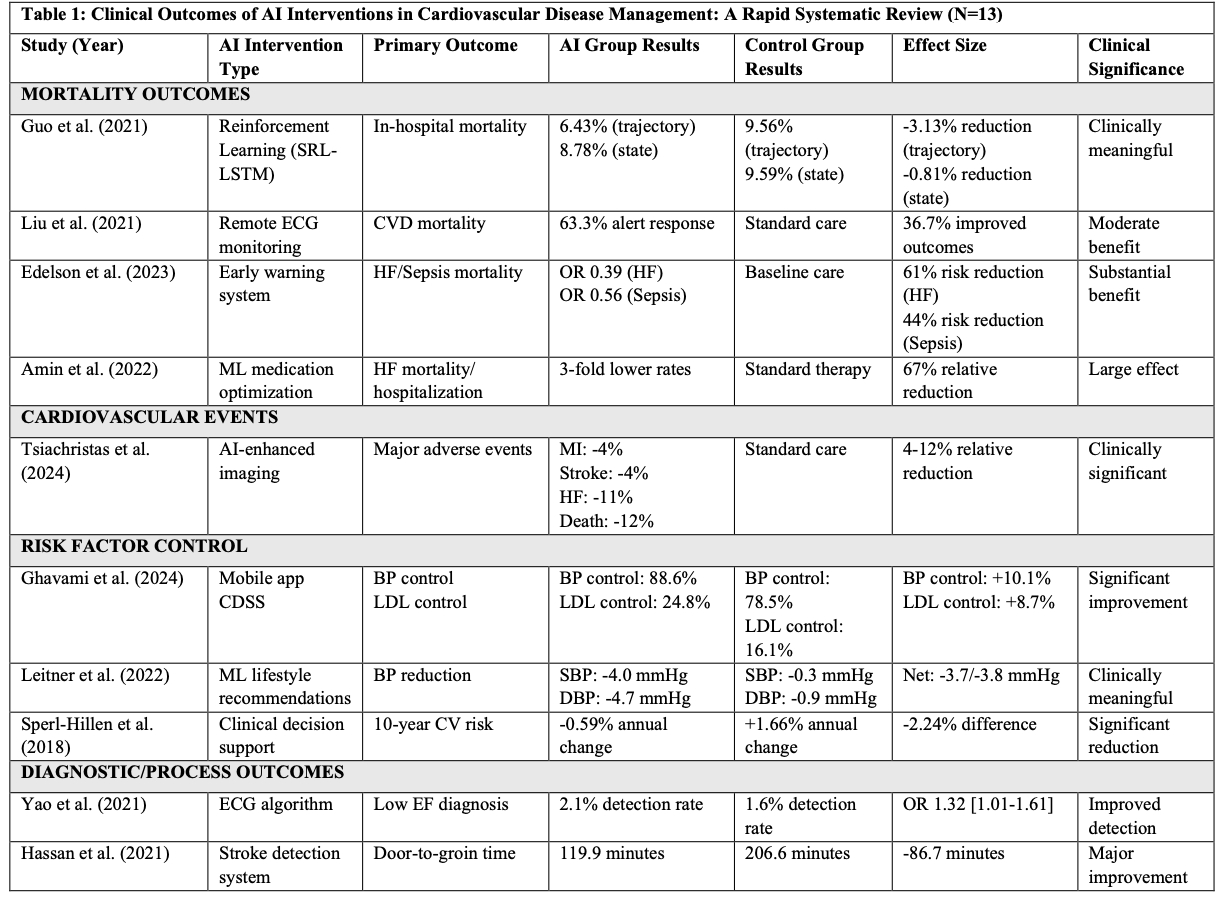
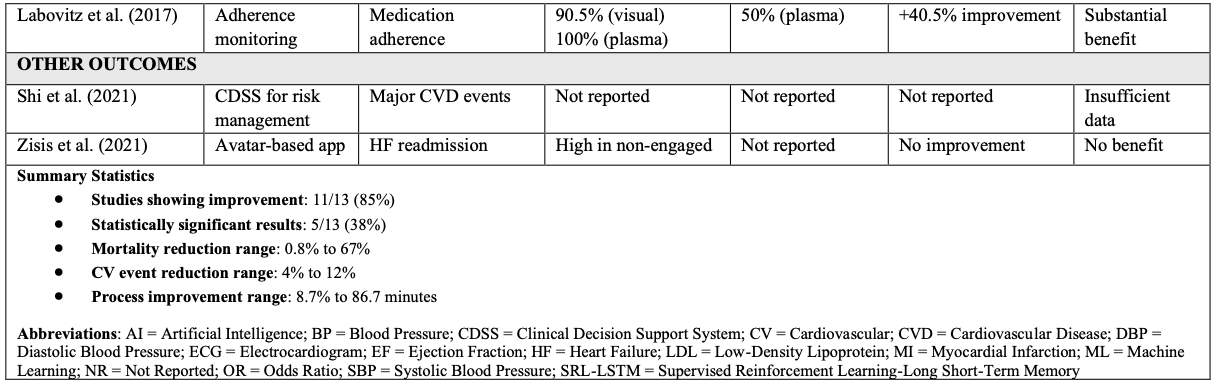
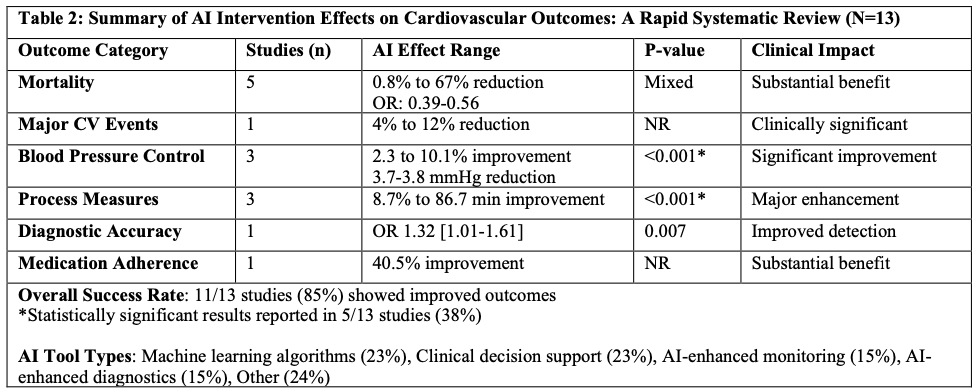
Results Thirteen studies were included (4 randomized controlled trials (RCTs), 3 cluster-RCTs, and 6 observational studies) including up to 22,641 participants across intensive care, community, and remote settings (Tables 1 & 2). Overall, 11 out of 13 studies (85% reported improvement in cardiovascular outcomes. Reported mortality reduction ranged from 0.8% to 12%, with an odds ratio of 0.39-0.56 for heart failure and sepsis mortality. Major cardiovascular event reductions ranged from 4% to 12% for myocardial infarction, stroke, heart failure, and cardiac death. For other outcomes, improvements included a decrease in blood pressure ranging from 2.3 to 10.1 mmg across 3 studies, an 86.7-minute reduction in door-to-treatment times, and a 40.5% improvement in medication adherence, and an 8.7% improvement in lipoprotein cholesterol (LDL) control.
Conclusion Al-guided interventions consistently improved cardiovascular outcomes, with the strongest evidence for machine learning algorithms and clinical decision support systems. These findings support integrating Al tools into routine cardiovascular care for risk factor management, mortality reduction, and process optimization. Future research should address long-term effectiveness and implementation, especially in populations who are most impacted by CVD.
Adu, Cambria
(
Johns Hopkins University
, Baltimore , Maryland , United States )
Tom-ayegunle, Kehinde
(
Johns Hopkins University
, Baltimore , Maryland , United States )
Washington, India
(
Johns Hopkins University
, Boston , Massachusetts , United States )
Gledhill, Samuel
(
Johns Hopkins University
, San Diego , California , United States )
Xiao, William
(
Johns Hopkins University
, Baltimore , Maryland , United States )
Rodriguez, Christy
(
Johns Hopkins University
, Baltimore , Maryland , United States )
Asante, Randford
(
Johns Hopkins University
, Baltimore , Maryland , United States )
Olatunji, Gbolahan
(
Montefiore St. Luke's Cornwall
, Newburgh , New York , United States )
Tummala, Vennela
(
Johns Hopkins University
, Baltimore , Maryland , United States )
Douglas, Kyara
(
Johns Hopkins University
, Baltimore , Maryland , United States )
Ogunleye, Blessing
(
Johns Hopkins University
, Baltimore , Maryland , United States )
Ogungbe, Bunmi
(
Johns Hopkins University
, Baltimore , Maryland , United States )
Author Disclosures:
Cambria Adu:DO NOT have relevant financial relationships
| Kyara Douglas:No Answer
| Blessing Ogunleye:No Answer
| Bunmi Ogungbe:DO NOT have relevant financial relationships
| Kehinde Tom-Ayegunle:No Answer
| India Washington:DO NOT have relevant financial relationships
| Samuel Gledhill:DO NOT have relevant financial relationships
| William Xiao:No Answer
| Christy Rodriguez:No Answer
| Randford Asante:No Answer
| Gbolahan Olatunji:DO NOT have relevant financial relationships
| Vennela Tummala:No Answer
Jiang Chao, Dong Jianzeng, Cai Jun, Anderson Craig, Du Xin, Tang Yangyang, Han Rong, Song Yanna, Wang Chi, Lin Xiaolei, Yi Yang, Rodgers Anthony, Ma Changsheng