Association Between Food Insecurity and Diagnoses of Cardiovascular Disease and Stroke: National Health and Nutrition Examination Survey (2005-2020)
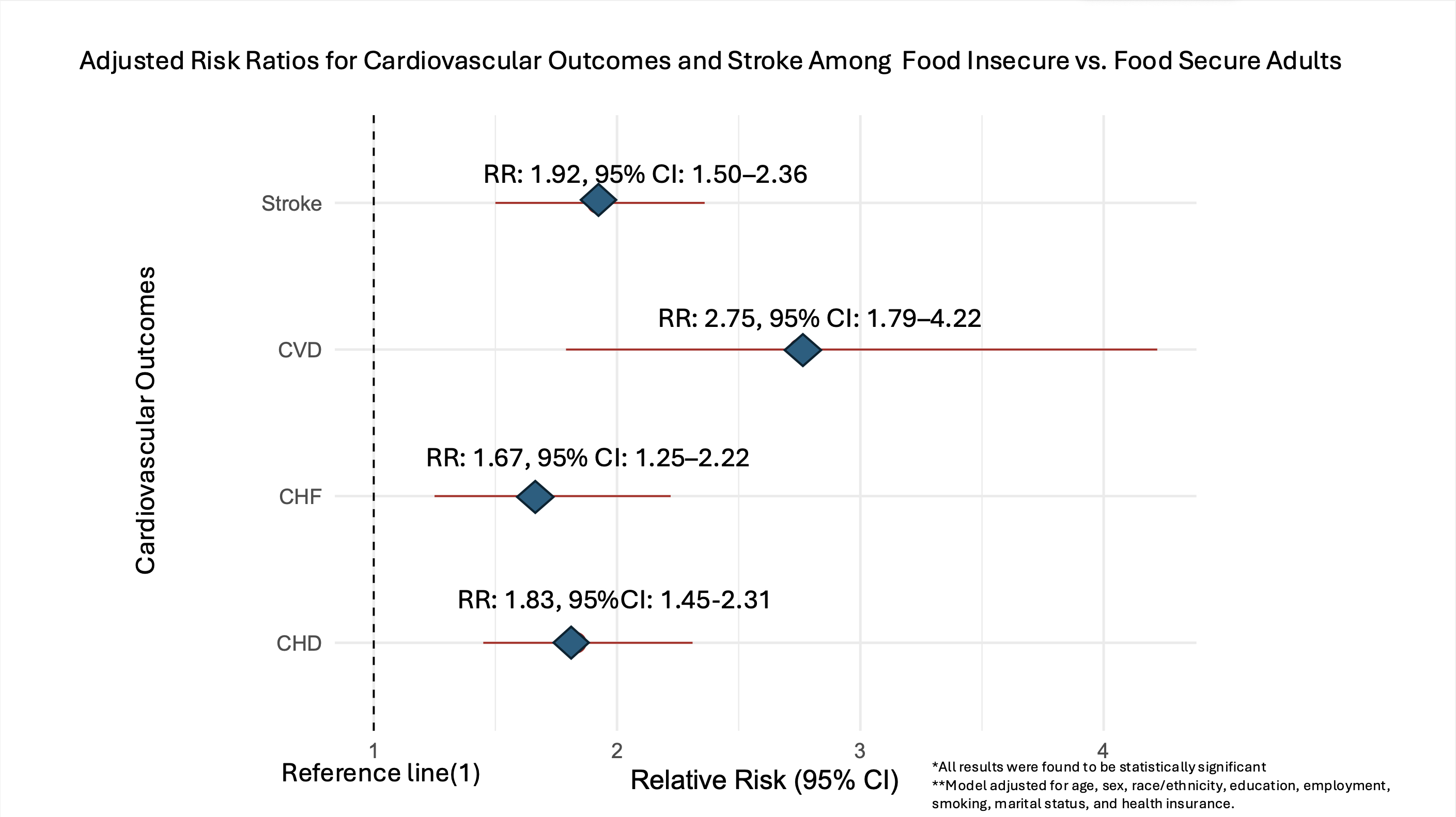
Abstract Body (Do not enter title and authors here): Background: Cardiovascular disease (CVD), characterized by coronary heart disease (CHD) and congestive heart failure (CHF), remains a leading cause of morbidity and mortality worldwide, with management heavily dependent on dietary adherence and lifestyle modifications. Food insecurity—limited or uncertain access to nutritionally adequate foods—may significantly impair CVD self-management, yet its association with cardiovascular outcomes remains inadequately characterized. Methods: We conducted a cross-sectional analysis of the National Health and Nutrition Examination Survey (2005-2020). Exposure, food insecurity was assessed using the U.S. Food Security Survey Module (US FSSM). The outcomes included self-reported physician-diagnosed CVD, CHD, CHF, and stroke. We used survey-weighted generalized linear models with quasi-Poisson family and log link to estimate risk ratios, adjusting for age, sex, race and ethnicity, education, employment, marital status, smoking, and health insurance. Results: Among a sample of 23,142 adults, 4,038 had previously diagnosed with CVD and 1805 diagnosed with stroke. The prevalence of CVD was higher among individuals experiencing food insecurity compared to those who were food secure (12% vs. 6%, (p=0.0041). Food insecurity was associated with a significantly higher risk of CVD (RR: 2.75, 95% CI: 1.79–4.22, Figure). Similarly, individuals who were food insecure had a higher risk of CHD (RR: 1.83, 95%CI: 1.45-2.31), CHF (RR: 1.67, 95% CI: 1.25–2.22), and stroke (RR: 1.92, 95% CI: 1.50–2.36), compared those who were food secure. Conclusions: Food insecurity is independently associated with a 2-3 fold increased risk of major cardiovascular conditions and stroke among U.S. adults. These findings highlight the need for systematic food security screening in cardiovascular care and suggest that addressing food access may improve outcomes and reduce costs for populations that are most impacted.
Washington, India
(
Johns Hopkins University
, Boston , Massachusetts , United States )
Akubo, Chelsea
(
Boston University
, Boston , Massachusetts , United States )
Gledhill, Samuel
(
Johns Hopkins University
, San Diego , California , United States )
Vassiliadi, Lydia
(
Johns Hopkins University
, Baltimore , Maryland , United States )
Rodriguez, Christy
(
Johns Hopkins University
, Baltimore , Maryland , United States )
Ogungbe, Bunmi
(
Johns Hopkins University
, Baltimore , Maryland , United States )
Author Disclosures:
India Washington:DO NOT have relevant financial relationships
| Chelsea Akubo:DO NOT have relevant financial relationships
| Samuel Gledhill:DO NOT have relevant financial relationships
| Lydia Vassiliadi:DO NOT have relevant financial relationships
| Christy Rodriguez:No Answer
| Bunmi Ogungbe:DO NOT have relevant financial relationships