
Logo

American Heart Association

  19
  0


Final ID: MP2114

Impact of Photon counting CT on the Diagnostic Performance of CTA in Elderly Population

Abstract Body (Do not enter title and authors here): Background: Coronary computed tomography angiography (CTA) is a well-established noninvasive tool for diagnosing coronary artery disease (CAD). However, its accuracy may be limited in elderly patients due to heavy coronary calcifications. Photon counting CT (PCT) offers improved spatial resolution and reduced blooming artifacts, potentially overcoming this limitation. This study evaluates the diagnostic performance of PCT compared to conventional dual-source CT (DSCT) in an elderly population.

Methods: This retrospective single-center study included patients over 70 years of age who underwent coronary CTA using either PCT or DSCT. Patients in the PCT group underwent imaging between February and June 2025 and were compared with patients scanned with DSCT between January 2022 and December 2024. Coronary CTA scans were analyzed for the degree of maximal coronary stenosis using CAD-RADS classification, the presence of blooming artifact and Effective radiation dose measured in mSv. Diagnostic accuracy of PCT and DSCT was assessed using invasive coronary angiography (ICA) as the reference standard.

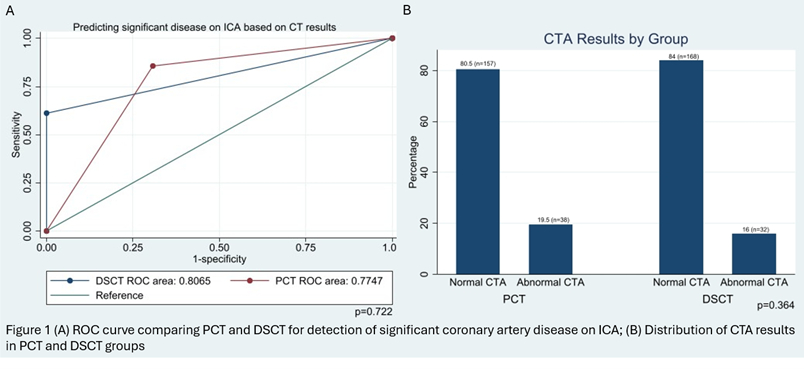
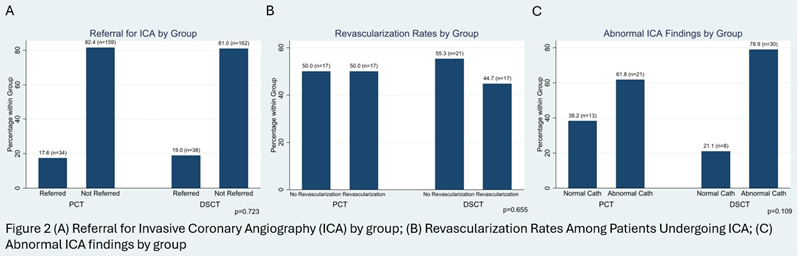
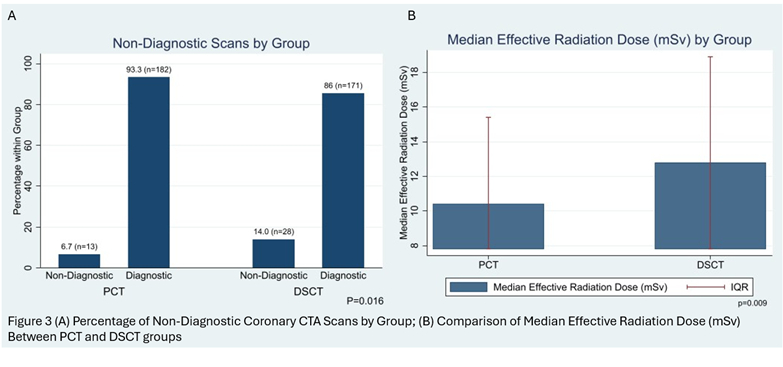
Results: A total of 395 elderly patients [median age: 75 (IQR: 70-79)] were included in the study, with 195 in the PCT group and 200 in the DSCT group. The presence of significant disease on CTA did not differ significantly between groups (19.5% (n=38) in PCT arm vs 16% (n=32) in DSCT arm, p=0.364) (Figure 1B). The diagnostic accuracy for detecting significant disease on ICA was similar between the two scanners based on a per-patient analysis (AUC for PCT=0.77; AUC for DSCT=0.81, p=0.722) (Figure 1A). The rates of ICA referral, significant disease on ICA and revascularization were not significantly different between the two groups (p=0723, p=0.109, p=0.655 respectively) (Figure 2). Notably, the PCT group had significantly fewer non-diagnostic scans with fewer reported blooming artifacts (6.7% (n=13) vs 14% (n=28), p=0.016) (Figure 3A). Additionally, the median Effective radiation dose was significantly lower in the PCT group compared to the DSCT group (10.4 mSv (IQR: 7.8-15.4) vs 12.8 mSv (IQR: 7.8-18.8), p=0.009, using K Factor of 0.026) (Figure 3B).

Conclusion: The diagnostic performance of PCT and DSCT was similar in detecting CAD in elderly (>70 years) patients. However, PCT was associated with fewer non-diagnostic scans, reduced blooming artifacts, and significantly lower radiation exposure, highlighting its potential advantages in this patient population.
  • Aramouni, Karl  ( Houston Methodist Hospital , Houston , Texas , United States )
  • Ahmed, Waleed  ( Houston Methodist Hospital , Houston , Texas , United States )
  • Author Disclosures:
    Karl Aramouni: DO NOT have relevant financial relationships | Waleed Ahmed: No Answer
Meeting Info:

Scientific Sessions 2025

2025

New Orleans, Louisiana

Session Info:

Non-Invasive Imaging of the Coronary Arteries: Plaque, Stenosis and Risk

Monday, 11/10/2025 , 09:15AM - 10:25AM

Moderated Digital Poster Session

More abstracts on this topic:
You have to be authorized to contact abstract author. Please, Login
Not Available