
Logo

American Heart Association

  17
  0


Final ID: MP1459

Maternal GLP-1 Receptor Agonist Exposure and the Risk of Congenital Cardiovascular Defects: A Global Pharmacovigilance Study

Abstract Body (Do not enter title and authors here): Background:
GLP-1 receptor agonists (GLP-1 RAs) are increasingly being recommended to women of reproductive age for the treatment of obesity and type II diabetes. However, their safety profile during early pregnancy is mainly unknown. Congenital cardiovascular defects (CCVDs) are among the most serious and often fatal birth disorders. Understanding the teratogenic danger of GLP-1 RAs becomes more important as their use grows.
Objective:
To evaluate the association between maternal GLP-1 RA exposure and the risk of CCVDs using global pharmacovigilance data.
Methods:
A retrospective disproportionality study was conducted using VigiBase, the World Health Organization's worldwide Individual Case Safety Report (ICSR) database, which covered the period from January 2010 to December 2023. Pregnancy-related ICSRs involving GLP-1 RAs were discovered, and Reporting Odds Ratios (RORs) were calculated for CCVDs in comparison to other congenital abnormalities. The analyses were stratified by particular agent (e.g., liraglutide, semaglutide) and trimester of exposure. Sensitivity analysis omitted publications containing known teratogens.
Results:
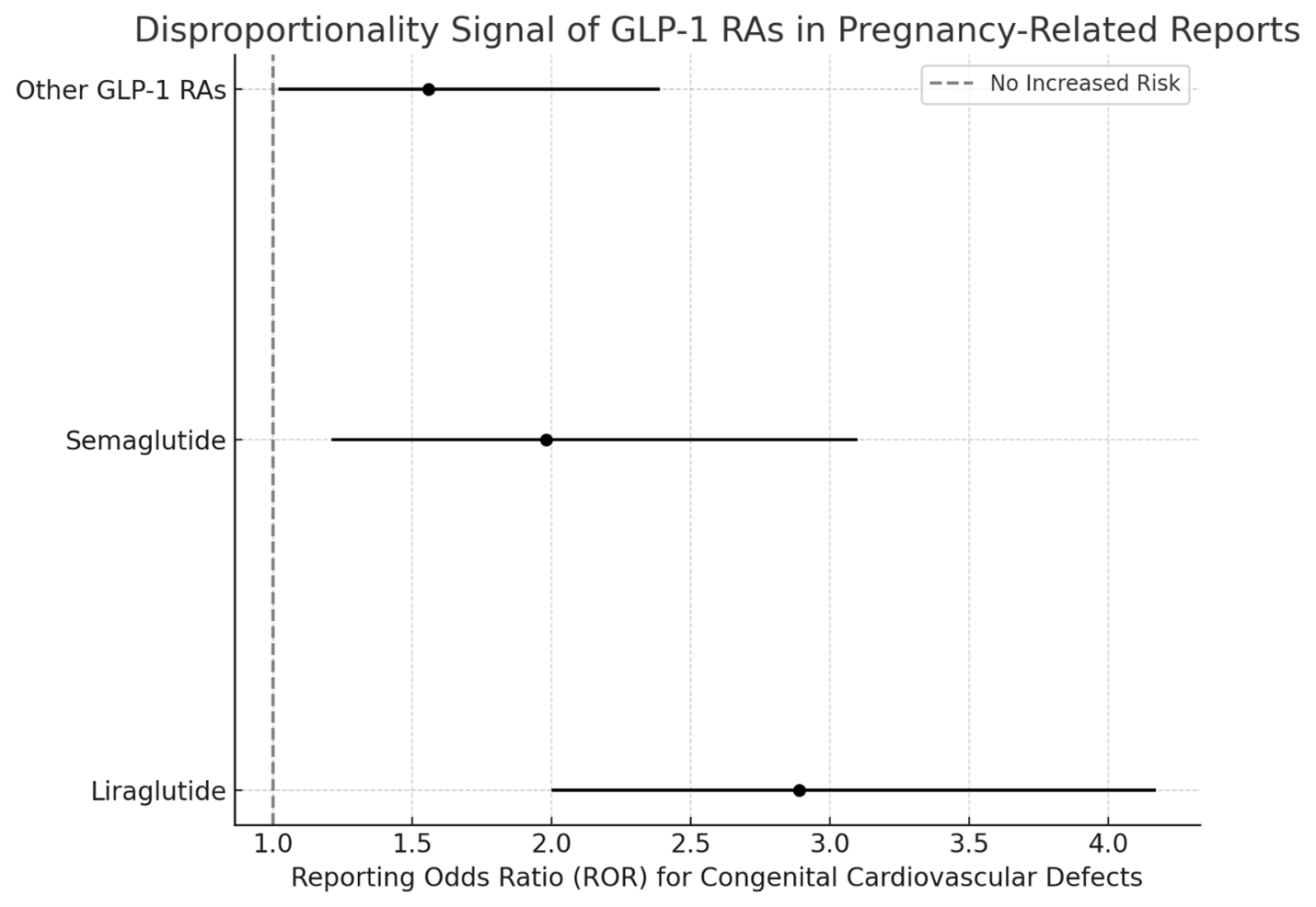
There were 112 incidences of CCVD among 7,428 pregnancy-related ICSRs that used GLP-1 RAs. GLP-1 RA exposure was associated with a significantly increased reported risk of CCVDs (ROR: 2.47; 95% CI: 1.97-3.10). Liraglutide provided the most powerful individual signal (ROR: 2.89), followed by semaglutide (ROR: 1.98). Notably, about 85% of CCVD patients were exposed during their first trimester. Sensitivity studies demonstrated that the signal persisted despite removing co-exposures to high-risk teratogens such as ACE inhibitors and retinoids.
Conclusion:
This pharmacovigilance study discovered a potential safety signal linking first-trimester maternal exposure to GLP-1 RAs with an increased risk of congenital cardiovascular malformations. While causation cannot be established from spontaneous encounters, these results need prospective cohort research and highlight the importance of preconception counseling and contraception planning in women of reproductive potential using GLP-1 RA. These results might influence regulatory recommendations and strengthen pharmacovigilance measures in maternal and fetal care.
  • Kumar, Harendra  ( Dow University of Health Sciences , Hyderabad , Pakistan )
  • Author Disclosures:
    Harendra Kumar: DO NOT have relevant financial relationships
Meeting Info:

Scientific Sessions 2025

2025

New Orleans, Louisiana

Session Info:

Cardiovascular Health at the Crossroads of Sex, Race, and Risk

Sunday, 11/09/2025 , 09:15AM - 10:30AM

Moderated Digital Poster Session

More abstracts on this topic:
AI-Derived Retinal Vasculature Features Predict Cardiovascular Risk in Patients with Chronic Kidney Disease: Insights from the CRIC Study

Dhamdhere Rohan, Modanwal Gourav, Rahman Mahboob, Al-kindi Sadeer, Madabhushi Anant

Accuracy Of Stroke Prediction Using The Predicting Risk Of CVD Events Equation Among Diverse Adults Of The Northern Manhattan Study

Mesa Robert, Veledar Emir, Levin Bonnie, Agudelo Christian, Elfassy Tali, Gardener Hannah, Rundek Tatjana, Brown Scott, Yang Eugene, Elkind Mitchell, Gutierrez Jose, Besser Lilah, Gutierrez Carolina

You have to be authorized to contact abstract author. Please, Login
Not Available