
Logo

American Heart Association

  20
  0


Final ID: MP967

Prognostic Value of Stress Myocardial Perfusion Imaging in Predicting Major Adverse Cardiovascular Events (MACE): A Systematic Review and Meta-Analysis of 42,000 Patients

Abstract Body (Do not enter title and authors here): Background:
Stress myocardial perfusion imaging (MPI), which includes single-photon emission computed tomography (SPECT) and positron emission tomography (PET), is often used to identify myocardial ischemia. Beyond its diagnostic utility, MPI may provide important prognostic information about the likelihood of future major adverse cardiovascular events (MACE). However, assessments of its predictive usefulness across many patient groups and imaging modalities are conflicting.
Objective:
The purpose of this systematic review and meta-analysis is to assess the predictive value of abnormal stress MPI findings in predicting MACE across current studies.
Methods:
We conducted a systematic search of PubMed, EMBASE, and Scopus until May 2025 for prospective or retrospective cohort studies that showed a relationship between aberrant stress MPI findings and incident MACE, such as all-cause mortality, myocardial infarction, and revascularization. Hazard ratios (HRs) or relative risks (RRs) were calculated using 95% confidence intervals (CIs). Pooled estimates were generated using a random-effects model. The I square statistic was used to measure heterogeneity, while the funnel plot and Egger's test were used to investigate publication bias.
Results:
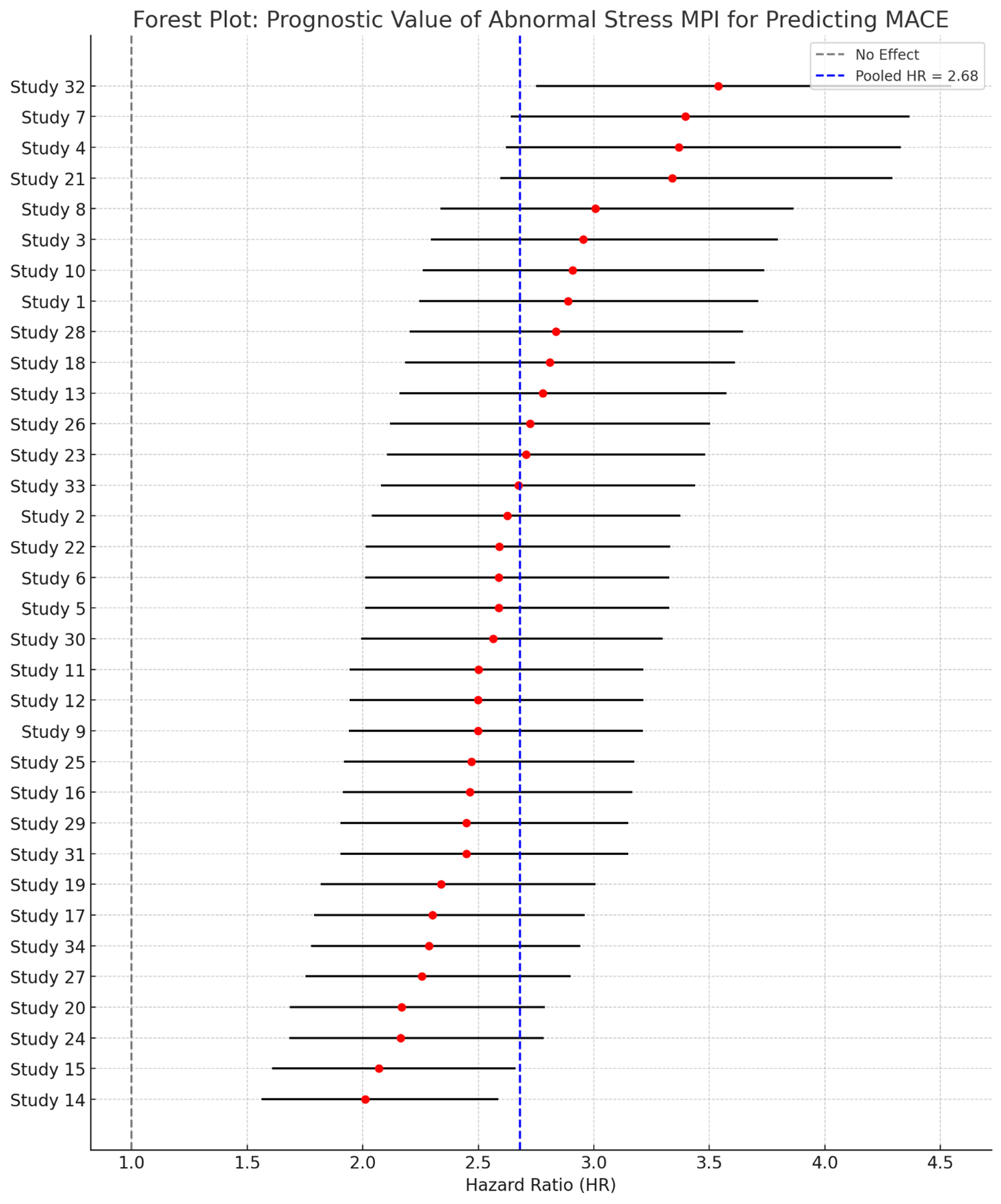
34 studies with 42,378 patients (mean follow-up: 2.9 years) met the inclusion criteria. Abnormal MPI was highly associated with an increased risk of MACE (pooled HR: 2.68; 95% CI: 2.20-3.27; p < 0.001). Subgroup analysis revealed comparable prognostic significance in the SPECT (HR: 2.51; 95% CI: 2.04-3.10) and PET (HR: 2.89; 95% CI: 2.24-3.73) populations. The study showed significant heterogeneity (I square= 53%) but no significant publication bias was found. The absolute incidence rate was 17.3% in those with abnormal MPI vs 6.4% in those with normal images.
Conclusion:
Abnormal stress MPI is a strong and reliable independent predictor of future severe adverse cardiovascular events. These data suggest the use of MPI not only for ischemia diagnosis, but also as a risk assessment tool in normal cardiovascular care. Incorporating MPI results into clinical decision-making may result in more effective preventive and therapeutic activities for high-risk individuals.
  • Kumar, Harendra  ( Dow University of Health Sciences , Karachi , Pakistan )
  • Author Disclosures:
    Harendra Kumar: DO NOT have relevant financial relationships
Meeting Info:

Scientific Sessions 2025

2025

New Orleans, Louisiana

Session Info:

Visualizing Pulmonary Hypertension: Exploring the Role of Imaging in Disease Understanding

Saturday, 11/08/2025 , 01:45PM - 03:00PM

Moderated Digital Poster Session

You have to be authorized to contact abstract author. Please, Login
Not Available