Risk of Cardiovascular Events Using the SMART Polyvascular Disease Risk Score in Patients With Peripheral Artery Disease
Abstract Body (Do not enter title and authors here): Background: The Secondary Manifestations of Arterial Disease (SMART) risk prediction model is an established calculator to estimate the 10-year risk of non-fatal myocardial infarction (MI), ischemic stroke, or all-cause death, collectively termed as major adverse cardiovascular events (MACE) from 14 readily available clinical characteristics. The risk for cardiovascular events in patients with peripheral artery disease (PAD) can be mitigated using this risk score-based projection model.
Objective: Use of the SMART polyvascular disease score to compute the risk for MACE in U.S. patients with PAD.
Methods: We accessed the Baylor Scott & White EPIC informatics and data warehouse to identify patients at their first outpatient cardiology evaluation for PAD and abdominal aortic aneurysm between April 2014 and October 2023 to estimate up to 10-year risk of MACE, a composite of all-cause death, ischemic stroke, and non-fatal MI. Cox regression, accelerated failure time model, and survival analyses were used to develop and validate the SMART risk score.
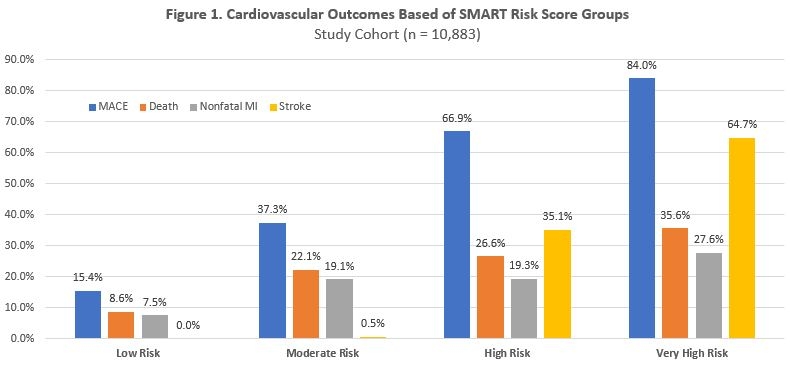
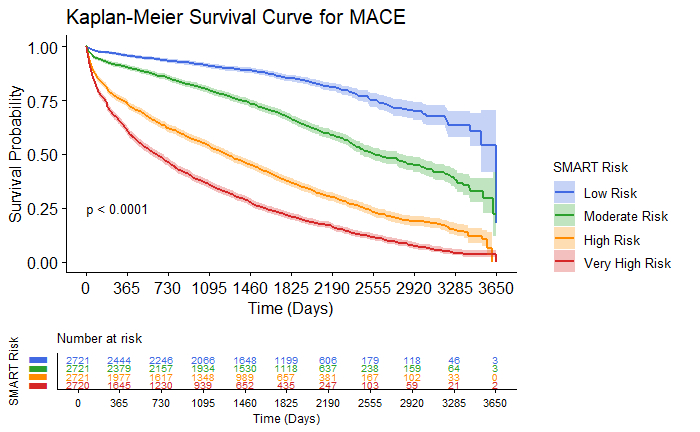
Results: A total of 10,883 patients (mean age 69.4 ± 10.8 years, 37.2% female) were analyzed with a median follow-up of 5.5 years (interquartile range 3.6 – 6.1 years). The SMART risk score allowed accurate estimation of MACE. Patients in low (<45%), moderate (45% - <60%), high (60% - <89%), and very high (≥89%) SMART risk score groups had observed MACE events rates of 15.4%, 37.3%, 66.9% and 84.0%, respectively (p<0.0001 for all inter-group comparisons). The most common MACE composite was stroke (25.1%) over 10 years, followed by mortality (23.2%) and nonfatal MI (18.3%). In the very high-risk group, 10-year risk of stroke (64.7%), mortality (35.6%), and nonfatal MI (27.6%) were extremely high. The event rates of MACE and its components is plotted in Figure 1. The K-M survival curves stratified by the four SMART risk categories. These curves demonstrate that observed survival patterns are consistent with model-based risk stratification. K–M event rates for MACE and its individual components, along with mean time to MACE, are shown in Figure 2.
Conclusion: The SMART risk score provides an effective, reproducible method for predicting long-term cardiovascular risk in patients with established PAD. Our findings emphasize its clinical utility for improving risk stratification, guiding individualized treatment decisions, and optimizing secondary prevention strategies.
Jeong, Minseob
( Baylor Heart and Vascular Hospital
, Dallas
, Texas
, United States
)
Gupta, Anand
( Baylor Scott and White Health
, Dallas
, Texas
, United States
)
Banerjee, Subhash
( Baylor University Medical Center
, Dallas
, Texas
, United States
)
Author Disclosures:
Minseob Jeong:DO NOT have relevant financial relationships
| Anand Gupta:DO NOT have relevant financial relationships
| Subhash Banerjee:DO have relevant financial relationships
;
Consultant:AngioSafe:Active (exists now)
; Research Funding (PI or named investigator):Novartis:Active (exists now)
; Research Funding (PI or named investigator):Esperion:Past (completed)
; Research Funding (PI or named investigator):Philips:Expected (by end of conference)
; Research Funding (PI or named investigator):GE Healthcare:Active (exists now)
; Speaker:Kaneka:Active (exists now)