
Logo

American Heart Association

  19
  0


Final ID: MP2571

Dynamic PET Imaging Quantifies Absolute Measures of Calf Muscle Perfusion in a Porcine Model of Peripheral Endovascular Arterial Occlusion and PAD Patients with Claudication

Abstract Body (Do not enter title and authors here): Introduction: Peripheral artery disease (PAD) is an atherosclerotic disorder of the lower extremities promoting muscle ischemia. Our lab previously validated the use of fluorine-18 sodium fluoride (18F-NaF) dynamic analog PET imaging for quantification of muscle perfusion in PAD. However, newer digital PET scanners with larger axial field-of-views could provide higher sensitivity detection of ischemia and broader perfusion assessment of the legs in PAD. This study sought to test the utility of a novel digital PET scanner for detecting muscle ischemia in a porcine model as well as PAD patients with claudication.
Methods: Female Yorkshire pigs (N=6, 16.1 ± 4.0 kg) underwent unilateral iliac arterial occlusion via endovascular deployment of a covered stent and Amplatzer plug. On the day of occlusion, a 2.5-minute dynamic PET scan of the legs was performed following administration of 18F-NaF (182.56 ± 9.55 MBq) using a large axial field-of-view digital PET scanner with bismuth germanate (BGO) crystals (GE Omni Legend). Co-registered CT images were acquired for attenuation correction and calf muscle segmentation. An image-derived arterial input was obtained from the abdominal aorta and time activity curves for the bilateral calves, to facilitate 1-tissue compartment modeling and calculation of skeletal muscle perfusion values (reported as ml/100g/min). The same dynamic PET approach was then translated to PAD patients (N = 21; 18F-NaF dose: 310.43 ± 22.2 MBq), using the popliteal artery as an arterial input, to assess calf muscle perfusion. T-tests were used to compare perfusion values between ischemic and non-ischemic limbs in pigs and patients.
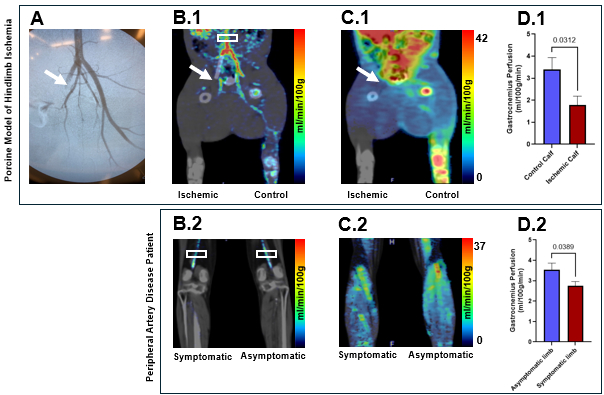
Results: Digital subtraction angiography confirmed successful stent/plug deployment and arterial occlusion in pigs immediately post-occlusion (Fig. 1A). Dynamic PET/CT imaging revealed excellent count detection for kinetic modeling (Fig. 1B.1-2) and significant reductions in calf muscle perfusion between occluded and non-occluded limbs in the porcine model (p=0.031; Fig. 1C.1). Translation to PAD patients demonstrated significant reductions in calf perfusion in symptomatic versus asymptomatic limbs (p=0.039; Fig. 1C.2).
Conclusions: Dynamic PET/CT imaging on emerging digital PET scanners allows for broader scan coverage, high-sensitivity detection of regional alterations in muscle ischemia in PAD, and provides unique opportunities for detection of disease and monitoring of treatment responses in PAD.
  • Rimmerman, Eleanor  ( The Ohio State University , Columbus , Ohio , United States )
  • Musini, Kumudha  ( The Ohio State University , Columbus , Ohio , United States )
  • Shin, Kyle  ( Ohio State College of Medicine , Columbus , Ohio , United States )
  • Jayaraman, Anjana  ( Nationwide Children's Hospital , Columbus , Ohio , United States )
  • Tomko, Patrick  ( Nationwide Children's Hospital , Columbus , Ohio , United States )
  • Go, Michael  ( Ohio State College of Medicine , Columbus , Ohio , United States )
  • Stacy, Mitchel  ( Ohio State College of Medicine , Columbus , Ohio , United States )
  • Author Disclosures:
    Eleanor Rimmerman: DO NOT have relevant financial relationships | Kumudha Musini: DO NOT have relevant financial relationships | Kyle Shin: DO NOT have relevant financial relationships | Anjana Jayaraman: DO NOT have relevant financial relationships | Patrick Tomko: No Answer | Michael Go: No Answer | Mitchel Stacy: DO NOT have relevant financial relationships
Meeting Info:

Scientific Sessions 2025

2025

New Orleans, Louisiana

Session Info:

Best of Vascular Imaging

Monday, 11/10/2025 , 10:45AM - 12:00PM

Moderated Digital Poster Session

More abstracts on this topic:
An Ovary-Intact Postmenopausal HFpEF Animal Model.

Strom Joshua, Farman Gerrie, Gohlke Jochen, Van Der Pijl Robbert, Granzier Hendrikus (henk), Methawasin Mei

Atrial 18F-Fludeoxyglucose Avidity is Higher in Persistent than Paroxysmal Atrial Fibrillation

Haykal Romanos, Kassar Ahmad, Chamoun Nadia, Chahine Yaacoub, Hensley Tori, Al Yasiri Hala, Andrikopoulou Efstathia, Sadic Murat, Akoum Nazem

More abstracts from these authors:
Deep Learning-Guided CT Image Analysis Quantifies 18-Month Changes in Regional Muscle Atrophy in Patients with Peripheral Artery Disease

Musini Kumudha, Rimmerman Eleanor, Chou Ting-heng, Shin Kyle, Go Michael, Stacy Mitchel

Vessel-Specific CT Calcium Scoring in Peripheral Artery Disease Using Deep Learning

Musini Kumudha, Rimmerman Eleanor, Chou Ting-heng, Shin Kyle, Bobbey Adam, Atway Said, Corriere Matthew, Go Michael, Stacy Mitchel

You have to be authorized to contact abstract author. Please, Login
Not Available