
Logo

American Heart Association

  75
  0


Final ID: Th0077

Vessel-Specific CT Calcium Scoring in Peripheral Artery Disease Using Deep Learning

Abstract Body: Objective: CT calcium scoring is a tool for assessing disease severity and risk for adverse events in coronary artery disease; however, quantification of vessel-specific calcium burden from CT images in peripheral artery disease (PAD) has remained relatively understudied due to the time-consuming nature of segmenting the arterial network. Therefore, we sought to test the performance of a semi-automated deep learning approach to segment and quantify vessel-specific calcium burden from CT images in PAD patients to streamline eventual clinical implementation of calcium scoring in PAD.
Methods: Patients with PAD (N=80) were prospectively enrolled for non-contrast CT imaging. Images were manually segmented to quantify calcium mass for the femoral-popliteal, peroneal, anterior tibial, and posterior tibial arteries. Manually processed images were used as input data to train an nnU-Net deep learning model. Data augmentation techniques were applied to increase the dataset to 157 images (80 patients=157 legs) to achieve better generalization of results. The dataset was randomly split using an 90/10 ratio for model training and testing. Dice coefficient was calculated to assess the agreement between manual and deep learning image analysis results.
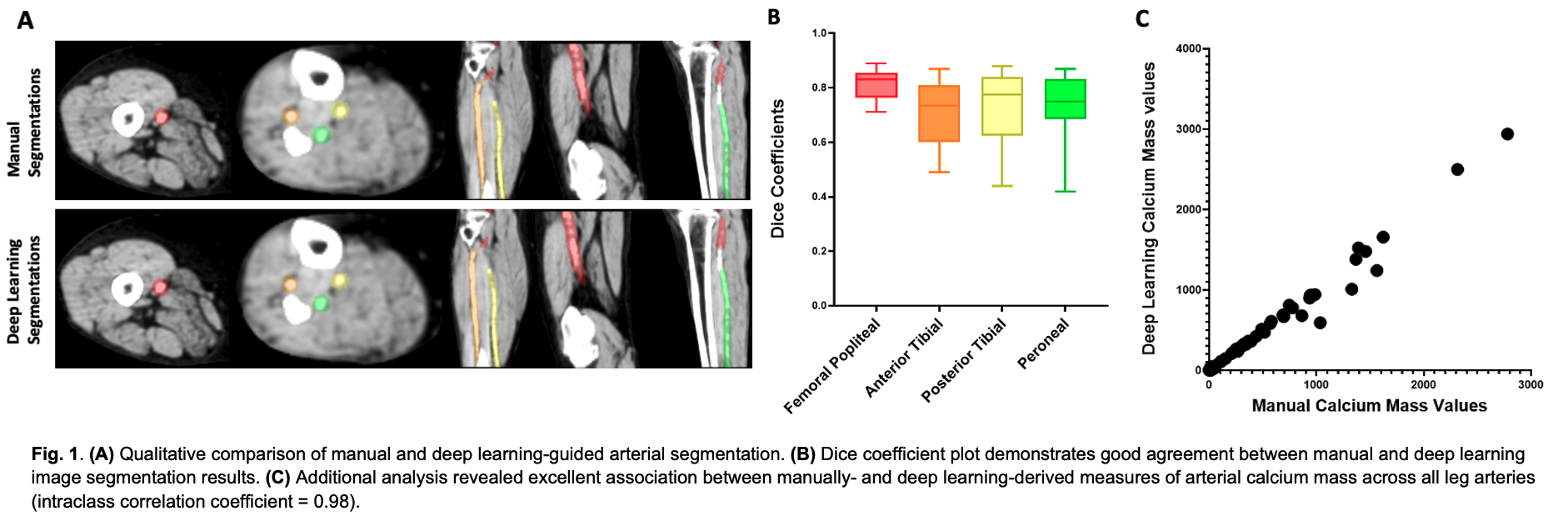
Results: Deep learning-guided image segmentation results qualitatively agreed with manual image analysis (Fig. 1A). Quantitatively, deep learning produced dice coefficients of 0.82 ± 0.05 for femoral-popliteal, 0.71 ± 0.12 for anterior tibial, 0.74 ± 0.12 for posterior tibial, and 0.73 ± 0.12 for the peroneal artery, thus representing good performance for multi-vessel segmentation (Fig. 1B). Calcium mass values derived from both manual and deep learning image analysis demonstrated excellent agreement, with an intraclass correlation coefficient of 0.98 (Fig. 1C).
Conclusions: Deep learning allows for accurate quantification of vessel-specific CT calcium values for the lower extremities of PAD patients, which is a challenging task due to arteries comprising a small percentage (i.e., 0.07%) of the overall CT image. This AI-based approach significantly reduces CT image analysis time from hours to seconds and represents a promising approach for future risk stratification in PAD.
  • Musini, Kumudha  ( The Ohio State University , Columbus , Ohio , United States )
  • Rimmerman, Eleanor  ( The Ohio State University , Columbus , Ohio , United States )
  • Chou, Ting-heng  ( NTUNHS , Taipei , Taiwan )
  • Shin, Kyle  ( The Ohio State University , Columbus , Ohio , United States )
  • Bobbey, Adam  ( Nationwide Children's Hospital , COLUMBUS , Ohio , United States )
  • Atway, Said  ( Ohio State College of Medicine , Columbus , Ohio , United States )
  • Corriere, Matthew  ( Ohio State College of Medicine , Columbus , Ohio , United States )
  • Go, Michael  ( Ohio State College of Medicine , Columbus , Ohio , United States )
  • Stacy, Mitchel  ( Ohio State College of Medicine , Columbus , Ohio , United States )
  • Author Disclosures:
    Kumudha Musini: DO NOT have relevant financial relationships | Eleanor Rimmerman: DO NOT have relevant financial relationships | Ting-Heng Chou: No Answer | Kyle Shin: DO NOT have relevant financial relationships | Adam Bobbey: No Answer | Said Atway: No Answer | Matthew Corriere: No Answer | Michael Go: No Answer | Mitchel Stacy: DO NOT have relevant financial relationships
Meeting Info:
Session Info:

15. Poster Session 3 & Reception

Thursday, 04/24/2025 , 05:00PM - 07:00PM

Poster

More abstracts on this topic:
Age- and Sex-Related Coronary Atherosclerosis by Artificial Intelligence Quantitative Coronary CT Angiography from the INVICTUS Registry

Okubo Ryo, Ichikawa Keishi, Abe Mitsunori, Kitagawa Toshiro, Ikenaga Hiroki, Osawa Kazuhiro, Saji Mike, Iguchi Nobuo, Nakazawa Gaku, Takahashi Kuniaki, Ijichi Takeshi, Matsuo Hitoshi, Mikamo Hiroshi, Kurata Akira, Moroi Masao, Iijima Raisuke, Crabtree Tami, Min James, Earls James, Nakanishi Rine, Sobue Yoshihiro, Kaneko Umihiko, Sato Hideyuki, Fujimoto Shinichiro, Nozaki Yui, Kajiya Takashi, Miyoshi Toru

Analysis of Near-Infrared Spectroscopy Vascular Occlusion Test as a Complement to Ankle-Brachial Index and 6-Minute Walk Test in Patients Diagnosed with Peripheral Artery Disease

Rodriguez Cesar, Lanka Santh Prakash, Maraj Joshua, Alsabbagh Yaman, Farres Sam, Ade Carl, Liu Xiuwen, Delp Judy

More abstracts from these authors:
Vessel-by-Vessel CT Calcium Scoring in Peripheral Artery Disease: Association with Patient-Level Factors

Rimmerman Eleanor, Musini Kumudha, Chou Ting-heng, Trainer Jenna, Atway Said, Go Michael, Stacy Mitchel

Deep Learning-Guided CT Image Analysis Quantifies 18-Month Changes in Regional Muscle Atrophy in Patients with Peripheral Artery Disease

Musini Kumudha, Rimmerman Eleanor, Chou Ting-heng, Shin Kyle, Go Michael, Stacy Mitchel

You have to be authorized to contact abstract author. Please, Login
Not Available