
Logo

American Heart Association

  14
  0


Final ID: Su4016

Dilated Cardiomyopathy and Heart Failure in an Infant due to an Intronic Deletion Disrupting TAZ Splicing

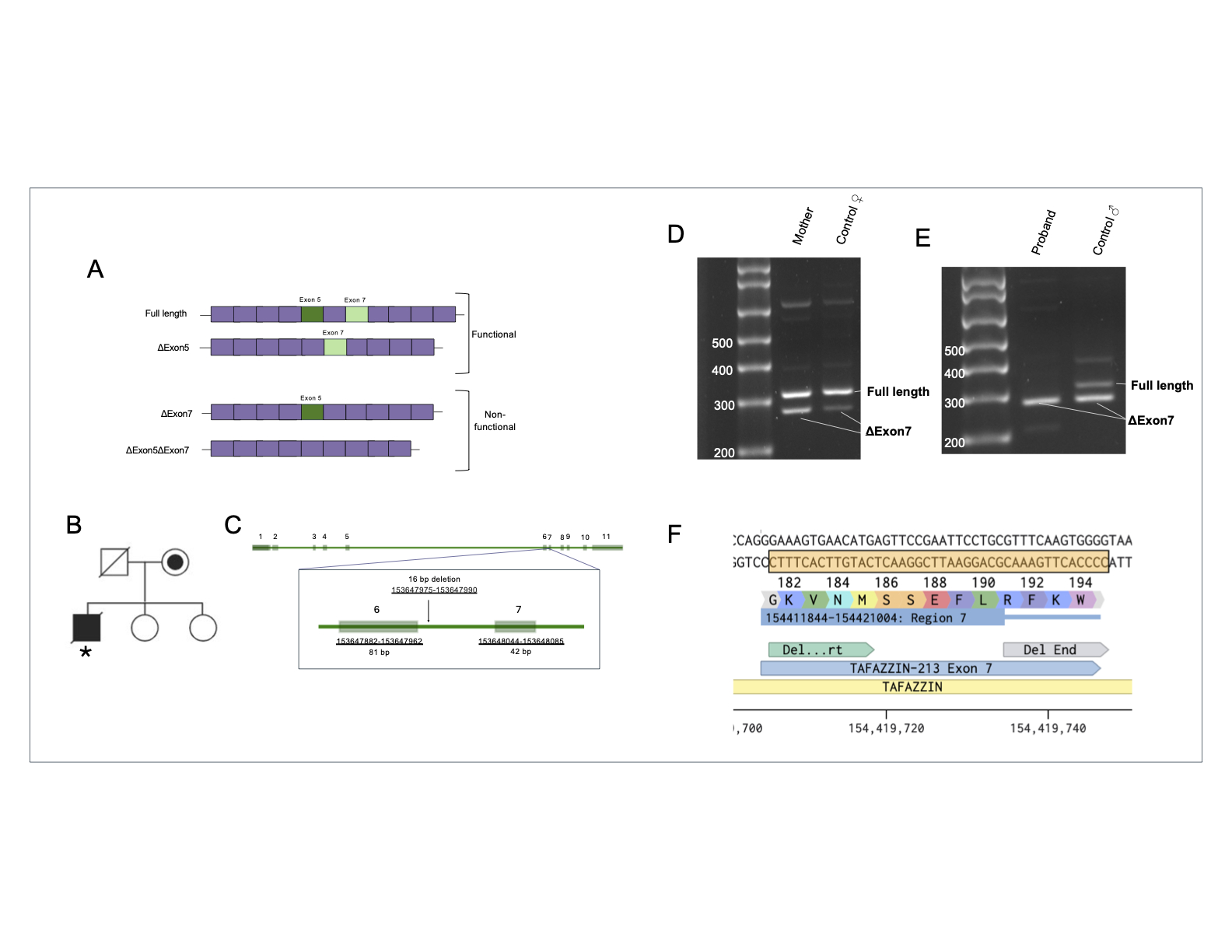
Abstract Body (Do not enter title and authors here): Background: Barth syndrome (BS) is an X-linked recessive disorder caused by loss of function mutations in the TAZ gene. BS is characterized by dilated cardiomyopathy, skeletal myopathy and neutropenia. TAZ encodes the Tafazzin protein, which catalyzes the transacylation of cardiolipin, a component of mitochondrial membranes. Several TAZ isoforms are observed in normal individuals, however, only a subset of these exhibit transacylase activity (Fig A). We identified a 16 base pair TAZ intronic deletion, initially classified as benign, in a 14-month-old male patient who presented with acute onset heart failure and subsequently passed away (Fig B,C).

Hypothesis: We hypothesized that the 16-base pair intronic deletion was not benign, and instead altered splicing of TAZ, leading to a nonfunctional TAZ isoform (ΔEx7) and heart failure.

Methods: To assess an effect on splicing, RNA was isolated from peripheral blood from the proband’s mother and a female control. RT-PCR was used to detect deletion of TAZ exon 7 (ΔEx7) in both samples and PCR products were sequenced. RNA was isolated from the hearts of the proband and a healthy control male infant and similarly analyzed for ΔEx7 TAZ.

Results: The blood sample from the proband’s mother exhibited more ΔEx7 TAZ compared to control (Fig D). The proband’s cardiac tissue expressed only ΔEx7 TAZ transcript, with undetectable levels of full-length TAZ transcript (Fig E), confirmed by sequencing to lack exon 7 (Fig F). Age, sex matched healthy control cardiac tissue expressed both isoforms.

Conclusion: The 16bp deletion in intron 6 of TAZ caused deletion of Exon 7, which is known to encode a nonfunctional Tafazzin protein. These results provide sufficient data to reclassify the genetic result to likely pathogenic and provide actionable results for management of the proband’s mother and her surviving children. These data underscore the importance of reanalysis and functional assessment of genetic variants associated with cardiomyopathy.
  • Goraya, Sayhaan  ( Northwestern University , Chicago , Illinois , United States )
  • Dellefave-castillo, Lisa  ( Northwestern University , Chicago , Illinois , United States )
  • Page, Patrick  ( Northwestern University , Chicago , Illinois , United States )
  • Kwon, Jason  ( Northwestern University , Chicago , Illinois , United States )
  • Stachowski, Marisa  ( Northwestern University , Chicago , Illinois , United States )
  • Puckelwartz, Megan  ( Northwestern University , Chicago , Illinois , United States )
  • Mcnally, Elizabeth  ( Northwestern University , Chicago , Illinois , United States )
  • Author Disclosures:
    Sayhaan Goraya: DO NOT have relevant financial relationships | Lisa Dellefave-Castillo: DO NOT have relevant financial relationships | Patrick Page: No Answer | Jason Kwon: DO NOT have relevant financial relationships | Marisa Stachowski: No Answer Elizabeth McNally: DO have relevant financial relationships ; Consultant:Tenaya Therapeutics:Past (completed) ; Other (please indicate in the box next to the company name):Novartis:Active (exists now) ; Consultant:PepGene:Active (exists now)
Meeting Info:

Scientific Sessions 2025

2025

New Orleans, Louisiana

Session Info:

Predicting and Treating Genetic Cardiomyopathies

Sunday, 11/09/2025 , 11:30AM - 12:30PM

Abstract Poster Board Session

More abstracts on this topic:
A novel LMNA mutant (R225X) leads to cardiac conduction disorders

Li Tingting, Chelu Mihail, Wang Xiaolei, Song Jia, Li Luge, Gutierrez Yaqueline, Shinohara Anna, Whitfield William, Adeleye Adeniyi, Li Na

A Case of Hypertrophic Cardimyopathy: Digenic Variants of Uncertain Significance Mutations in MHY7 and RYR2 Genes

Durukan Selina, Uzunoglu Ekin, Farahmandsadr Maryam, Soffer Daniel

More abstracts from these authors:
Combining Noncoding and Coding Genetic Variation Improves Arrhythmia Risk Prediction

Monroe Tanner, Pesce Lorenzo, Kearns Samuel, Page Patrick, Dellefave-castillo Lisa, Webster Gregory, Puckelwartz Megan, Mcnally Elizabeth

Combining Monogenic and Polygenic Analysis Improves Sudden Cardiac Death Risk Prediction

Monroe Tanner, Pesce Lorenzo, Kearns Samuel, Dellefave-castillo Lisa, Webster Gregory, Puckelwartz Megan, Mcnally Elizabeth

You have to be authorized to contact abstract author. Please, Login
Not Available