Glucagon-Like Peptide-1 Receptor Agonists and Anthracycline Therapy in Breast Cancer: A Real-World Propensity-Matched Analysis
Abstract Body (Do not enter title and authors here): Background Anthracycline cardiotoxicity increases breast cancer morbidity and mortality. Glucagon-like peptide-1 receptor agonists (GLP-1RAs) improve cardio-renal outcomes in diabetes, but their effect during anthracycline therapy is unknown.
Objectives: To determine whether adding GLP-1RAs to anthracycline-based therapy reduces mortality and major cardio-renal events compared to anthracycline alone.
Methods We conducted a retrospective propensity-score–matched cohort study within the TriNetX Global Collaborative Network (146 health-care organizations) of adult females with breast cancer who received anthracyclines between 2005-2024. Cohort A received ≥1 GLP-1a (n = 1691); Cohort B did not (n = 1691). Outcomes were captured 1-1095 days after index and analyzed with Kaplan–Meier survival and Cox proportional-hazards models. Significance was defined as log-rank P < 0.05 with 95 % confidence intervals (CIs) excluding 1. Cohorts were also matched for medication use [ACE inhibitors, Angiotensin receptor blockers, Sodium glucose transporter -2 reuptake inhibitors, Furosemide, and Spironolactone use].
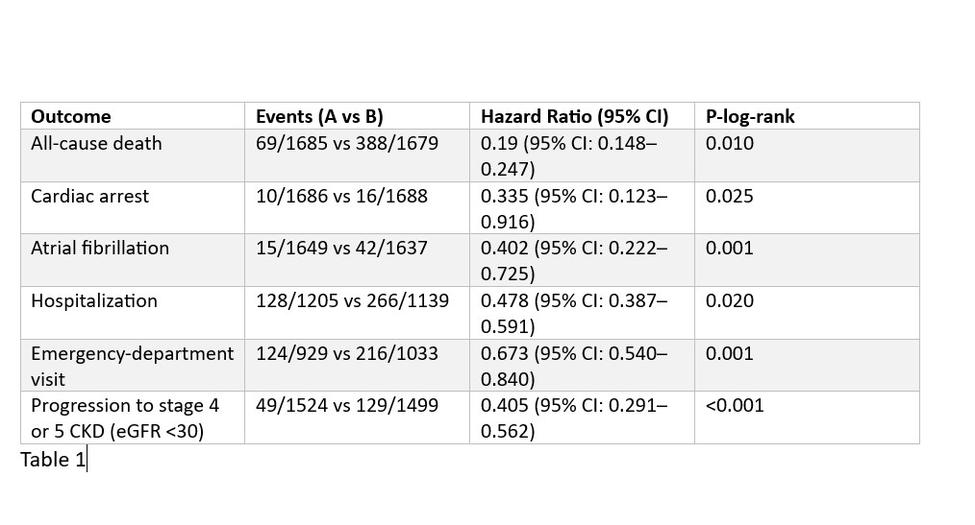
Results Mean follow-up: 625 ± 379 vs 728 ± 398 days. GLP-1RA therapy lowered risk of all-cause death (HR 0.19, 0.148-0.247, P < 0.01), cardiac arrest (0.335, 0.12-0.92, P=0.03), atrial fibrillation (0.40, 0.22-0.73, P < 0.01), hospitalization (0.478, 0.39-0.59, P < 0.001), emergency-department visit (0.67, 0.54-0.84, P < 0.001), and progression to stage 4 or 5 chronic kidney disease (eGFR <30 mL/min 1.73 m2; 0.41, 0.29-0.56, P < 0.001) (Table 1).
Conclusions: The findings suggest that GLP-1a medications may offer protective benefits beyond glucose control, potentially improving cardiovascular, renal, and overall survival outcomes in breast cancer patients undergoing anthracycline chemotherapy. These real-world data support prospective trials of GLP-1a agents as cardio-renal protective adjuncts in oncology domains. Next steps include conducting prospective clinical trials, exploring mechanisms of action, stratifying patient populations, and expanding research into other cancer types or therapies.
Seijari, Mohammed Najdat
(
Good Samaritan Hospital, Trihealth
, Cincinnati , Ohio , United States )
Zamani, Taraneh
(
Good Samaritan Hospital, Trihealth
, Cincinnati , Ohio , United States )
Khan, Fayaz
(
TriHealth Good Samaritan Hospital
, Cincinnati , Ohio , United States )
Rajbhandari, Pranita
(
Good Samaritan Hospital, Trihealth
, Cincinnati , Ohio , United States )
Ajenaghughrure, Godbless
(
trihealth good samaritan hospital
, Cincinnati , Ohio , United States )
Hijazi, Mohamad
(
Trihealth
, Cincinnati , Ohio , United States )
Author Disclosures:
Mohammed Najdat Seijari:DO NOT have relevant financial relationships
| Taraneh Zamani:DO NOT have relevant financial relationships
| Fayaz Khan:DO NOT have relevant financial relationships
| Pranita Rajbhandari:No Answer
| Godbless Ajenaghughrure:DO NOT have relevant financial relationships
| Mohamad Hijazi:DO NOT have relevant financial relationships