Stroke Incidence Variations Among Atrial Fibrillation Patients Stratified by Cancer Subtype: A Decade of Real-World Data
Abstract Body (Do not enter title and authors here): Introduction: Cancer is an increasingly common comorbidity among patients with atrial fibrillation (AF), in part due to advances in treatments with improved survival. Furthermore, certain cancers and their therapies can contribute to the development of AF. As a result, the population living with both conditions is growing. While prior studies have established that cancer is associated with an elevated risk of stroke, data remain limited regarding how this risk varies by specific cancer types among patients with AF.
Hypothesis: Patients with AF and cancer have a higher overall incidence of ischemic stroke, with risk varying significantly by cancer type.
Methods: We utilized the TriNetX Research Network to access de-identified patient data from 73 healthcare organizations using International Classification of Diseases, Tenth Revision codes. We analyzed the cumulative incidence of first-ever ischemic stroke or transient ischemic attack from Jan.1st, 2015 to Dec. 31st, 2024 in AF patients with and without 21 different malignant cancers occurring within one year of any AF diagnosis. Cancers were grouped into solid and liquid types, and stroke incidences were further stratified by sex.
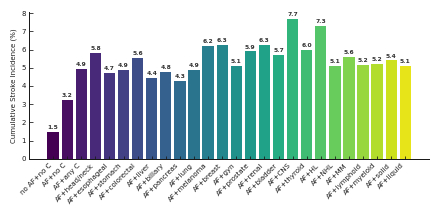
Results: We identified 162,993 AF patients with one of 21 cancers, 1,753,126 AF patients without cancer, and 80,635,927 patients without AF or cancer. The cumulative incidence of stroke over 10 years was higher for AF patients with any cancer type (4.93%) compared to AF patients without any cancer (3.23%) and those with neither (1.46%). The highest incidence occurred with CNS cancer (7.68%) and Hodgkin lymphoma (7.32%; Figure 1). Melanoma (6.20%) had the next highest stroke incidence in men, while renal (7.35%) and head & neck (6.58%) cancers had the next highest incidence in women.
Conclusion: In this large, real-world analysis spanning a decade, AF patients with cancer had a higher cumulative risk of ischemic stroke compared to those without cancer. Notably, the degree of risk varied substantially by cancer type.
Miks, Charles
( University of Iowa Health Care
, Iowa City
, Iowa
, United States
)
Alzahrani, Ashraf
( University of Iowa Health Care
, Iowa City
, Iowa
, United States
)
Farjo, Peter
( University of Iowa Health Care
, Iowa City
, Iowa
, United States
)
Dominic, Paari
( University of Iowa Health Care
, Iowa City
, Iowa
, United States
)
Author Disclosures:
Charles Miks:DO NOT have relevant financial relationships
| Ashraf Alzahrani:DO NOT have relevant financial relationships
| Peter Farjo:DO NOT have relevant financial relationships
| Paari Dominic:DO have relevant financial relationships
;
Consultant:Boston Scientific:Active (exists now)
; Consultant:Biosense Webster:Active (exists now)