
Logo

American Heart Association

  27
  0


Final ID: MP1011

Cancer Independently Increased Stroke Incidence in Atrial Fibrillation Patients from 2015-2024

Abstract Body (Do not enter title and authors here): Introduction: Cancer induces a prothrombotic state through multiple mechanisms. Although patients with cancer are at increased risk of thromboembolism, stroke risk stratification tools in atrial fibrillation (AF) patients have historically excluded malignancy and may underestimate overall risk.

Hypothesis: Patients with AF and cancer have increased stroke incidence compared to those without cancer after adjusting for established risk factors.

Methods: We utilized the TriNetX Research Network to access de-identified patient data from 73 healthcare organizations using International Classification of Diseases, Tenth Revision codes. We identified AF patients with and without a diagnosis of any of 21 cancers occurring within one year of AF diagnosis. Cumulative stroke or transient ischemic attack incidence was calculated for the period between Jan.1st, 2015 to Dec. 31st, 2024. Subgroup analyses were performed by CHA2DS2-VASc score (0 to 7, excluding prior stroke). A Cox proportional hazards model assessed the independent contribution of cancer relative to individual CHA2DS2-VASc variables. We also performed a 10-year Kaplan-Meier survival analysis for ischemic stroke in a propensity-matched cohort of AF patients with and without cancer.

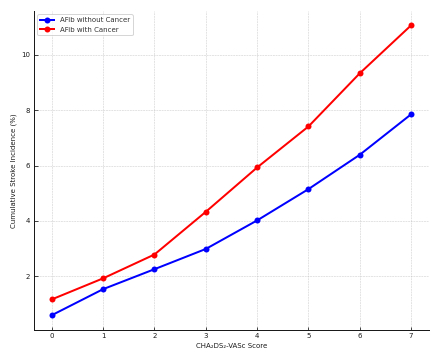
Results: A total of 162,993 AF patients with cancer were compared to 1,753,126 AF patients without cancer. Higher CHA2DS2-VASc scores were associated with higher stroke incidence, and the presence of cancer further increased stroke incidence at each score level. In the multivariable Cox model, cancer was independently associated with stroke after accounting for CHA2DS2-VASc variables (adjusted hazard ratio [aHR] 1.37; 95% confidence interval [CI], 1.34-1.41; p < 0.0001; Figure 1). After matching for CHA2DS2-VASc components, 10-year stroke-free survival was significantly lower in AF patients with cancer (HR 1.72; 95% CI, 1.68–1.76; p < 0.0001; Figure 2).

Conclusion: In this large, real-world cohort, cancer emerged as an independent predictor of ischemic stroke in AF patients, with a magnitude of risk comparable to established CHA2DS2-VASc variables. These findings support the incorporation of malignancy into future stroke risk stratification frameworks for AF.
  • Miks, Charles  ( University of Iowa Health Care , Iowa City , Iowa , United States )
  • Alzahrani, Ashraf  ( University of Iowa Health Care , Iowa City , Iowa , United States )
  • Farjo, Peter  ( University of Iowa Health Care , Iowa City , Iowa , United States )
  • Dominic, Paari  ( University of Iowa Health Care , Iowa City , Iowa , United States )
  • Author Disclosures:
    Charles Miks: DO NOT have relevant financial relationships | Ashraf Alzahrani: DO NOT have relevant financial relationships | Peter Farjo: DO NOT have relevant financial relationships | Paari Dominic: DO have relevant financial relationships ; Consultant:Boston Scientific:Active (exists now) ; Consultant:Biosense Webster:Active (exists now)
Meeting Info:

Scientific Sessions 2025

2025

New Orleans, Louisiana

Session Info:

Oncological Considerations in Arrhythmia Management

Saturday, 11/08/2025 , 01:45PM - 03:00PM

Moderated Digital Poster Session

More abstracts on this topic:
A novel deep learning framework identified associated genes and Interpretable deep learning translation of GWAS findings for drug repurposing in Atrial Fibrillation

Tonegawa-kuji Reina, Xu Jielin, Guntupalli Suman, Barnard John, Chung Mina, Cheng Feixiong

A Case Series of Papillary Fibroelastomas on the Coumadin ridge

Aboukhatwa Omar, Akiki Elias, Kurmann Reto, Larson Kathryn, Keeney Michael, Bois Melanie, Klarich Kyle

More abstracts from these authors:
Stroke Incidence Variations Among Atrial Fibrillation Patients Stratified by Cancer Subtype: A Decade of Real-World Data

Miks Charles, Alzahrani Ashraf, Farjo Peter, Dominic Paari

Leadless Pacemaker Implantation in the Region of Bachmann’s Bundle: Initial Results

Makhdum Leena, Alzahrani Ashraf, Farjo Peter, Dominic Paari, Bailin Steven

You have to be authorized to contact abstract author. Please, Login
Not Available