Nocturnal Very Low Frequency of Heart Rate Variability Predicts Adverse Cardiovascular Events in Obese Individuals
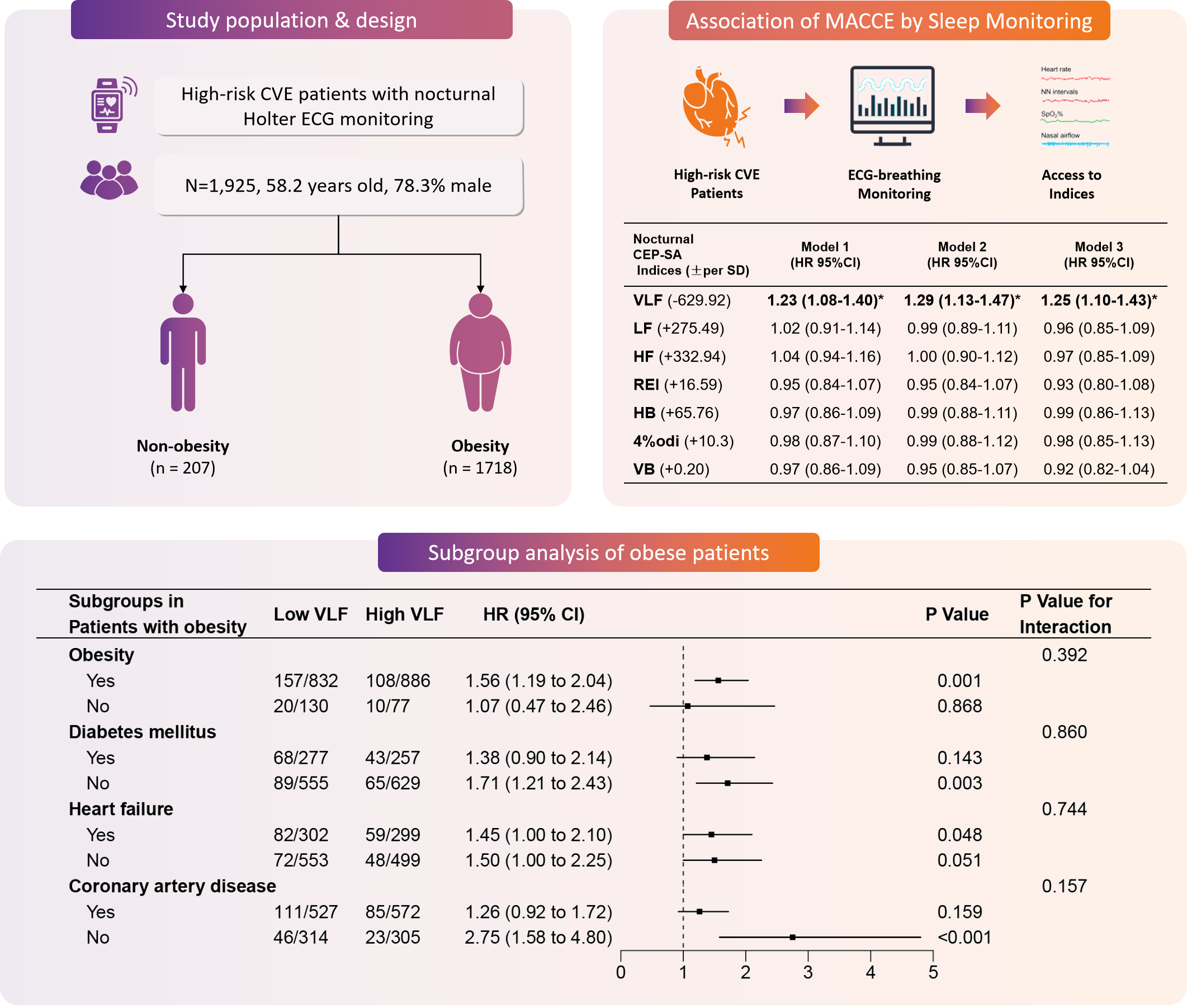
Abstract Body (Do not enter title and authors here): Background: The risk of major adverse cardiovascular and cerebrovascular events (MACCEs) in obese individuals is often assessed by hypoxia and hypopnea levels, while heart rate variability (HRV) has not been widely studied in this population. Aims: To study the association between HRV and MACCEs in patients with obesity. Methods: This prospective cohort included 1925 patients undergoing nocturnal Holter electrocardiographic monitoring and home sleep apnea test (HSAT) from 2017–2021. Obesity was defined as excess for body mass index (BMI) and one measurement of body size (waist circumference, waist-to-hip ratio and waist-to-height ratio), or excess for two measurements of body size regardless of BMl. Nocturnal HRV indices were obtained from variation in the normal-to-normal intervals and divided into 3 subtypes based on frequency-domain spectrum, i.e., high frequency (HF, 0.15–0.5 Hz), low frequency (LF, 0.04–0.15 Hz), and very low frequency (VLF, 0.0033–0.04 Hz). Hypoxic burden and ventilation burden indices were recorded by HSAT monitors. Low VLF level was defined as a VLF of < the median value. Predictive values of HRV, hypoxia burden and ventilation burden indices were assessed with Cox regression. Sensitivity analysis was performed in obese patients (n=1718, 89.2%) to assess if the association between VLF and MACCEs was modified by diabetes mellitus (DM) (n=534), heart failure (n=601), and coronary artery disease (CAD) (n=1099). Results: Mean age was 58.2±11.5 years (78.3% men). Median follow-up was 3.1 years. MACCEs occurred in 15.3% (295/1925). Patients with decreased per VLF standard deviation (629.92 ms2) had a higher cumulative risk of MACCEs (adjusted hazard ratio [aHR] 1.25, 95% confidence interval [CI], 1.10–1.43, P=0.001). Neither other HRV indices nor indices of hypoxia and ventilation burdens were correlated with MACCEs (P>0.05). In obese patients, the association of low VLF level with MACCEs was observed in those without DM (aHR 1.71, 95% CI 1.21–2.43, P=0.003), with heart failure (aHR 1.45, 95% CI 1.00–2.10, P<0.048), and without CAD (aHR 2.75, 95% CI 1.58–4.80, P<0.001). No significant interaction was found among subgroups of DM, CAD and heart failure (P for interaction > 0.05). Conclusion: Reduced nocturnal VLF was linked to increased risk of MACCE in obese patients. The results of this study highlight the importance and argue for the necessity of monitoring nocturnal VLF in cardiovascular risk assessment for obese individuals.
Ling Wang:DO NOT have relevant financial relationships
| Huangtao Ruan:No Answer
| Jin Liu:DO NOT have relevant financial relationships
| Xiaozhao Lu:DO NOT have relevant financial relationships
| Yijia Li:DO NOT have relevant financial relationships
| Wei-Guo Ma:DO NOT have relevant financial relationships
| Zhi-Cheng Jing:DO NOT have relevant financial relationships
Liu Chao, Huang Wei, Li Xian-mei, Xu Xi-qi, Jing Zhi-cheng, Wang Li-ting, Dai Hai-long, Li Jiang, Cao Yunshan, Wu Bing-xiang, Yao Hua, Yu Zai-xin, Zhang Rui-feng
4370192_File000001.jpg
You have to be authorized to contact abstract author. Please, Login