Evaluating Representativeness of the All of Us Cohort: Comparison of Demographics and Cardiovascular Disease Burden with National Survey Data
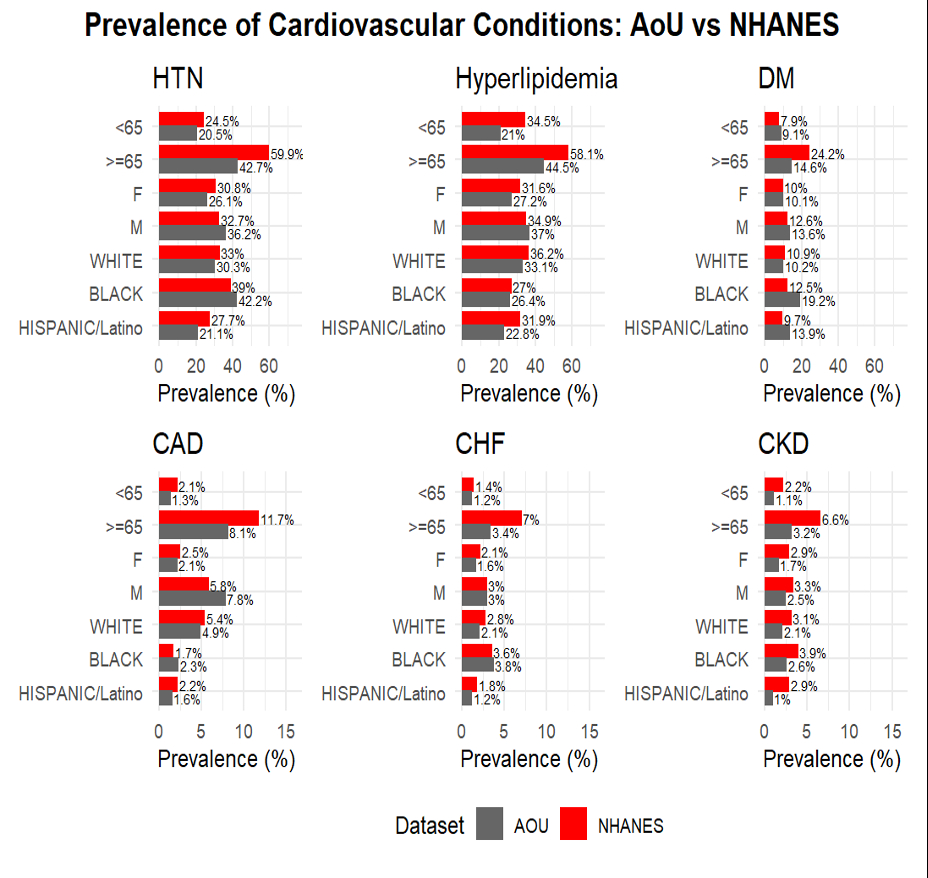
Abstract Body (Do not enter title and authors here): Introduction: The All of Us (AoU) Research Program, sponsored by the National Institutes of Health, is building one of the largest research cohorts in the U.S with a focus on enrolling participants historically underrepresented in research. Knowing how AoU participants differ from the U.S population in terms of demographics, cardiovascular (CV) risk factors and established cardiovascular disease (CVD) is critical for cardiovascular researchers using these data to inform the generalizability of their conclusions. Research question: How do demographic characteristics and the self-reported prevalence of major CV risk factors and established CVD in the AoU cohort compare with those reported in the National Health and Nutrition Examination Survey (NHANES)? Methods: We used AoU Controlled Tier dataset version 7, including participants aged ≥18 enrolled between May 2017-June 2022 who completed the Personal and Family Health History survey. We compared this to adults ≥18 years from the 2017–March 2020 cycle of NHANES who completed key demographic and medical condition questionnaires; CDC-provided sampling weights to maintain population-level representation. We compared CV risk factors and established CVD overall, and by sub-groups of age (<65 vs ≥65), sex, and race/ethnicity. Results: AoU participants who completed the survey (N=185,232) were older than NHANES participants (9,683 participants representing 248 million U.S adults) with a mean age 56 vs 48 years, and included a greater proportion of women (60.4% vs 51.8%) and Black individuals (18.6% vs 11.5%; all p<0.001). Overall, the prevalence of cardiovascular risk factors in the AoU Survey cohort was similar or slightly lower than NHANES. However, when stratified by age, AoU Survey participants had a consistently lower burden of CV comorbidities. This pattern was not observed among Black participants, who exhibited higher rates of hypertension, diabetes, chronic kidney disease, and congestive heart failure. Similarly, male participants showed higher rates of hypertension, diabetes, hyperlipidemia, and coronary artery disease. Conclusion: AoU in line with its mission, includes larger proportions of historically underrepresented groups. Overall cardiovascular disease prevalence is generally lower than the U.S. population, but subgroups such as Black and male participants show higher rates. Researchers should interpret AoU survey–based estimates with caution and account for subgroup differences when generalizing findings.
Yang, Mengjing
(
Yale University
, Fairfield , Connecticut , United States )
Admassu, Tinsae
(
Yale University
, Fairfield , Connecticut , United States )
Huang, Chenxi
(
Yale University
, New Haven , Connecticut , United States )
Murugiah, Karthik
(
Yale University
, Fairfield , Connecticut , United States )
Author Disclosures:
Mengjing Yang:DO NOT have relevant financial relationships
| Tinsae Admassu:DO NOT have relevant financial relationships
| Chenxi Huang:DO NOT have relevant financial relationships
| Karthik Murugiah:DO NOT have relevant financial relationships
Ahmad Husnain, Khan Muhammad, Sharif Aleena, Hossain Mohammad, Eltawansy Sherif, Faizan Muhammad, Ali Muhammad Faizan, Ahmed Ashraf, Abdul Malik Mohammad Hamza Bin, Pahwani Ritesh, Patel Rahul, Mehdi Hassan