A Quarter Century of Mortality Trends in Hypertension and Sick Sinus Syndrome Among Elderly in the United States
Abstract Body:
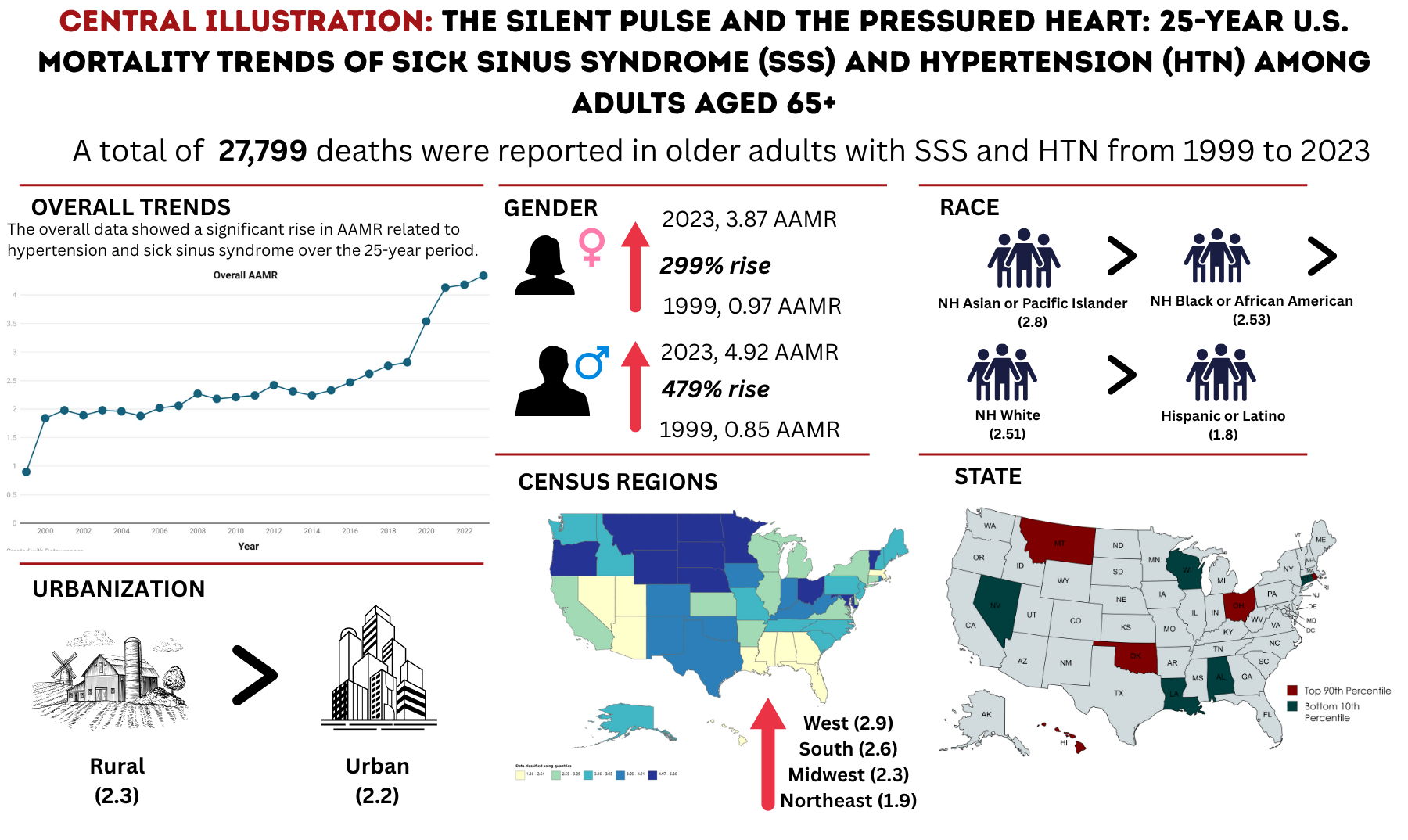
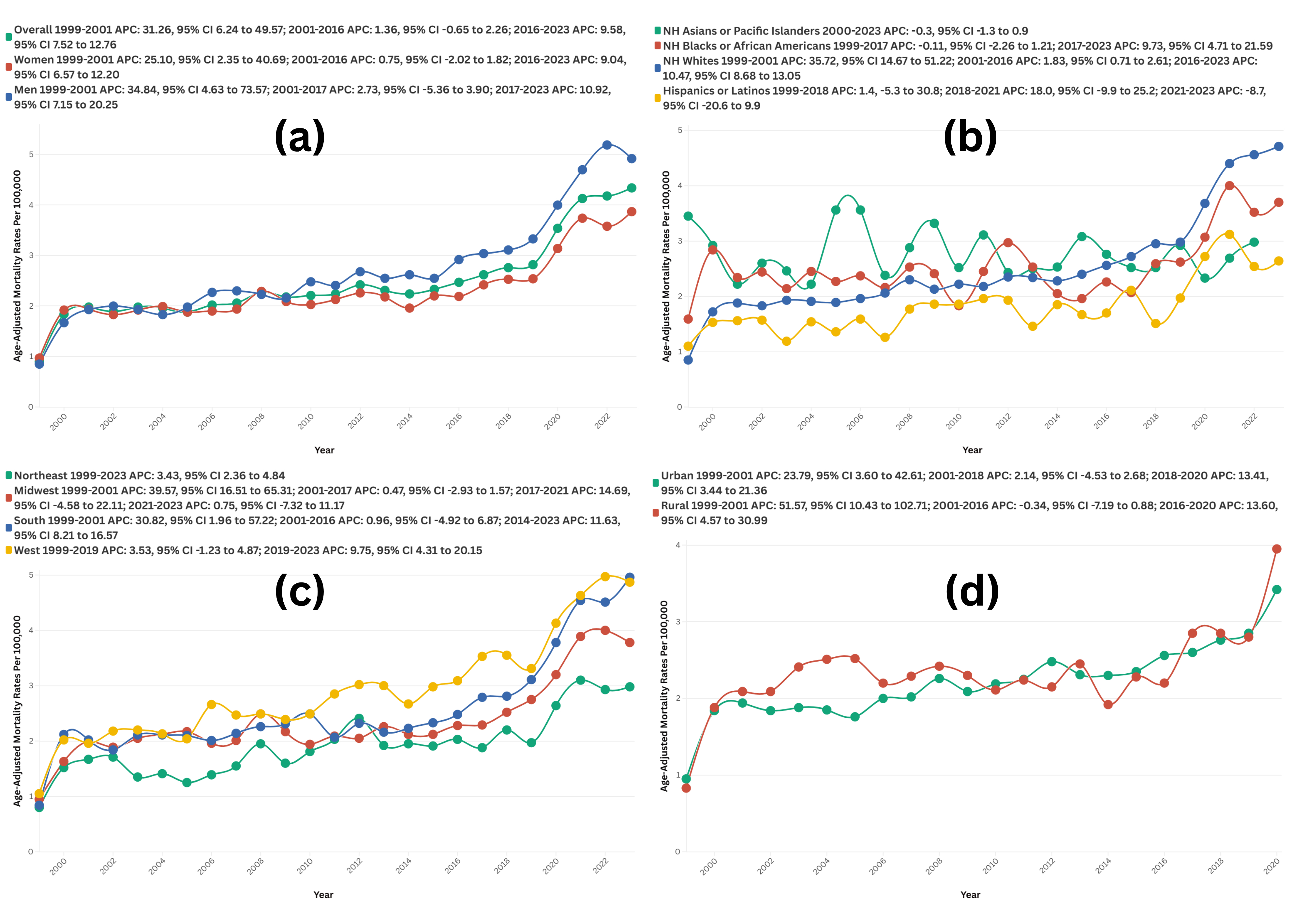
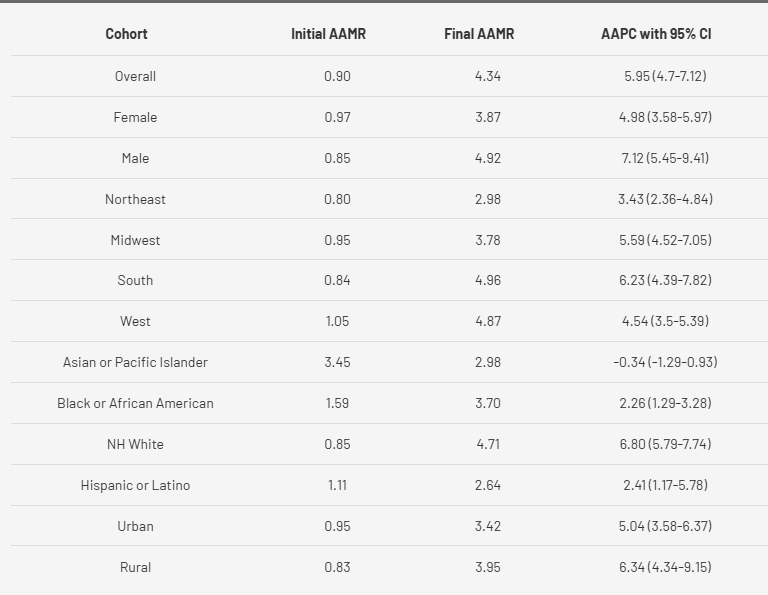
Background: Hypertension (HTN) and sick sinus syndrome (SSS) are common and often coexisting conditions in the elderly, contributing significantly to cardiovascular morbidity and mortality. Despite advances in management, the long-term mortality trends related to these conditions remain poorly characterized on a national scale. Aim: To analyze 25-year nationwide mortality trends associated with HTN and sick sinus syndrome among U.S. adults aged 65 and older, identifying demographic and regional disparities. Methods Mortality data from CDC WONDER (1999–2023) were analyzed using Joinpoint regression to assess deaths related to HTN and SSS in U.S. adults aged 65+. Age-adjusted mortality rates (AAMRs) and average annual percent change (AAPC) with 95% confidence intervals were calculated. Results HTN coexisting with SSS contributed to 27,799 deaths in individuals aged over 65 years. Between 1999 and 2023, the overall AAMR surged from 0.90 to 4.34, with a staggering AAPC of 5.95 (95% CI: 4.70–7.12, p < 0.000001). Females consistently exhibited higher mortality rates than males (AAMR: 3.00 vs. 2.71); however, the trajectory of increase was steeper in males (AAPC: 7.12, 95% CI: 5.45–9.41) compared to females (AAPC: 4.98, 95% CI: 3.58–5.97). Among racial groups, NH Asian or Pacific Islander had the highest AAMR (2.76), followed by NH Blacks (2.53), and NH Whites (2.51). Surprisingly, NH white saw the fastest rise in mortality (AAPC: 6.80, 95% CI: 5.79–7.74), followed by Hispanics (AAPC: 2.41, 95% CI: 1.17–5.78), and NH Blacks (AAPC: (AAPC: 2.26, 95% CI: 1.29–3.28). Among all U.S. census regions, the West faced the highest mortality burden (AAMR: 2.91), followed by the South (2.57). The South saw the most pronounced increase (AAPC: 6.23, 95% CI: 4.39–7.82), followed by the Midwest (AAPC: 5.59, 95% CI: 4.52–7.05), whereas the states with the highest AAMRs were Nebraska (8.05), South Carolina (7.22), and Oregan (6.75). Rural areas exhibited slightly higher AAMRs than urban areas (2.33 vs. 2.20), and the mortality trajectory was also steeper in rural populations (AAPC: 3.64, 95% CI: 4.34–9.15) compared to urban areas (AAPC: 5.04, 95% CI: 3.58–6.37). Conclusion HTN and SSS-related mortality has escalated over the past 25 years, with the most notable increases seen in males, NH Whites, rural areas, and the South region. These disparities emphasize the urgent need for targeted interventions to address the growing mortality burden, especially among vulnerable populations.
Eltawansy, Sherif
(
Jersey Shore UMC
, Monroe , New Jersey , United States )
Ali, Muhammad Faizan
(
Jinnah Postgraduate Medical Center
, Karachi , Pakistan )
Ahmad, Husnain
(
Shalamar Medical and Dental College
, Lahore , Pakistan )
Faizan, Muhammad
(
Shalamar Medical and Dental College
, Lahore , Pakistan )
Ahmed, Ashraf
(
Bridgeport Hospital
, Bridgeport , Connecticut , United States )
Abdul Malik, Mohammad Hamza Bin
(
Nassau University Medical Center
, East Meadow , New York , United States )
Pahwani, Ritesh
(
HCA Florida Brandon Hospital/USF Morsani College of Medicine
, Brandon , Florida , United States )
Patel, Rahul
(
University of North Carolina
, Morganton , North Carolina , United States )
Mehdi, Hassan
(
Jinnah Postgraduate Medical Center
, Karachi , Pakistan )
Khan, Muhammad
(
Bacha Khan Medical College, Mardan
, Mardan , Pakistan )
Sharif, Aleena
(
Sheikh Zayed Medical College
, BAHAWALPUR , Pakistan )
Hossain, Mohammad
(
Jersey Shore UMC
, Monroe , New Jersey , United States )
Author Disclosures:
Sherif Eltawansy:DO NOT have relevant financial relationships
| Muhammad Khan:DO NOT have relevant financial relationships
| Asad Iqbal:No Answer
| Aleena Sharif:No Answer
| Mohammad Hossain:DO NOT have relevant financial relationships
| Muhammad Faizan Ali:DO NOT have relevant financial relationships
| Husnain Ahmad:DO NOT have relevant financial relationships
| Muhammad Faizan:DO NOT have relevant financial relationships
| Ashraf Ahmed:DO NOT have relevant financial relationships
| Mohammad Hamza Bin Abdul Malik:DO NOT have relevant financial relationships
| Ritesh Pahwani:No Answer
| Rahul Patel:DO NOT have relevant financial relationships
| hassan mehdi:No Answer
Ahmad Husnain, Khan Muhammad, Sharif Aleena, Hossain Mohammad, Eltawansy Sherif, Faizan Muhammad, Ali Muhammad Faizan, Ahmed Ashraf, Abdul Malik Mohammad Hamza Bin, Pahwani Ritesh, Patel Rahul, Mehdi Hassan
Ali Muhammad Faizan, Khan Muhammad, Sharif Aleena, Hossain Mohammad, Ahmad Husnain, Eltawansy Sherif, Faizan Muhammad, Ahmed Ashraf, Abdul Malik Mohammad Hamza Bin, Pahwani Ritesh, Patel Rahul, Mehdi Hassan
4359471_File000000.jpg
4359471_File000001.jpg
4359471_File000002.jpg
You have to be authorized to contact abstract author. Please, Login