Creation of U.S. Population-Based, Age- and Sex-Specific Percentile Reference Standards for Atherogenic Lipid Measurements
Abstract Body (Do not enter title and authors here): Background: Atherogenic lipid concentrations (non-HDL-C, LDL-C, and apoB) typically increase during young adulthood. However, “normal” ranges used in clinical care are derived from distributions from middle-aged populations, potentially underestimating lipid burden in young adults. Age- and sex-specific percentiles may provide a more accurate understanding of lipid burden across the life course.
Methods: We used National Health and Nutrition Examination Survey (NHANES) data from 1999-August 2023, including adults aged 18 to 79 years with non-missing non-HDL-C, LDL-C, or apoB. For participants reporting treatment with statins, we imputed underlying lipid measures using censored data methods. We created age- and sex-specific lipid percentiles in a “healthy” cohort, defined as body mass index >18.5 and <30 kg/m2, glucose <126 mg/dL, no diabetes, and no ASCVD, using a modified LMS estimation procedure as done for the 2000 CDC Pediatric Growth Charts.
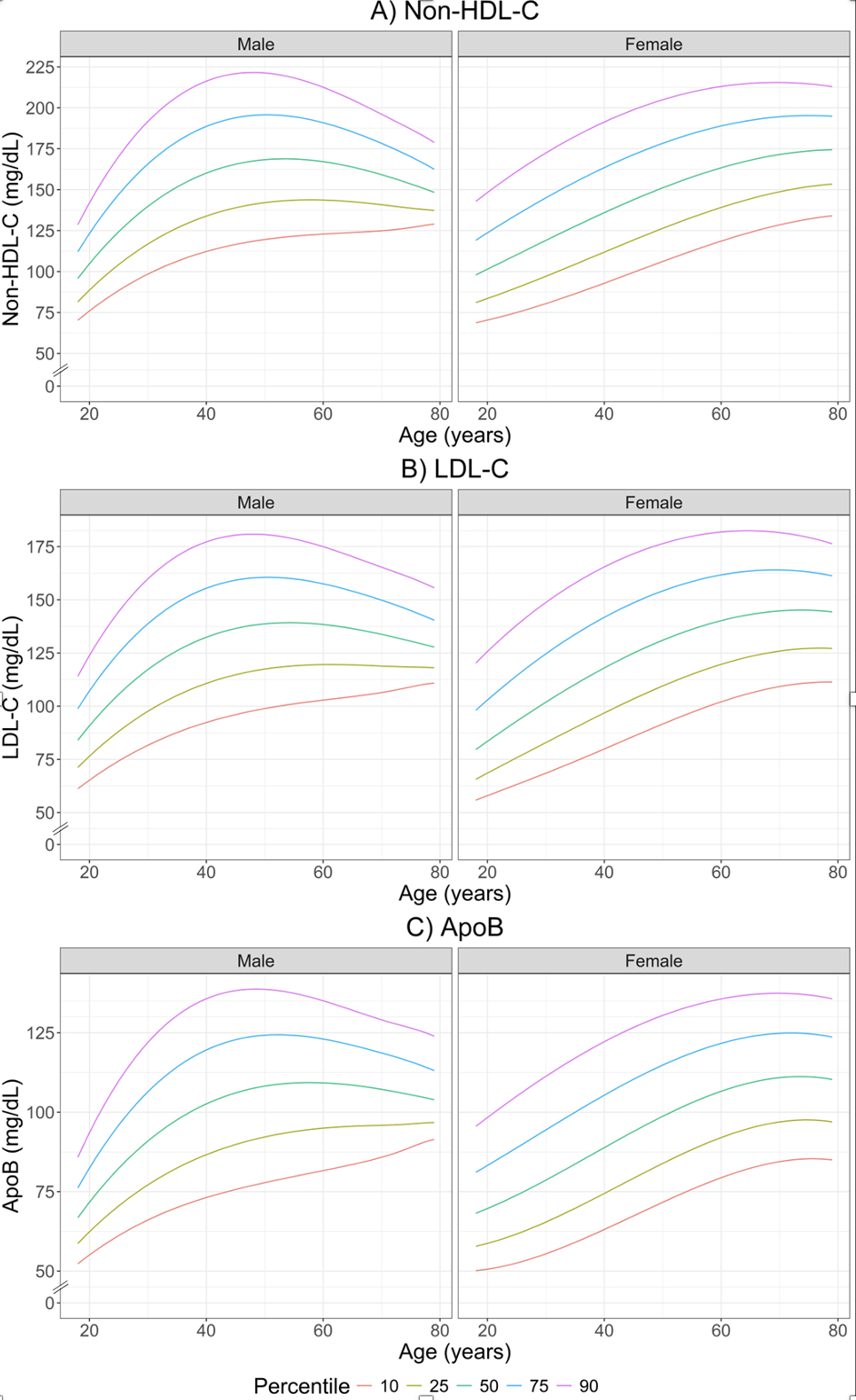
Results: We included 4,723, 4,596, and 2,979 participants in our healthy non-HDL-C, LDL-C, and apoB participant samples, respectively, for the creation of percentiles; 52% were female. Estimated treatment effects assuming imputed underlying lipids in treated adults corresponded to mean percent reductions of 28%, 31%, and 26% for non-HDL-C, LDL-C, and apoB, respectively. As expected, the absolute lipid levels reflected in age-specific percentiles were higher in middle age than in young adulthood (Figure). For men, the median (IQR) lipid values (in mg/dL) for ages 18-40, 41-60, and 61-79y were 137 (119-151), 168 (166-169), and 159 (154-163) for non-HDL-C; 115 (101-125), 139 (137-139), and 134 (131-136) for LDL-C; and 89 (79-97), 108 (106-109), and 107 (106-108) for apoB, respectively. For women, the median values for ages 18-40, 41-60, and 61-79y were 117 (108-127), 152 (145-158), and 172 (168-174) for non-HDL-C; 100 (90-109), 132 (126-136), and 145 (143-145) for LDL-C; and 78 (73-83), 99 (95-103), and 111 (109-111) for apoB, respectively.
Conclusion: The lipid levels represented by age- and sex-specific percentiles vary substantially across adulthood, indicating that percentile-based assessments may better reflect lipid burden across the adult life course than absolute values obtained from middle-aged adults. Further research is needed to evaluate their predictive value for cumulative lipid exposure and ASCVD risk, as well as their interpretability and acceptance in clinical practice.
Wilkins, John
(
Northwestern University
, Chicago , Illinois , United States )
Gauen, Abigail
(
Northwestern University
, Chicago , Illinois , United States )
Petito, Lucia
(
Northwestern University
, Chicago , Illinois , United States )
Allen, Norrina
(
NORTHWESTERN UNIVERSITY
, Chicago , Illinois , United States )
Author Disclosures:
John Wilkins:DO NOT have relevant financial relationships
| Abigail Gauen:No Answer
| Lucia Petito:DO have relevant financial relationships
;
Research Funding (PI or named investigator):Omron Healthcare Co., Ltd.:Active (exists now)
; Consultant:Ciconia Medical:Past (completed)
| Norrina Allen:DO NOT have relevant financial relationships