
Logo

American Heart Association

  23
  0


Final ID: MP259

Impact of Socioeconomic Food Insecurity on Stroke Outcomes: A County-Level Geospatial Analysis Using CDC WONDER and USDA Data

Abstract Body (Do not enter title and authors here): Background:
Food insecurity, defined as having limited or unpredictable access to enough food, is a severe public health issue that disproportionately affects socioeconomically disadvantaged people. Although stroke mortality and disability reflect well-established regional and racial disparities, the independent impact of food poverty on stroke outcomes is unknown. The relationship between county-level food insecurity and stroke mortality in the United States was investigated using national geospatial datasets.
Methods:
We conducted a cross-sectional ecological study using publicly available data from the CDC WONDER (Multiple Cause of Death Database, 2016-2021) and the USDA Food Access Research Atlas. USDA figures were used to categorize counties based on their food insecurity prevalence: low (<5%), moderate (5-14.9%), and high (≥ 15%). The age-adjusted stroke death rates (ICD-10: I61.x and I63.x) were obtained from CDC WONDER. Covariates included the county's poverty rate, racial composition, median family income, urban-rural status, and the density of major stroke centers. Geospatial mapping and multivariable linear regression models were used to assess associations.
Results:
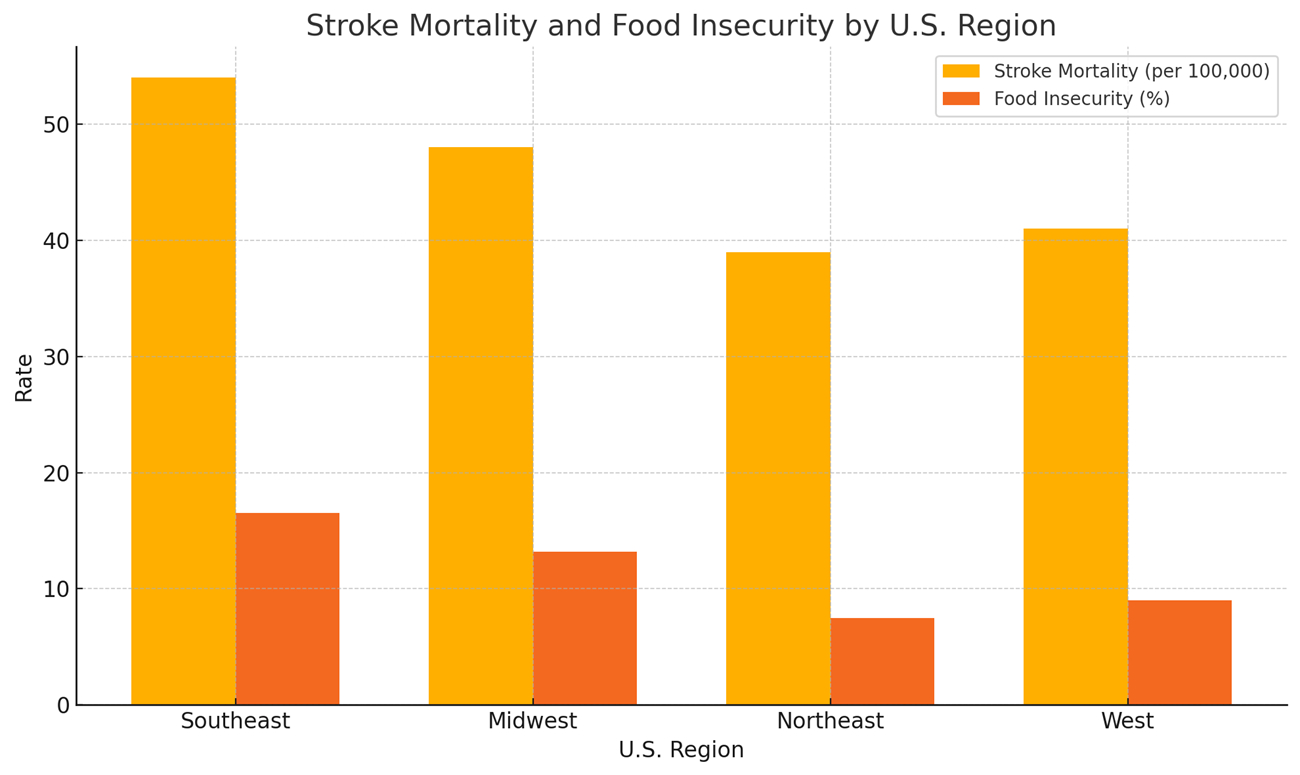
Among 3,142 U.S. counties analyzed, those with high food insecurity had significantly higher age-adjusted stroke mortality rates (mean: 53.7 per 100,000) than those with low food insecurity (mean: 37.2 per 100,000; p<0.001). Despite controlling socioeconomic and healthcare access, significant food insecurity was still linked to higher stroke mortality (β = +4.21, 95% CI: 2.99-5.44, p < 0.001). Geographic heatmaps revealed death hotspots in the Southeast (Mississippi Delta, Alabama Black Belt) and rural Midwest—areas with high food poverty and low healthcare density. Black and Hispanic inhabitants in high-insecurity counties got much lower ratings.
Conclusion:
Food insecurity at the county level is a robust and independent predictor of stroke mortality in the United States, even after controlling for socioeconomic and healthcare access characteristics. emphasizes the critical need to include food security interventions into cardiovascular disease prevention frameworks. Targeted public health measures in high-risk communities may reduce stroke inequities and increase population-level outcomes.
  • Kumar, Harendra  ( Dow University of Health Sciences , Hyderabad , Pakistan )
  • Teena, Fnu  ( Dow University of Health Sciences , Hyderabad , Pakistan )
  • Georgiyeva, Kateryna  ( Memorial Hospital Pembroke , Pembroke Pines , Florida , United States )
  • Author Disclosures:
    Harendra Kumar: DO NOT have relevant financial relationships | FNU teena: DO NOT have relevant financial relationships | Kateryna Georgiyeva: DO NOT have relevant financial relationships
Meeting Info:

Scientific Sessions 2025

2025

New Orleans, Louisiana

Session Info:

Stroke Outcomes: AI, Access, and Equity

Saturday, 11/08/2025 , 10:45AM - 12:00PM

Moderated Digital Poster Session

More abstracts on this topic:
10-Year Trends in Last Known Well to Arrival Time in Acute Ischemic Stroke Patients: 2014-2023

Ferrone Nicholas, Sanmartin Maria, O'hara Joseph, Jimenez Jean, Ferrone Sophia, Wang Jason, Katz Jeffrey, Sanelli Pina

10-Year Trend Analysis of Medicare Payment in Stroke Inpatient Hospital Admission

Wong Ka-ho, Krothapalli Neeharika, Littig Lauren, Champagne Alison, Majersik Jennifer, Reddy Vivek, De Havenon Adam

You have to be authorized to contact abstract author. Please, Login
Not Available