
Logo

American Heart Association

  18
  0


Final ID: Su2137

LPA-Targeted siRNAs Lower Lp(a) by Over 90%: A Meta-Analysis of Olpasiran, Lepodisiran, and Zerlasiran

Abstract Body (Do not enter title and authors here): Introduction:
Elevated lipoprotein(a) [Lp(a)] is a genetically determined, independent risk factor for atherosclerotic cardiovascular disease (ASCVD). Currently, no approved therapies specifically target Lp(a) reduction. Small-interfering RNA (siRNA) therapeutics—such as olpasiran, lepodisiran, and zerlasiran—are promising investigational agents designed to address this therapeutic gap. These agents selectively target LPA mRNA in hepatocytes, suppressing apolipoprotein(a) synthesis and reducing circulating Lp(a) concentrations..

Research Question:
What is the pooled efficacy and safety profile of siRNA agents that target LPA mRNA?

Methods:
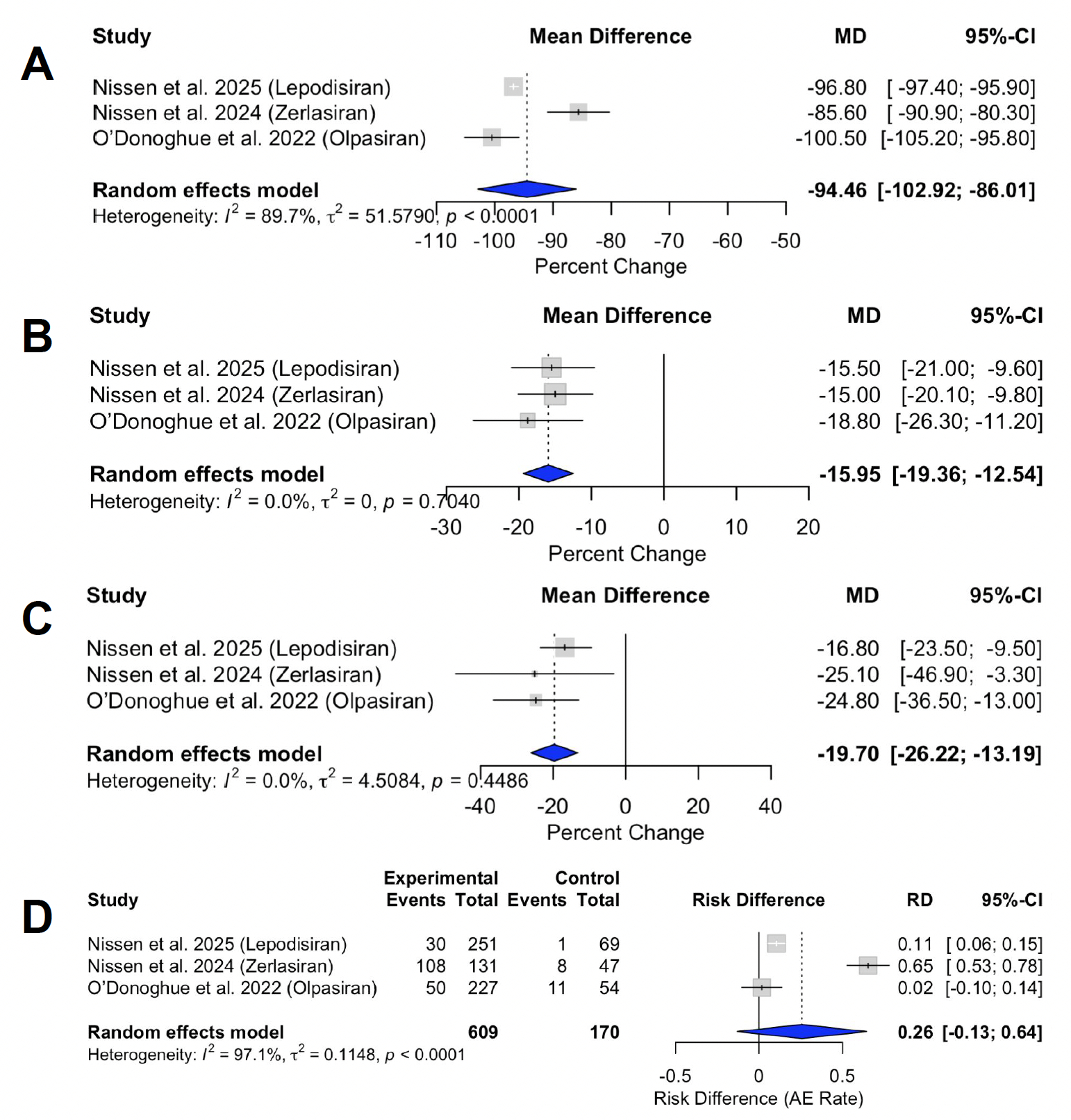
A systematic search of MEDLINE and EMBASE was conducted through June 2025 to identify trials evaluating siRNA therapies that directly silence LPA mRNA. Outcomes of interest included percent changes in Lp(a), apolipoprotein B (ApoB), and low-density lipoprotein cholesterol (LDL-C), along with adverse event rates compared to placebo. To ensure cross-trial consistency, efficacy endpoints were extracted from assessments conducted between weeks 34 and 36, using data from the highest siRNA dose per study. Forest plots display mean differences with corresponding 95% confidence intervals (CI). Heterogeneity was quantified using the I2 statistic, and adverse events were summarized as absolute risk differences due to low event rates in control groups.

Results: Three phase 2 trials met the inclusion criteria. siRNA therapy achieved a significant pooled mean reduction in Lp(a) of −94.46% [95% CI −102.92 to −86.01], with substantial heterogeneity (I2 = 89.7%). siRNA therapies decreased ApoB by −15.95% [95% CI −19.36 to −12.54] and LDL-C by −19.70% [95% CI −26.22 to −13.19], both without significant heterogeneity (I2 = 0%). Adverse events occurred more frequently in the siRNA group, with a pooled absolute risk difference of 26.0% [95% CI −13.0 to 64.0] compared to placebo; however, this finding demonstrated high heterogeneity (I2 = 97.1%), and the confidence interval crossed the null.

Conclusions:
siRNA therapeutics targeting LPA mRNA demonstrate substantial efficacy, lowering Lp(a) levels by over 90% with concurrent reductions in ApoB and LDL-C. Ongoing phase 3 trials will be pivotal in further characterizing their safety profile and determining the extent to which these promising lipid changes translate into cardiovascular risk reduction.
  • Shokravi, Arveen  ( University Of Calgary , Calgary , Alberta , Canada )
  • Singh, Rishav  ( University of British Columbia , Vancouver , British Columbia , Canada )
  • Sharma, Sohat  ( University of British Columbia , Vancouver , British Columbia , Canada )
  • Taleghani, Masoud  ( Independent Physician , Seattle , Washington , United States )
  • Author Disclosures:
    Arveen Shokravi: DO NOT have relevant financial relationships | Rishav Singh: No Answer | Sohat Sharma: No Answer | Masoud Taleghani: No Answer
Meeting Info:

Scientific Sessions 2025

2025

New Orleans, Louisiana

Session Info:

Lipid Management in the 21st Century: Progress and Promise in the Second Quarter

Sunday, 11/09/2025 , 03:15PM - 04:15PM

Abstract Poster Board Session

More abstracts on this topic:
Adverse Outcomes with Cardiac Contractility Modulation: Insights From the MAUDE Registry

Katapadi Aashish, Chelikam Nikhila, Katapadi Aashika, Darden Douglas, Gopinathannair Rakesh, Kabra Rajesh, Atkins Donita, Lakkireddy Dhanunjaya, Pothineni Naga Venkata

APOH plays a distinct role in lipid trait dysregulation and increased CVD risk

Fisher Giselle, Rader Daniel, Huang Helen, Zhang David, Rodrigues Amrith, Blackwell Autumn, Naseer Nawar, Levin Michael, Conlon Donna, Schneider Carolin

You have to be authorized to contact abstract author. Please, Login
Not Available