
Logo

American Heart Association

  21
  0


Final ID: MP1865

Proof-of-Concept Viral Transduction in Human Living Myocardial Slices: Advancing Human Pre-Clinical Models for Cardiac Gene Therapy

Abstract Body (Do not enter title and authors here): Background
Cardiac gene therapy holds the potential to transform the treatment of inherited and acquired cardiovascular diseases by correcting the causative basis of disease. However, despite extensive research, progress has been hindered, primarily due to the limited translation of pre-clinical models to human clinical settings. More advanced, human-based pre-clinical platforms are urgently needed to bridge the gap from bench to bedside. Human living myocardial slices (LMS), are 3D tissue sections with native multicellularity, structure and function, providing a promising platform to address these challenges.
Aims
Our study aimed to develop a platform for viral transduction of cardiomyocytes in human LMS, to advance pre-clinical gene therapy research and accelerate cardiac nucleic acid drug development.
Methods
LMS prepared from failing and non-failing donor hearts were cultured at physiological preload in a specialized biomimetic culture chamber with continuous force monitoring. After 2-4 days in culture, adenovirus carrying a fluorescent probe (GFP or mCherry) with either a ubiquitous or a cardiac-specific promoter was applied directly to the LMS surface at varying multiplicities of infection (MOIs). Slice contractility was monitored throughout culture to assess virus and transgene effects on function. At culture endpoint (5-10 days post transduction), slices were characterized using isometric Frank-Starling experiments in a custom bioreactor, fixed and probed for protein expression with antibodies, visualized via confocal microscopy, and lysed for transgene protein expression analysis via western blotting.
Results
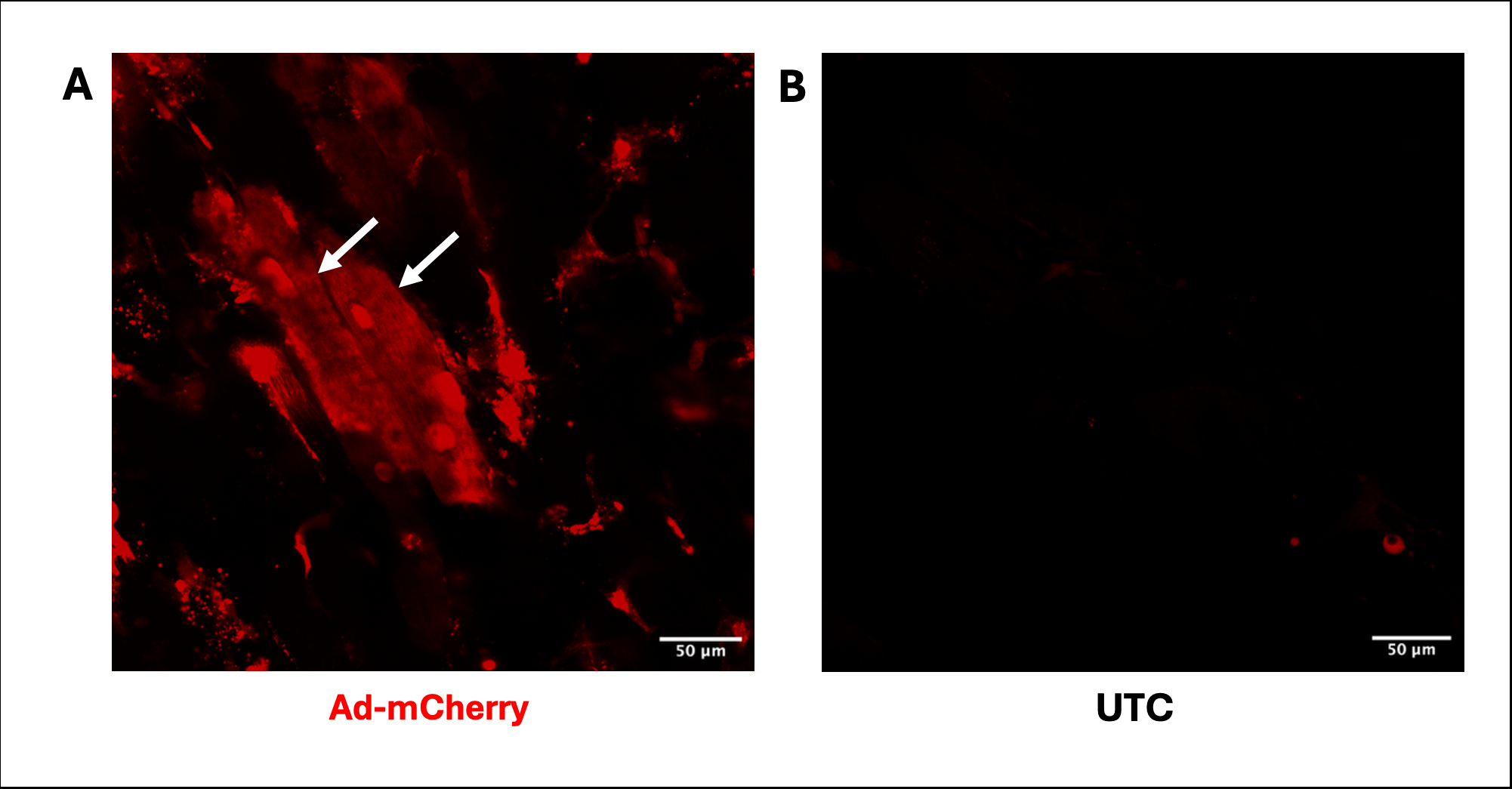
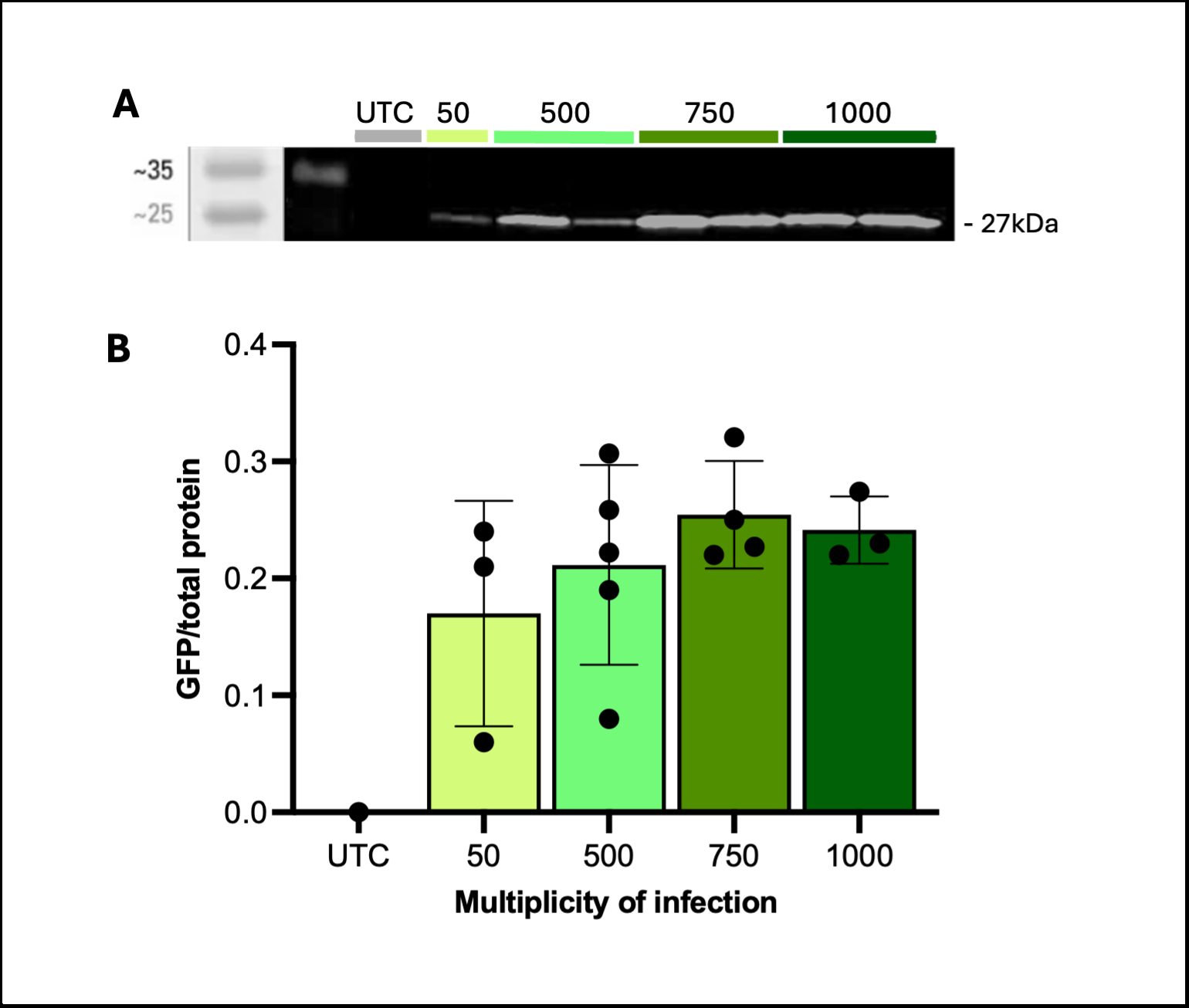
We demonstrate reproducible adenoviral transduction of GFP and mCherry in both cardiomyocytes and non-cardiomyocytes without compromising contractile function. An MOI-dependent increase in transduction and protein expression was observed, confirmed through confocal imaging (Figure 1) and western blot analysis (Figure 2).
Conclusion
This proof-of-concept study establishes feasibility of viral transduction of human LMS from explanted hearts, opening new avenues for translational heart research in the gene therapy space. Our expertise in LMS methodology positions us to develop this platform as a novel pre-clinical tool for genetic therapies, with future studies focusing on transducing failing human hearts with cardiac recovery-associated proteins.
  • Pamias Lopez, Blanca  ( University of Pennsylvania , Philadelphia , Pennsylvania , United States )
  • Pitoulis, Fotios  ( University of Pennsylvania , Philadelphia , Pennsylvania , United States )
  • Bedi, Kenneth  ( University of Pennsylvania , Philadelphia , Pennsylvania , United States )
  • Cheng, Lan  ( University of Pennsylvania , Philadelphia , Pennsylvania , United States )
  • Prosser, Benjamin  ( University of Pennsylvania , Philadelphia , Pennsylvania , United States )
  • Margulies, Kenneth  ( University of Pennsylvania , Philadelphia , Pennsylvania , United States )
  • Ibrahim, Michael  ( University of Pennsylvania , Philadelphia , Pennsylvania , United States )
  • Author Disclosures:
    Blanca Pamias Lopez: DO NOT have relevant financial relationships | Fotios Pitoulis: No Answer | Kenneth Bedi: No Answer | Lan Cheng: No Answer | Benjamin Prosser: DO have relevant financial relationships ; Consultant:Bayer:Active (exists now) ; Research Funding (PI or named investigator):MT-Act:Active (exists now) | Kenneth Margulies: DO have relevant financial relationships ; Researcher:Amgen:Active (exists now) ; Researcher:Bristol Myers Squibb:Active (exists now) | Michael Ibrahim: No Answer
Meeting Info:

Scientific Sessions 2025

2025

New Orleans, Louisiana

Session Info:

Novel Mechanistic and Therapeutic Insights Into Heart Failure

Sunday, 11/09/2025 , 11:50AM - 12:50PM

Moderated Digital Poster Session

More abstracts on this topic:
A Single-Dose of a Novel CasX-Editor Lowers APOC3 Levels In Vivo

Karanth Santhosh, Ripley-phipps Sterling, Miller Katherine, Su Ali, Mrak Anna, Karmarkar Maitreyee, Eggers Michelle, Bardai Farah, Narsineni Lokesh, Li Yuexuan, Langner Heera, Bucher Simon, Szulwach Keith, Goh Natalie, Mok Amanda, Reimer Kirsten, Oakes Benjamin, Khakoo Aarif, Mirotsou Maria, Smekalova Elena, Saraya Jennifer, Stein Shannon, Sato Anna, Bale Shyamsundhar, Krupa Oleh, Mauriello Anthony

Defining the Functional Landscape of the Low-Density Lipoprotein Receptor Locus.

Vyas Hitarthi, Emmer Brian

More abstracts from these authors:
One Carbon Metabolism Defect In Human Failing Hearts

Jung Jae Woo, Flam Emily, Bedi Kenneth, Jang Cholsoon, Rabinowitz Joshua, Margulies Kenneth, Arany Zoltan

Directing Cardiac Growth through Local Control of Translation

Prosser Benjamin

You have to be authorized to contact abstract author. Please, Login
Not Available