
Logo

American Heart Association

  125
  0


Final ID: MDP953

Cell-free DNA Analysis Profiles End-Organ Injury and Predicts Outcomes with Left Ventricular Assist Device Implantation

Abstract Body (Do not enter title and authors here): Introduction
Durable left ventricular assist devices (LVADs) improve survival in heart failure but carry high risks of infection, hemocompatibility-related adverse events (HRAE), and death. Current clinical tools use subjective assessments or do not incorporate changes in end-organ injury, limiting their prognostic value with these complications. Plasma cell-free DNA (cfDNA), a potential marker for systemic and tissue-specific injury, holds promise to enhance patient risk stratification and prognosis.
Hypothesis
LVAD implantation decreases systemic and end-organ injury, measured by cfDNA.
Goal
We aimed to assess changes in global and organ-specific injury patterns with LVAD implantation via cfDNA, and to determine if pre-LVAD cfDNA levels predict post-LVAD complications.
Methods
We prospectively recruited 40 LVAD candidates and 40 healthy controls. Pre- and post-LVAD plasma samples were analyzed for nuclear cfDNA (ncfDNA) and mitochondrial cfDNA (mtcfDNA) using digital droplet PCR. Tissue-specific cfDNA levels were measured using bisulfite sequencing and a deconvolution algorithm with a DNA methylation library. Wilcoxon sign-rank tests were used to compare cfDNA levels, and log-rank tests were used to compare outcomes. The clinical outcomes were HRAE-free survival (major bleeding, stroke, device thrombosis, death), and post-LVAD infection. Random forest machine learning analysis ranked tissue-specific cfDNA to identify the tissue patterns of those who develop HRAE and those who develop infection.
Results
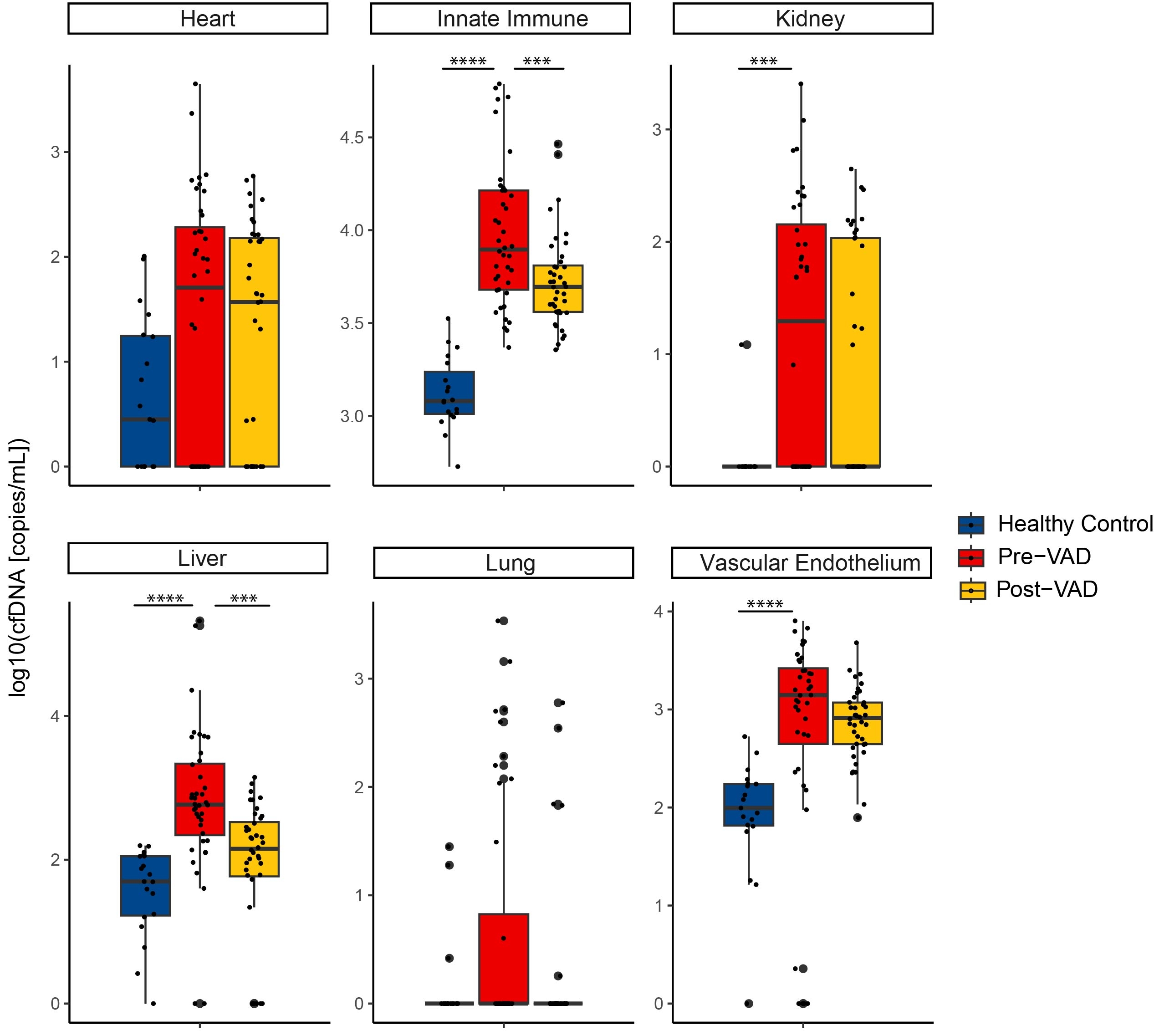
Prior to LVAD implantation, patients had 4-fold higher ncfDNA and 2-fold higher mtcfDNA compared to healthy controls. After LVAD placement, ncfDNA (18980 vs. 10228 copies/mL, p < .001) and mtcfDNA levels (1051882 vs 579609 copies/mL, p < .001) nearly halved, with significant reductions in innate immune and liver cfDNA (Figure). High pre-LVAD ncfDNA levels were associated with worse HRAE-free survival (p = .035) and infection (p < .001). Tissue sources important in determining HRAEs were distinct from those related to infections.
Conclusion
LVAD placement significantly improves systemic and tissue-specific injury, measured by reductions in cfDNA. While pre-LVAD cfDNA levels predict both post-LVAD HRAEs and infections, the cfDNA tissue contributions influencing these outcomes are distinct. Future studies will need to validate these findings and compare cfDNA to other predictors of poor LVAD outcomes.
  • Park, Ashley  ( National Institutes of Health , Washington , District of Columbia , United States )
  • Rodrigo, Maria  ( Medstar Washington Hospital Center , Washington , District of Columbia , United States )
  • Shah, Keyur  ( VIRGINIA COMMONWEALTH UNIVERSITY , Richmond , Virginia , United States )
  • Valantine, Hannah  ( Stanford Sch of Med , Portola Valley , California , United States )
  • Shah, Palak  ( Inova Schar Heart and Vascular , Falls Church , Virginia , United States )
  • Agbor-enoh, Sean  ( National Heart, Lung, and Blood Ins , Bethesda , Maryland , United States )
  • Andargie, Temesgen  ( National Heart, Lung, and Blood Ins , Bethesda , Maryland , United States )
  • Hill, Tom  ( NIH , Bethesda , Maryland , United States )
  • Redekar, Neelam  ( NIH , Bethesda , Maryland , United States )
  • Tian, Xin  ( NIH , Bethesda , Maryland , United States )
  • Park, Woojin  ( NHLBI , Rockville , Maryland , United States )
  • Kong, Hyesik  ( National Heart, Lung, and Blood Ins , Bethesda , Maryland , United States )
  • Cavagna, Isabella  ( Inova Schar Heart and Vascular , Arlington , Virginia , United States )
  • Jang, Moon  ( NIH , Bethesda , Maryland , United States )
  • Author Disclosures:
    Ashley Park: DO NOT have relevant financial relationships | Maria Rodrigo: No Answer | Keyur Shah: DO have relevant financial relationships ; Consultant:BridgeBio:Active (exists now) ; Consultant:Pfizer :Past (completed) ; Research Funding (PI or named investigator):BridgeBio:Active (exists now) ; Research Funding (PI or named investigator):AstraZeneca :Active (exists now) | Hannah Valantine: No Answer | Palak Shah: DO have relevant financial relationships ; Consultant:JVP Labs:Active (exists now) ; Royalties/Patent Beneficiary:Inova Health System / Natera:Active (exists now) ; Research Funding (PI or named investigator):Abbott:Past (completed) ; Ownership Interest:Procyrion:Active (exists now) ; Consultant:Tosoh Biosciences:Active (exists now) ; Consultant:Ortho Clinical Diagnostics:Active (exists now) ; Consultant:Merck:Active (exists now) ; Consultant:Natera:Active (exists now) | Sean Agbor-Enoh: DO NOT have relevant financial relationships | Temesgen Andargie: DO NOT have relevant financial relationships | Tom Hill: No Answer | Neelam Redekar: No Answer | Xin Tian: DO NOT have relevant financial relationships | Woojin Park: No Answer | Hyesik Kong: DO NOT have relevant financial relationships | Isabella Cavagna: DO NOT have relevant financial relationships | Moon Jang: No Answer
Meeting Info:

Scientific Sessions 2024

2024

Chicago, Illinois

Session Info:

Updates in Mechanical Circulatory Support

Sunday, 11/17/2024 , 11:10AM - 12:35PM

Moderated Digital Poster Session

More abstracts on this topic:
Acute Stroke Characteristics, Treatment and Outcomes in Children on Mechanical Circulatory Support

Cheronis Chrisoula, Jackson Karla, Mayne Elizabeth, Teeyagura Prathyusha, Lee Sarah

ACS-Specific Gut Microbial and Metabolic Profiles Reveal Diagnostic and Recovery Markers

Xu Jing, Fu Jingyuan, Dai Die, Yang Yanan, Yang Jingang, Gao Shanshan, Wu Chongming, He Jiumin, Chen Weihua, Yang Yue-jin

More abstracts from these authors:
Admission Cell-free DNA Predicts Cardiogenic Shock Progression and In-Hospital Mortality

Park Ashley, Kong Hyesik, Andargie Temesgen, Jang Moon, Solomon Michael, Brusca Samuel, Barnett Christopher, Obrien Connor, Agbor-enoh Sean

Donor-Derived Cell-Free DNA Stratifies Risk of Mortality and Graft Dysfunction in Severe Acute Cardiac Allograft Rejection

Safiullah Zaid, Su Han, Kong Hyesik, Jang Moon, Shah Palak, Berry Gerald, Valantine Hannah, Tian Xin, Agbor-enoh Sean

You have to be authorized to contact abstract author. Please, Login
Not Available