Post-Impella Creatinine as a Predictor of Length of Stay Outcomes in Patients Undergoing Heart Transplant After Impella 5.5 Support
Abstract Body (Do not enter title and authors here): Background: Renal dysfunction is a known prognostic factor in advanced heart failure and among patients receiving temporary mechanical circulatory support (tMCS). However, the predictive value of post-Impella creatinine in determining healthcare resource utilization in patients bridged to transplant with Impella 5.5 remains unclear. This study aimed to evaluate the association between post-Impella creatinine and key hospitalization metrics in this population.
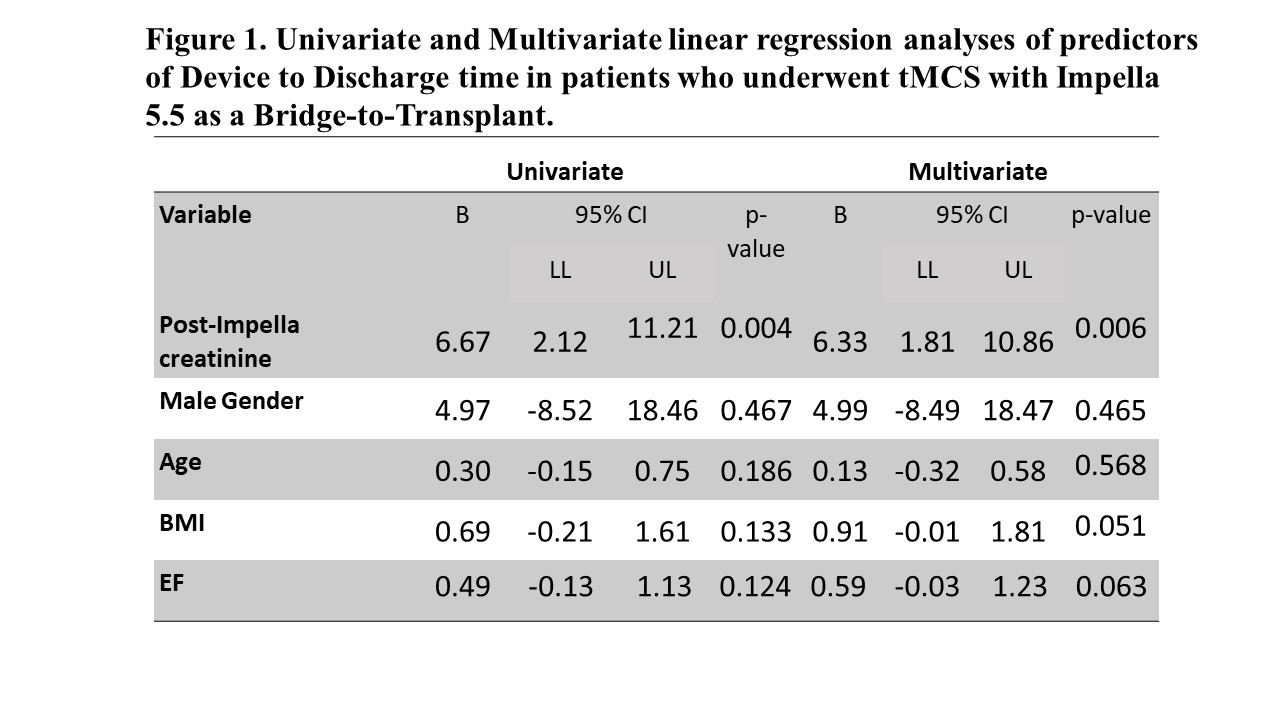
Methods: We performed a retrospective cohort study of patients who received Impella 5.5 as a bridge-to-transplant between January 2020 and January 2025. Serum creatinine was collected 72 hours after Impella placement. The primary outcome was device-to-discharge time. Secondary outcomes included transplant-to-discharge time, post-transplant ICU length of stay (LOS), and total LOS (admission-discharge). Univariate and multivariable linear regressions were used to examine the association between post-Impella creatinine and each outcome, adjusting for age, gender, BMI, and LVEF.
Results: 133 patients were supported with the Impella 5.5 as BTT and were included (median age 58 years (51–65), 82.7% were male, and 71.4% presented with non-ischemic cardiomyopathy. The median BMI was 27.7 (24.3–32.3), LVEF 17% (15–22), and post-Impella creatinine 1.32 mg/dL (0.96–1.71). The median device-to-discharge time was 45 days (29-64), transplant-to-discharge time was 14 days (12–19), ICU LOS post-transplant was 6 days (4–8), and total LOS was 58 days (42–76). Higher post-Impella creatinine was significantly associated with longer device-to-discharge time (β = 6.67, p = 0.004), longer transplant-to-discharge duration (β = 3.42 p = 0.003), longer ICU LOS (β = 2.19, p = 0.007), and longer total LOS (β = 7.24, p = 0.002) on univariate analysis. Post-impella creatinine remained significantly associated with device-to-discharge time in the multivariate model after adjusting for confounders (β = 6.33, p = 0.006). Importantly, this suggests that patients with lower post-Impella creatinine levels may experience shorter hospitalizations and faster recovery trajectories following transplant.
Conclusions: Post-Impella creatinine is a significant predictor of prolonged hospitalization in patients supported with Impella 5.5 as a bridge to transplant. These findings emphasize the prognostic importance of early renal function assessment and may guide risk stratification and resource planning in advanced heart failure care.
Mautong, Hans
(
John H. Stroger Jr. Hospital
, Chicago , Illinois , United States )
Desai, Aarti
(
Mayo Clinic
, Jacksonville , Florida , United States )
Alak, çetin
(
Mayo Clinic
, Jacksonville , Florida , United States )
Wlodkowski, Peter
(
Mayo Clinic
, Jacksonville , Florida , United States )
Ruiz, Jose
(
Mayo Clinic
, Jacksonville , Florida , United States )
Leoni, Juan
(
Mayo Clinic
, Jacksonville , Florida , United States )
Nativi-nicolau, Jose
(
Mayo Clinic
, Jacksonville , Florida , United States )
Patel, Parag
(
Mayo Clinic
, Jacksonville , Florida , United States )
Shapiro, Anna
(
Mayo Clinic
, Jacksonville , Florida , United States )
Chaudhary, Sanjay
(
Mayo Clinic
, Jacksonville , Florida , United States )
Goswami, Rohan
(
Mayo Clinic
, Jacksonville , Florida , United States )
Author Disclosures:
Hans Mautong:DO NOT have relevant financial relationships
| Sanjay Chaudhary:DO NOT have relevant financial relationships
| Rohan Goswami:No Answer
| Aarti Desai:DO NOT have relevant financial relationships
| çetin alak:DO NOT have relevant financial relationships
| Peter Wlodkowski:DO NOT have relevant financial relationships
| Jose Ruiz:DO NOT have relevant financial relationships
| Juan Leoni:DO NOT have relevant financial relationships
| Jose Nativi-Nicolau:DO have relevant financial relationships
;
Research Funding (PI or named investigator):Alnylam:Active (exists now)
; Research Funding (PI or named investigator):Natera:Active (exists now)
; Research Funding (PI or named investigator):Alexion:Active (exists now)
| Parag Patel:DO NOT have relevant financial relationships
| Anna Shapiro:No Answer