Rising Toll: Alarming Trends in Ischemic Heart Disease Mortality and DALYs Across South Asia (1990–2021)
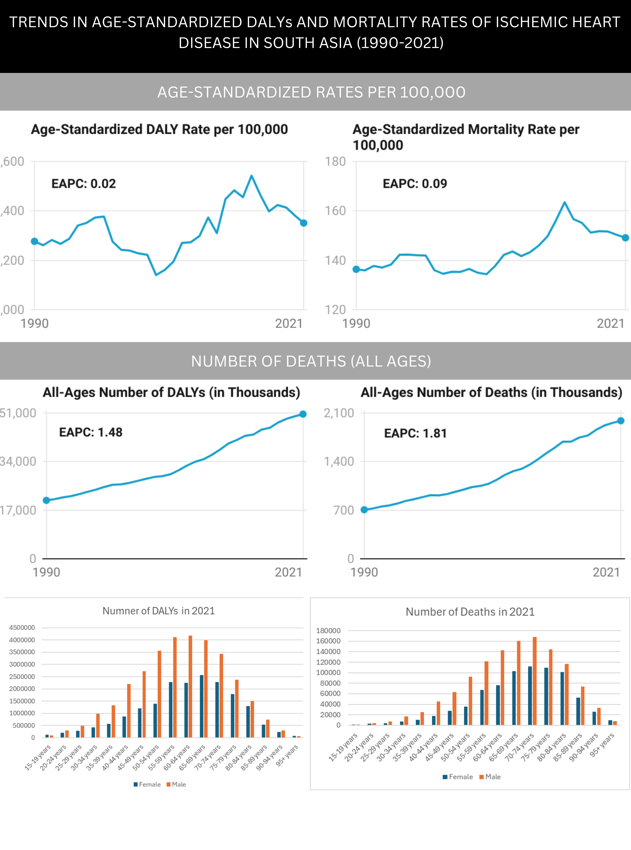
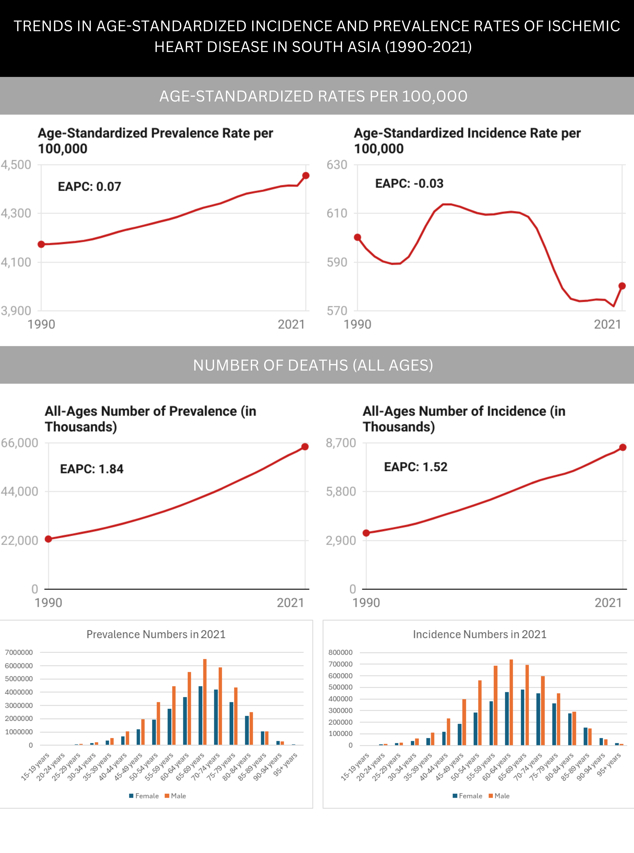
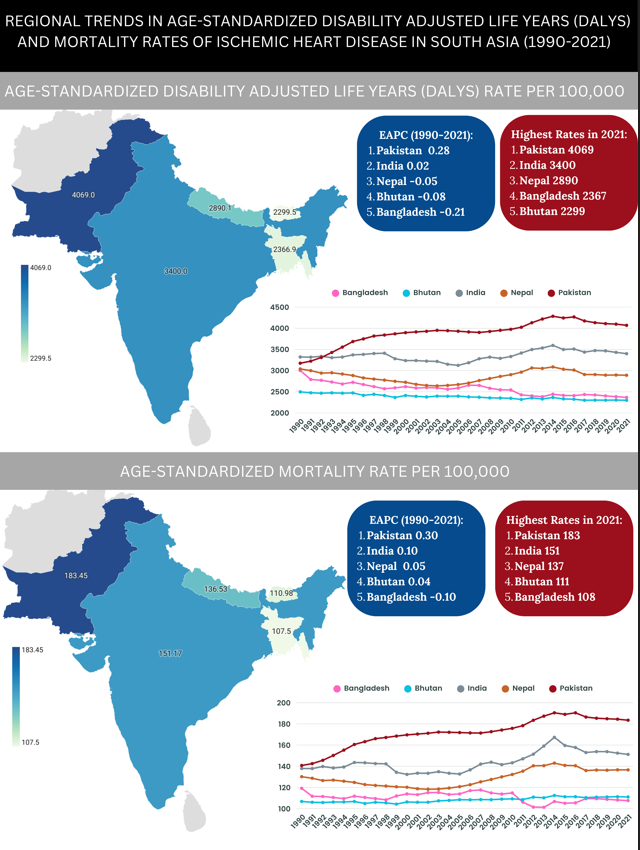
Abstract Body (Do not enter title and authors here): Introduction: Cardiovascular diseases (CVD) are the leading global cause of death, with 58% of related deaths occurring in Asia. Notably, over 80% of cardiovascular deaths are attributable to ischemic heart disease (IHD) or stroke. South Asians, comprising 25% of the world’s population, face a disproportionately high burden of premature CVD. Despite this, the true impact of IHD in this high-risk group is likely underestimated, highlighting the need for further research to better understand its evolving burden. Objective: We aim to investigate trends in ischemic heart disease (IHD) mortality and disability-adjusted life years (DALYs) across age groups, sexes, and regions in South Asia from 1990 to 2021, to provide a more accurate understanding of its impact in this high-risk population. Methods: Data on the burden of IHD in South Asia including age-standardized mortality rates (ASMRs), disability-adjusted life years (DALYs), stratified by age group, sex, and country patterns were collected from the Global Burden of Disease from 1990 to 2019. Temporal trends were assessed using estimated annual percentage change (EAPC) to quantify changes over time. Results: Between 1990 and 2021, South Asia saw a slight increase in the age-standardized DALY rate (ASDR) for IHD, from 3276.8 to 3351.1 per 100,000 (EAPC: 0.02), and a rise in age-standardized mortality rate (ASMR) from 136.4 to 149.1 (EAPC: 0.22), with peaks in 2014. Males consistently had higher ASDRs and ASMRs than females, with the male ASDR rising from 3854.3 to 4325.6 (EAPC: 0.12), while female rates declined (EAPC: -0.08). The highest DALY and mortality burden was seen in the 75+ age group, with ASDR of 22,261 and ASMR of 1690.5 in 2021. Regionally, Pakistan reported the highest ASDR (4069) and ASMR (183.5) with the steepest rise (EAPCs: 0.28 and 0.30), while Bangladesh had the lowest rates and a declining trend Conclusion: The burden of IHD in South Asia remains substantial, with overall increases in both DALY and mortality rates from 1990 to 2021, particularly among older adults and males. Pakistan showed the highest burden and the fastest rise, while Bangladesh showed a declining trend. Marked disparities across regions, sexes, and age groups highlight the need for targeted strategies. These findings call for urgent, region-specific public health interventions and efficient resource allocation to mitigate the escalating impact of IHD in South Asia.
Yadav, Ritu
(
Midwestern University GME
, Cottonwood , Arizona , United States )
Mirza, Tehmasp
(
Shalamar Medical and Dental College
, Lahore , Pakistan )
Karmani, Vikash Kumar
(
Jinnah Sindh Medical University
, Karachi , Pakistan )
Abdullah, Muhammad
(
Shalamar Medical College, Lahore
, Lahore , Pakistan )
Mir, Junaid
(
university of missouri columbia
, Columbia , Missouri , United States )
Hiriyur Prakash, Meghanaprakash
(
University at Arizona Phoenix
, Phoenix , Arizona , United States )
Uppal, Dipan
(
Cleveland Clinic Florida
, Weston , Florida , United States )
Sawant, Abhishek
(
University at Arizona Phoenix
, Phoenix , Arizona , United States )
Savant, Sia
(
University at Arizona Phoenix
, Phoenix , Arizona , United States )
Author Disclosures:
Ritu Yadav:DO NOT have relevant financial relationships
| Tehmasp Mirza:DO NOT have relevant financial relationships
| Vikash Kumar Karmani:DO NOT have relevant financial relationships
| Muhammad Abdullah:DO NOT have relevant financial relationships
| Junaid Mir:DO NOT have relevant financial relationships
| Meghanaprakash Hiriyur Prakash:DO NOT have relevant financial relationships
| Dipan Uppal:DO NOT have relevant financial relationships
| Abhishek Sawant:DO NOT have relevant financial relationships
| Sia Savant:DO NOT have relevant financial relationships