Peripheral Artery Disease Outcomes in GLP-1RA Trials: Meta-Regression of SBP, HbA1c, and Weight.
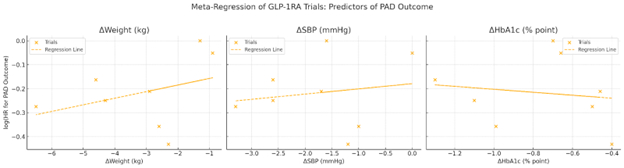
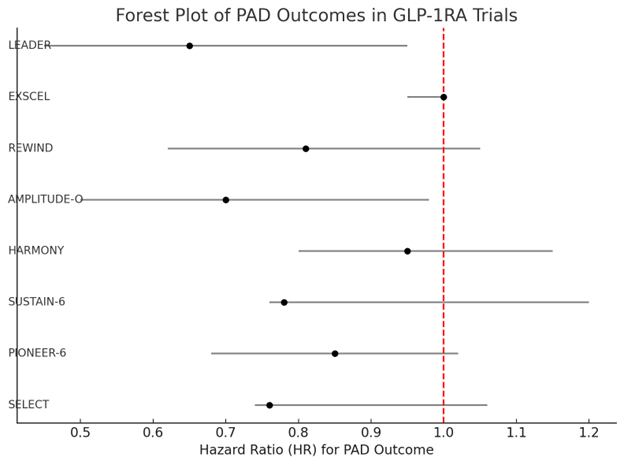
Abstract Body (Do not enter title and authors here): Introduction/Background: Peripheral artery disease (PAD) affects over 113 million people globally and is a major cause of limb loss, particularly diabetic patients. GLP-1 receptor agonists (GLP-1RAs) have shown to improve glycemic control, reduce weight, modestly lower blood pressure, and reduce major adverse cardiovascular events. Emerging evidence suggests a possible reduction in PAD-related events with GLP-1RA therapy, but the mechanisms remain unclear. Research Question/Hypothesis: We evaluate whether trial-level reductions in systolic blood pressure (ΔSBP), HbA1c (ΔHbA1c), or body weight (ΔWeight) predict improvements in PAD outcomes across GLP-1RA cardiovascular outcome trials. Methods/Approach: A PRISMA-based systematic search identified 8 randomized placebo-controlled GLP-1RA trials reporting PAD outcomes (major amputation, critical limb ischemia, or revascularization). For each trial, we extracted placebo-adjusted changes in SBP (mmHg), HbA1c (%), and body weight (kg), along with hazard ratios (HRs) for PAD events. We performed both univariable and multivariable inverse-variance–weighted meta-regressions using log(HR) as the dependent variable. A leave-one-out sensitivity analysis was used to increase robustness. Results/Data: Across 8 trials (N ≈ 60,000), mean changes were, ΔWeight –0.9 to –6.5 kg, ΔSBP 0 to –4 mmHg, and ΔHbA1c –0.2% to –1.3%. PAD event hazard ratios ranged from 0.65 to 1.00. In univariable meta-regression, no predictors were statistically significant (ΔWeight: β = 0.028, p = 0.39; ΔSBP: β = 0.022, p = 0.71; ΔHbA1c: β = –0.062, p = 0.74). In the multivariable model, ΔWeight showed the strongest trend toward PAD benefit (β = 0.036, p = 0.26; R2= 0.47). Leave-one-out analysis identified HARMONY trial as a source of heterogeneity; excluding it improved model fit (R2= 0.77) and strengthened the weight-PAD association (p = 0.058). Conclusion(s): In this meta-regression of GLP-1RA trials,only reduction in weight, not HbA1c or systolic blood pressure, was the most consistent predictor of improved PAD outcomes. Although statistical significance was not reached, sensitivity analyses suggest weight loss may mediate PAD benefits, particularly when accounting for heterogeneity across trials. These results support further exploration of GLP-1RA mediated metabolic mechanisms in PAD and underscore the need to incorporate PAD specific endpoints in future trials.
Marlecha, Pranay
(
Kempegowda Institute of Medical Sciences
, Bengaluru , Karnataka , India )
Sahu, Sweta
(
J.J.M. Medical College
, Davangere , India )
Nanjundappa, Aravinda
(
Cleveland Clinic
, Cleveland , Ohio , United States )
Author Disclosures:
Pranay Marlecha:DO NOT have relevant financial relationships
| Sweta Sahu:DO NOT have relevant financial relationships
| aravinda Nanjundappa:No Answer
Jiang Chao, Dong Jianzeng, Cai Jun, Anderson Craig, Du Xin, Tang Yangyang, Han Rong, Song Yanna, Wang Chi, Lin Xiaolei, Yi Yang, Rodgers Anthony, Ma Changsheng