The Long Pause: What Gaps in Care Reveal about Congenital Heart Disease Outcomes
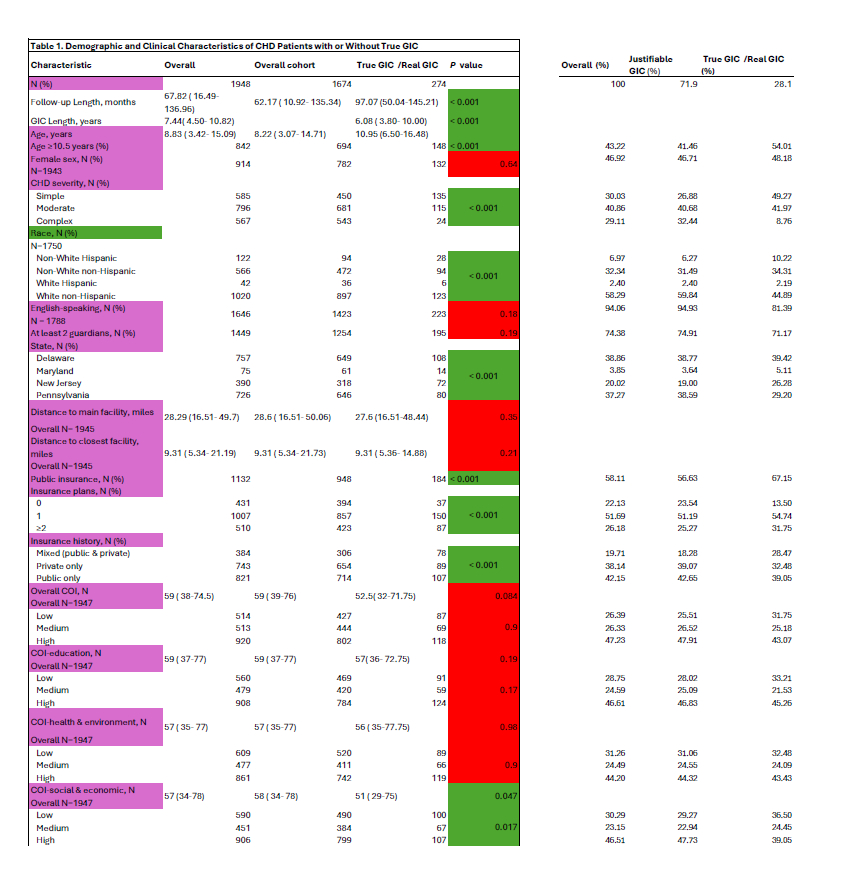
Abstract Body (Do not enter title and authors here): Introduction/Background: Lifelong continuity of care is essential for individuals with congenital heart disease (CHD). Despite guidelines recommending uninterrupted follow-up, gaps in care (GIC) remain common. These lapses are associated with increased morbidity, emergent interventions, prolonged hospital stays, and increased morbidity and mortality. Research Questions/Hypothesis: We aimed to better understand those with CHD, who have experienced significant GIC, what prompted their gaps, subsequent return to care, and clinical status upon return. Methods/Approach: In this retrospective cohort study, we analyzed 1,948 CHD patients aged 0–34 years who underwent surgery at a multi-state pediatric subspecialty center from 2003-2020. A GIC was defined as a >3-year lapse between cardiology visits. Patients were categorized as GIC (n=274) or without GIC (n=1674). Manual chart review was conducted of the GIC cohort to verify the GIC, causes for GIC such as documentation of SDOH factors, insurance or social concerns, as well as documentation of what prompted their return to care such as symptoms, needing cardiac clearance for a non-cardiac procedure, and incidence of urgent cardiac intervention after returning to care. Results/Data: Of the 274 CHD patients confirmed to have experienced a GIC, 7% (n=19) were symptomatic at the time of return. Four patients returned to care after needing cardiac clearance for a non-cardiac procedure. Insurance issues were cited as the primary cause of GIC in 5% (n=14), while five patients noted social stressors such as custody disputes or housing instability. Urgent cardiac interventions were required in 5% (n=15), including those with simple (n=5), moderate (n=9), and complex (n=1) CHD. Of those needing intervention 27% (n=4) experienced significant morbidity or mortality. The vast majority of those returning to care were asymptomatic. Conclusion: This study highlights the significant clinical impact that GIC can have across all CHD complexity levels. While this study did not explore root causes in depth, there was a striking lack of documentation around why GIC occur which prevents opportunities for systems wide improvement. Most patients return without symptoms, suggesting silent progression and missed opportunities for earlier intervention. Better understanding and documentation of GIC is essential for improving outcomes and designing effective retention strategies.
Zaidi, Abbas
(
Nemours Childrens Health
, Wilmington , Delaware , United States )
Alberts, Adam
(
Nemours Children's Health
, Wilmington , Delaware , United States )
Gumpili, Sai
(
Nemours Children's Health
, Wilmington , Delaware , United States )
Mcdonald, Mark
(
Nemours Children's Health
, Wilmington , Delaware , United States )
Rehmeyer, Nathanael
(
Nemours Children's Health
, Wilmington , Delaware , United States )
De Ferranti, Sarah
(
Boston Children's Hospital
, Boston , Massachusetts , United States )
Author Disclosures:
Abbas Zaidi:DO NOT have relevant financial relationships
| Adam Alberts:DO NOT have relevant financial relationships
| Sai Gumpili:No Answer
| Mark McDonald:DO NOT have relevant financial relationships
| Nathanael Rehmeyer:DO NOT have relevant financial relationships
| Sarah de Ferranti:DO NOT have relevant financial relationships