Long-Term Outcomes of Mechanical Versus Bioprosthetic Surgical Aortic Valve Replacement in Adults ≤55 Years: A Multicenter Analysis
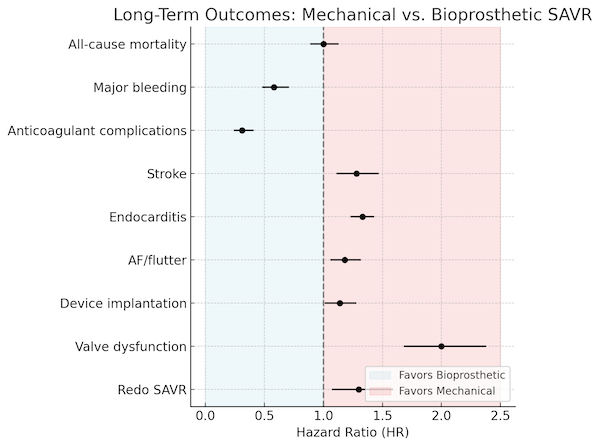
Abstract Body (Do not enter title and authors here): Background: Surgical aortic valve replacement (SAVR) in younger patients (<55 years) poses a clinical dilemma between mechanical and bioprosthetic valves. Long-term outcome comparisons remain limited in this age group. Methods: We analyzed a multicenter database of adults ≤55 who underwent SAVR with either a bioprosthetic or mechanical valve (n=6,306 in each group), excluding those with prior endocarditis. Propensity score matching balanced demographics and comorbidities. We examined 15-year outcomes including all-cause mortality, stroke, major bleeding, valve dysfunction, endocarditis, anticoagulant complications, new-onset atrial fibrillation/flutter, device implantation, and redo-intervention. Results: The mean age was 42.2 ± 14.0 years (bioprosthetic) and 42.1 ± 11.9 years (mechanical), and 30.6% vs. 31.3% were female (p=0.375), respectively. Long-term all-cause mortality was similar between groups (8.1% bioprosthetic vs. 8.3% mechanical; HR 1.00, 95% CI 0.89–1.13; p=0.73). Compared with mechanical valves, bioprosthetic valves were associated with lower risks of major bleeding (2.8% vs. 4.8%; HR 0.57, 95% CI 0.47–0.69; p<0.001) and anticoagulant complications (1.1% vs. 3.5%; HR 0.31, 95% CI 0.24–0.41; p<0.001). However, bioprosthetic valves had higher rates of valve dysfunction (6.1% vs. 3.3%; HR 2.00, 95% CI 1.70–2.35; p<0.001) and redo-SAVR (3.5% vs. 2.7%; HR 1.32, 95% CI 1.07–1.62; p=0.008). Bioprosthetic valves were also associated with lower risks of stroke (6.0% vs. 7.7%; HR 0.78, 95% CI 0.68–0.90; p<0.001), endocarditis (20.3% vs. 25.5%; HR 0.75, 95% CI 0.70–0.81; p<0.001), new-onset atrial fibrillation/flutter (11.4% vs. 13.5%; HR 0.85, 95% CI 0.76–0.94; p=0.002), and device implantation (7.4% vs. 8.5%; HR 0.88, 95% CI 0.78–0.99; p=0.035). Conclusion: In patients ≤55 undergoing SAVR, mortality was similar across valve types. Bioprosthetic valves were linked to fewer bleeding and anticoagulation-related complications, while mechanical valves carried higher risks of stroke, endocarditis, atrial fibrillation, and device implantation. These findings highlight the importance of individualized valve selection in younger adults.
Motairek, Issam
(
Cleveland Clinic
, Cleveland , Ohio , United States )
Wazni, Oussama
(
Cleveland Clinic Foundation
, Cleveland , Ohio , United States )
Jellis, Christine
(
Cleveland Clinic
, Cleveland Heights , Ohio , United States )
Vargo, Patrick
(
Cleveland Clinic
, Cleveland , Ohio , United States )
Menon, Venu
(
CLEVELAND CLINIC
, Cleveland , Ohio , United States )
Kapadia, Samir
(
CLEVELAND CLINIC
, Cleveland , Ohio , United States )
Jaber, Wael
(
CLEVELAND CLINIC FOUNDATION
, Cleveland , Ohio , United States )
Author Disclosures:
Issam Motairek:DO NOT have relevant financial relationships
| Oussama Wazni:DO NOT have relevant financial relationships
| Christine Jellis:DO have relevant financial relationships
;
Consultant:Kiniksa:Past (completed)
| Patrick Vargo:DO have relevant financial relationships
;
Speaker:Edwards Lifesciences:Active (exists now)
; Consultant:CellPhire Inc:Past (completed)
; Researcher:W.L. Gore :Active (exists now)
; Speaker:Artivion:Active (exists now)
; Speaker:Cook Medical:Active (exists now)
; Speaker:Abbott Medical:Active (exists now)
| Venu Menon:DO NOT have relevant financial relationships
| Samir Kapadia:DO NOT have relevant financial relationships
| Wael Jaber:DO have relevant financial relationships
;
Consultant:Boston Scientific:Active (exists now)
; Consultant:Pfizer:Active (exists now)