
Logo

American Heart Association

  18
  0


Final ID: MP999

Is It Safe to Discontinue Oral Anticoagulation After Catheter Ablation for Atrial Fibrillation? A Systematic Review and Meta-Analysis

Abstract Body (Do not enter title and authors here): Introduction: Catheter ablation is a well-established rhythm control strategy for atrial fibrillation (AF), demonstrating superior efficacy compared to antiarrhythmic drug therapy. However, the optimal post-procedural management of oral anticoagulation (OAC) remains uncertain, particularly regarding whether OAC can be safely discontinued in patients without recurrent arrhythmias after the blanking period.

Hypothesis: Discontinuing long-term anticoagulation after the blanking period is safe in patients undergoing catheter ablation for AF.

Methods: We systematically searched MEDLINE, Embase, and the Cochrane Central Register of Controlled Trials for randomized controlled trials (RCTs) and observational studies comparing OAC discontinuation versus continuation in patients undergoing catheter ablation for AF. Data were analyzed using Cochrane RevMan (version 9.3.0), with odds ratios (ORs) and 95% confidence intervals (CIs) calculated. Heterogeneity was assessed using the I2 statistic, with p < 0.05 and I2 > 25% indicating significant heterogeneity. The primary outcomes were new thromboembolic events and major bleeding.

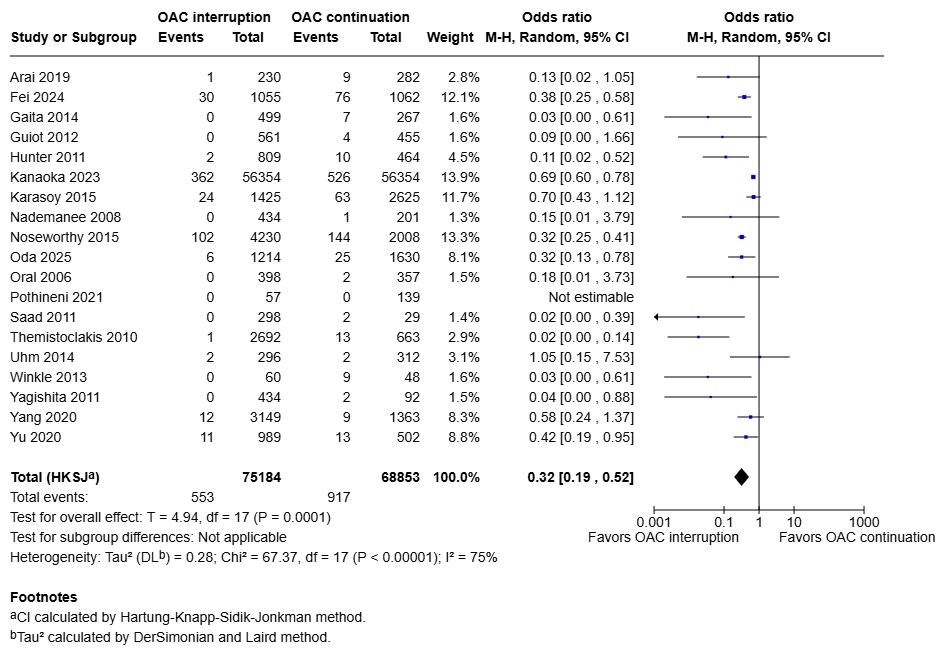
Results: Our analysis included 23 studies (1 RCT and 22 observational studies) comprising a total of 145,489 patients, of whom 75,585 discontinued anticoagulation. OAC discontinuation did not significantly affect the occurrence of new thromboembolic events (OR 0.76; 95% CI 0.55–1.04; p = 0.08; Figure 1) and was associated with a significant reduction in the risk of major bleeding (OR 0.32; 95% CI 0.19–0.52; p = 0.0001; Figure 2) compared to the continuation of long-term anticoagulation. No significant differences in thromboembolic events were observed in a sensitivity analysis restricted to patients with a CHA2DS2-VASc score ≥ 2 (OR 1.00; 95% CI 0.65–1.53; p = 1.00).

Conclusions: OAC discontinuation after the blanking period appears to be safe in patients undergoing catheter ablation for AF, with no increase in thromboembolic risk, even among high-risk individuals. Moreover, it significantly reduces the risk of major bleeding compared to long-term OAC continuation. These findings challenge the conventional practice of indefinite anticoagulation and suggest that discontinuation may be preferable in select patients; however, the limited randomized evidence warrants cautious interpretation.
  • Lucena, Larissa  ( Federal University of Rio Grande do Norte , Natal , RN , Brazil )
  • Giorgi, Juliana  ( HOSPITAL SIRIO LIBANES , Sao Paulo , Brazil )
  • Cavalcante, Deivyd  ( The University of North Texas Health Science Center at Fort Worth , Fort Worth , Texas , United States )
  • Sousa, Julio Cesar  ( Federal University of Rio Grande do Norte , Natal , RN , Brazil )
  • De Oliveira, William  ( Federal University of Rio Grande do Norte , Natal , RN , Brazil )
  • De Oliveira Neto, Nestor  ( Onofre Lopes University Hospital , Natal , RN , Brazil )
  • Costa Borges, Rafael  ( Federal University of Rio Grande do Norte , Natal , RN , Brazil )
  • Paiva, Irina  ( Federal University of Rio Grande do Norte , Natal , RN , Brazil )
  • Arruda De Oliveira, Antonio Lucas  ( Federal University of Rio Grande do Norte , Natal , RN , Brazil )
  • Silva Carvalho, Natália  ( Federal University of Rio Grande do Norte , Natal , RN , Brazil )
  • Leite, Victória  ( Federal University of Sao Paulo , Sao Paulo , SP , Brazil )
  • Medeiros, Amanda  ( Federal University of Rio Grande do Norte , Natal , RN , Brazil )
  • Author Disclosures:
    Larissa Lucena: DO NOT have relevant financial relationships | Juliana Giorgi: DO NOT have relevant financial relationships | Deivyd Cavalcante: DO NOT have relevant financial relationships | Julio Cesar Sousa: No Answer | William de Oliveira: No Answer | Nestor de Oliveira Neto: No Answer | Rafael Costa Borges: No Answer | Irina Paiva: No Answer | Antonio Lucas Arruda de Oliveira: No Answer | Natália Silva Carvalho: No Answer | Victória Leite: No Answer | AMANDA MEDEIROS: No Answer
Meeting Info:

Scientific Sessions 2025

2025

New Orleans, Louisiana

Session Info:

Updates in Atrial Fibrillation Risk Factors, Ablation, and Management

Saturday, 11/08/2025 , 12:15PM - 01:25PM

Moderated Digital Poster Session

More abstracts on this topic:
More abstracts from these authors:
The Impact of Fasting vs Non-fasting on Patient Safety and Comfort During Cardiac Transcatheter Procedures: A Systematic Review and Meta-Analysis

Lucena Larissa, Sousa Julio, Cavalcante Deivyd, Gomes Wilton, Freitas Marcos, Costa Borges Rafael, Arruda De Oliveira Antonio Lucas, Paiva Irina, Silva Carvalho Natália, Leite Victória

Safety and Efficacy of Reduced-Dose versus Full-Dose Direct Oral Anticoagulants in Cancer-Associated Venous Thromboembolism: A Systematic Review and Meta-analysis

Lucena Larissa, Hespanhol Larissa, Muniz Juliana, Duarte Amanda, Felix Nicole, Medeiros Kleyton, De Oliveira William, Giorgi Juliana

You have to be authorized to contact abstract author. Please, Login
Not Available