Logo

American Heart Association

  19
  0


Final ID: MP1342

Impella-Induced Aortic Regurgitation diminishes the effectiveness of Impella support at a clinically typical afterload: Insights from a Pulsatile Mock Circulation Model

Abstract Body (Do not enter title and authors here): Background: The Impella device provides percutaneous left ventricular support but may induce aortic regurgitation (AR) due to its transvalvular placement. In this study, we defined Impella-induced AR as consisting of two components: backward flow through the Impella cannula (Impella retrograde flow) and backward flow from the aorta into the left ventricle (LV retrograde flow). However, both the relationship between these regurgitant flows and afterload, and their actual volume, remain unknown.
Hypothesis: We hypothesized that elevated afterload increases Impella-induced AR by augmenting both Impella and LV retrograde flow, thereby diminishing the effectiveness of Impella support.
Methods: A mock circulation system was used to simulate Impella CP support under 135 unique hemodynamic conditions, created by testing every combination of three levels of circuit resistance (simulating peripheral resistance), nine Impella P-levels (P1–P9), and five levels of left ventricular function. Left ventricular function was simulated by adjusting the ejection-phase volume delivered by an external pump. The 100% ejection-phase volume was defined as 174 mL, and five levels were set at 20%, 30%, 40%, 50%, and 60%. For each condition, mean arterial pressure (MAP), Impella retrograde flow, LV retrograde flow, and their total (Impella-induced AR) were measured. Correlations between MAP and each individual regurgitant flow were analyzed.
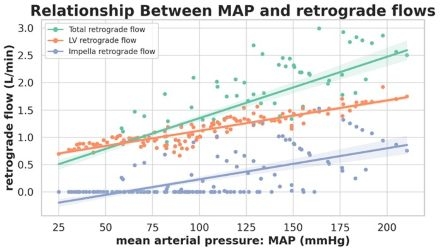
Results: Impella-induced AR was significantly correlated with MAP (r = 0.82, p < 0.0001), with LV retrograde flow being most closely correlated (r = 0.90). Impella retrograde flow also increased with MAP (r = 0.64).
At a clinically typical MAP of 65 mmHg, the average total regurgitant flow was 1.09 L/min, of which 0.97 L/min was LV retrograde flow and 0.12 L/min was Impella retrograde flow, demonstrating that significant Impella-induced AR occurs even at commonly targeted MAP levels.
Conclusions: Elevated MAP increases Impella-induced AR, particularly LV retrograde flow, resulting in reduced effective circulatory support. Strict afterload management may be essential to maximize the hemodynamic benefits of Impella support.
  • Nakano, Rui  ( Saiseikai Kumamoto Hospital , Kumamoto-shi , Japan )
  • Unoki, Takashi  ( Saiseikai Kumamoto Hospital , Kumamoto-shi , Japan )
  • Nishikawa, Takuya  ( NCVC , Osaka , Japan )
  • Otake, Masahiro  ( Department of Cardiovascular Dynami , Osakafu Osakashi , Japan )
  • Sakamoto, Tomohiro  ( Saiseikai Kumamoto Hospital , Kumamoto , Japan )
  • Nakao, Koichi  ( Saiseikai Kumamoto Hospital , Kumamoto , Japan )
  • Okumura, Ken  ( Saiseikai Kumamoto Hospital , Kumamoto , Japan )
  • Saku, Keita  ( NCVC , Osaka City , Japan )
  • Koyama, Junjiroh  ( Saiseikai Kumamoto Hospital , Kumamoto , Japan )
  • Author Disclosures:
    Rui Nakano: DO NOT have relevant financial relationships | Takashi Unoki: DO NOT have relevant financial relationships | Takuya Nishikawa: DO NOT have relevant financial relationships | Masahiro Otake: DO NOT have relevant financial relationships | Tomohiro Sakamoto: DO NOT have relevant financial relationships | Koichi Nakao: No Answer | Ken Okumura: DO NOT have relevant financial relationships | Keita Saku: DO have relevant financial relationships ; Advisor:Cubec:Active (exists now) ; Research Funding (PI or named investigator):Zeon Medical Inc.:Active (exists now) ; Research Funding (PI or named investigator):Neuroceuticals Inc.:Active (exists now) ; Research Funding (PI or named investigator):Asahi Kasei ZOLL Medical Corporation:Active (exists now) ; Research Funding (PI or named investigator):NTT Research:Active (exists now) ; Research Funding (PI or named investigator):Abiomed Inc.:Active (exists now) ; Speaker:Mallinckrodt Pharma K.K.:Active (exists now) ; Speaker:Abiomed Japan K.K.:Active (exists now) ; Advisor:WION:Active (exists now) | junjiroh koyama: No Answer
Meeting Info:

Scientific Sessions 2025

2025

New Orleans, Louisiana

Session Info:

Circulatory Support Under Scrutiny: Outcomes, Optimization, and Organ Vulnerability

Sunday, 11/09/2025 , 11:50AM - 01:00PM

Moderated Digital Poster Session

More abstracts on this topic:
4D Cardiac Magnetic Resonance Identifies Differences in Regional Strain Patterns Among Pediatric Heart Transplant Patients with Acute Rejection or Cardiac Allograft Vasculopathy

Henderson Christopher, Starnes Joseph, Samyn Margaret, Damon Bruce, Hernandez Lazaro, Goergen Craig, Soslow Jonathan, Prado Marco Aurélio, Earl Conner, Georgedurrett Kristen, Lee Simon, Nandi Deipanjan, Chan Kak-chen, Shugh Svetlana, Kikano Sandra

A novel mechanism of pediatric DCM that recapitulates aspects of the human disease via Notch signaling: a pathway to new therapeutics?

Nyarko Obed, Sucharov Carmen

More abstracts from these authors:
Total Support by a Trans-Aortic Valve Micro-Axial Flow Pump Reduces Coronary Blood Flow in Both Normal and Post-reperfusion Coronary Arteries in a Goat Model of Ischemia-Reperfusion

Ohba Kenta, Kawada Toru, Saku Keita, Otake Masahiro, Hiraki Nana, Yoshida Yuki, Morita Hidetaka, Sato Kei, Nishikawa Takuya, Fukumitsu Masafumi, Uemura Kazunori

Association of Inhaled Nitric Oxide with VA-ECMO Weaning and Short-Term Outcomes in ECPELLA Patients: A Retrospective Study

Tanaka Motomaro, Inoue Masayuki, Horio Eiji, Kodama Kazuhisa, Nishikawa Takuya, Saku Keita, Sakamoto Tomohiro, Nakao Koichi, Okumura Ken, Koyama Jyunjiro, Unoki Takashi, Nakano Rui, Hirata So, Inamori Taiji, Toyohuku Takaaki, Sato Tomohide, Konami Yutaka, Suzuyama Hiroto

You have to be authorized to contact abstract author. Please, Login
Not Available