The Association of Area Deprivation Index with Incident Chronic Hypertension in the Postpartum Period
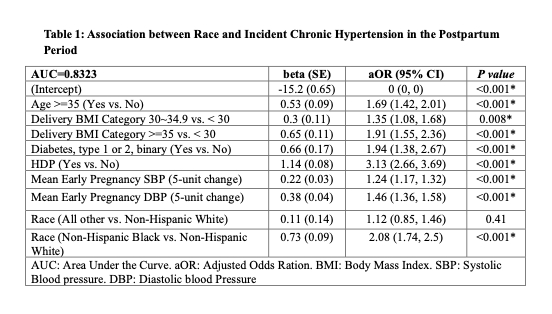
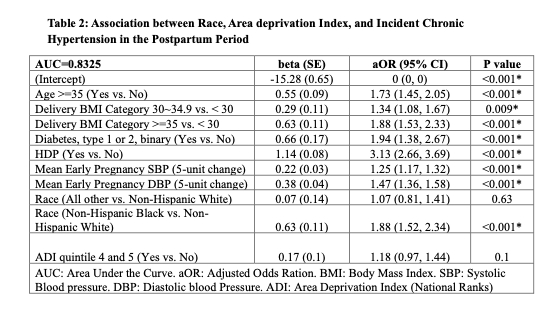
Abstract Body (Do not enter title and authors here): Introduction: The development of chronic hypertension (HTN) in the postpartum period increases cardiovascular disease risk later in life. Area Deprivation Index (ADI) is a validated measure that integrates neighborhood-based socioeconomic factors at the census block level and is associated with cardiovascular outcomes. The association between ADI, race, and postpartum HTN has not been well studied. Research Questions: Is there an association between ADI and the development of incident HTN in the postpartum period, and does ADI mitigate the association between race and postpartum HTN? Methods: This retrospective analysis examined electronic health record data of patients without a history of pre-pregnancy HTN who delivered between 2012-2020 within a large US-based healthcare system. ADI was grouped into quintiles, with the highest quintile representing the most socioeconomically disadvantaged group. High ADI (quintiles 4 and 5) was compared to lower ADI (quintiles 1-3). The outcome of incident HTN was assessed between 6 and 24 months postpartum based on diagnosis codes, blood pressure values, and medications. Logistic regression was used to model the association between covariates of interest and postpartum HTN. Results: The cohort consisted of 23,787 patients with mean age of 30.3 (SD 5.7) years and 37.4% identified as non-Hispanic Black. The incidence of chronic HTN varied across ADI quintiles (quintile 1 to 5): 1.6%, 2.4%, 3.0%, 4.1%, and 3.8%, respectively. Compared to the lowest ADI quintile, each ADI quintile was associated with incident HTN. After adjusting for demographic and clinical characteristics, Black patients had higher odds of postpartum HTN compared to White patients (Table 1). When ADI was added to the model, the effect estimate associated with Black race was slightly attenuated, however ADI was no longer significant (Table 2). Conclusions: Residing in a deprived neighborhood at the time of delivery is associated with incident chronic HTN in the postpartum period, however, this association does not persist after adjusting for race and other clinical characteristics. Furthermore, neighborhood deprivation does not entirely mitigate the impact of race on postpartum HTN. Additional factors that are not directly incorporated into the ADI framework, such as maternal stress and social support, racial segregation, and healthcare accessibility, may play a greater role in the association between race and incident chronic HTN in the postpartum period.
Boakye, Ellen
(
Hospital of the University of Pennsylvania
, Philadelphia , Pennsylvania , United States )
Zhao, Manyun
(
Hospital of the University of Pennsylvania
, Philadelphia , Pennsylvania , United States )
Chen, Jinbo
(
Hospital of the University of Pennsylvania
, Philadelphia , Pennsylvania , United States )
Lewey, Jennifer
(
Hospital of the University of Pennsylvania
, Philadelphia , Pennsylvania , United States )
Author Disclosures:
Ellen Boakye:DO NOT have relevant financial relationships
| Manyun Zhao:No Answer
| Jinbo Chen:No Answer
| Jennifer Lewey:DO NOT have relevant financial relationships