
Logo

American Heart Association

  18
  0


Final ID: MP599

Green Space Visitation Is Associated with Lower Risk of Type 2 Diabetes in a Large U.S. Healthcare System Cohort

Abstract Body (Do not enter title and authors here): Background: While green space exposure has been linked to improved cardiometabolic outcomes, the relationship between actual green space visitation and incident type 2 diabetes mellitus (T2DM) risk remains poorly defined. Population mobility data capturing neighborhood-level visitation patterns offer a novel approach to quantifying green space use. Using mobility-derived green space visitation data, we evaluated the association between neighborhood green space use and T2DM in a large U.S. healthcare system cohort.
Methods: We identified adults (≥18 years) without baseline T2DM using the Houston Methodist Learning Health System Registry between 2016 and 2023. Annual green space visits per capita at the census tract level were derived from Advan Patterns mobility data for the year 2021 and linked to patient addresses. Incident T2DM was defined using diagnostic codes, diabetes medication prescriptions, or hemoglobin A1c ≥6.5% occurring after baseline. Cox proportional hazards models estimated associations between green space visitation and incident T2DM, using both quartile-based comparisons (Q4 vs Q1) and continuous models (per 10 visits), adjusted sequentially for demographics, insurance status, cardiometabolic risk factors, the CDC Social Vulnerability Index, and annual PM2.5 exposure.
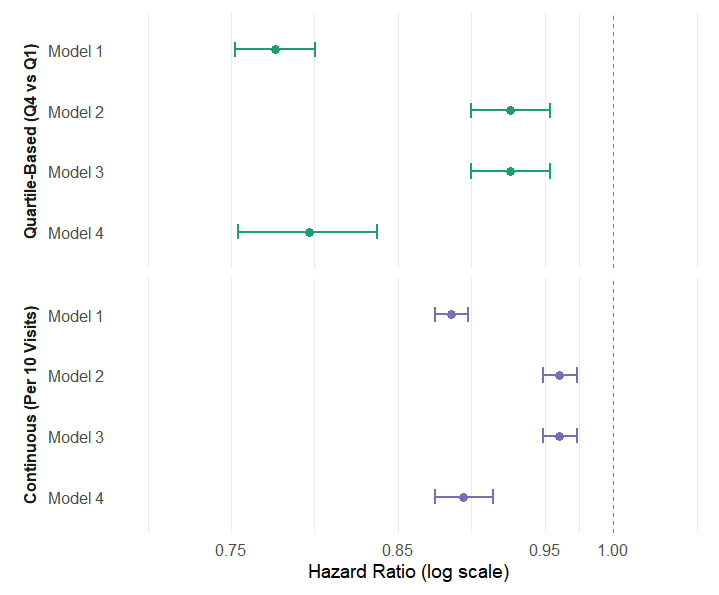
Results: Among 1,003,526 patients followed over 2.1 million person-years, 40,152 developed T2DM, yielding an overall incidence rate of 1.88 per 100 person-years. In quartile-based analysis, individuals in the highest quartile (Q4) of green space visits had a 21% lower risk of incident T2DM compared to the lowest quartile (Q1) after full adjustment (95% CI: 0.754–0.837; p<0.001) (Figure). In continuous models, every 10 additional green space visits per year was associated with a 10.7% lower risk of T2DM (95% CI: 0.874–0.913]; p<0.001).
Conclusion: Greater green space visitation is associated with a lower risk of developing T2DM. These findings highlight the potential of green space use as a modifiable environmental factor in T2DM prevention. Promoting equitable access to green environments may represent a scalable public health strategy to reduce diabetes risk and advance environmental health equity through urban planning and community-based interventions.
  • Ardakani, Jad  ( Houston Methodist Hospital , Houston , Texas , United States )
  • Rajagopalan, Sanjay  ( UNIV HOSP CLEVELAND MEDICAL CTR , Cleveland , Ohio , United States )
  • Maddock, Jay E  ( Houston Methodist Hospital , Houston , Texas , United States )
  • Nasir, Khurram  ( Houston Methodist Hospital , Houston , Texas , United States )
  • Al-kindi, Sadeer  ( Houston Methodist Hospital , Houston , Texas , United States )
  • Dong, Weichuan  ( Houston Methodist Hospital , Houston , Texas , United States )
  • Shahid, Izza  ( Houston Methodist Hospital , Houston , Texas , United States )
  • Gullapelli, Rakesh  ( Houston Methodist Hospital , Houston , Texas , United States )
  • Bose, Budhaditya  ( HOUSTON METHODIST , HOUSTON , Texas , United States )
  • Zhang, Tong  ( Case Western Reserve University , Cleveland , Ohio , United States )
  • Nicolas, Juan  ( Houston Methodist Hospital , Houston , Texas , United States )
  • Javed, Zulqarnain  ( Houston Methodist Hospital , Houston , Texas , United States )
  • Chen, Zhuo  ( Case Western Reserve University , Copley , Ohio , United States )
  • Author Disclosures:
    Jad Ardakani: DO NOT have relevant financial relationships | Sanjay Rajagopalan: DO NOT have relevant financial relationships | Jay E Maddock: DO NOT have relevant financial relationships | Khurram Nasir: No Answer | Sadeer Al-Kindi: No Answer | Weichuan Dong: DO NOT have relevant financial relationships | Izza Shahid: No Answer | Rakesh Gullapelli: No Answer | Budhaditya Bose: DO NOT have relevant financial relationships | Tong Zhang: DO NOT have relevant financial relationships | Juan Nicolas: DO NOT have relevant financial relationships | Zulqarnain Javed: DO NOT have relevant financial relationships | Zhuo Chen: DO NOT have relevant financial relationships
Meeting Info:

Scientific Sessions 2025

2025

New Orleans, Louisiana

Session Info:

Health in a Changing Climate: Understanding Environmental Drivers of Disease

Saturday, 11/08/2025 , 03:15PM - 04:20PM

Moderated Digital Poster Session

More abstracts on this topic:
84 Immune checkpoint profiling in major aortic diseases leads to identification of potential roles of CD155-CD206 pathway in suppressing inflammation and immune responses

Shao Ying, Saaoud Fatma, Xu Keman, Lu Yifan, Jiang Xiaohua, Wang Hong, Yang Xiaofeng

Cardiovascular and Respiratory Outcomes of Inspiratory Muscle Training in Pulmonary Hypertension Patients: A Systematic Review and Meta-Analysis

Javaid Hammad, Saddique Muhammad Nabeel, Mehmood Qasim, Tariq Shazia, Shahab Muhammad, Ali Aneika, Alam Shawail, Ali Sameel, Hakeem Luqman, Amjad Musfirah, Allah Bux Shahnaz, Hajizada Alisina

More abstracts from these authors:
Green Space Visitation and Coronary Heart Disease Across Diverse Climates: A Geospatial Analysis in Three U.S. Cities

Dong Weichuan, Chandra Mouli Sarayu, Zhang Tong, Ardakani Jad, Chen Zhuo, Rajagopalan Sanjay, Nasir Khurram, Maddock Jay E, Al-kindi Sadeer

Individual Social Determinants of Health, Area-Level Social Vulnerability and Incidence of Major Adverse Cardiovascular Events in a Primary Prevention Population: Real-World Evidence from The Houston Methodist CV Learning Health System (HM-CV-LHS) Registry

Shahid Izza, Gullapelli Rakesh, Bose Budhaditya, Nicolas Juan, Al-kindi Sadeer, Nasir Khurram, Javed Zulqarnain

You have to be authorized to contact abstract author. Please, Login
Not Available