Logo

American Heart Association

  18
  0


Final ID: MP527

Green Space Visitation and Coronary Heart Disease Across Diverse Climates: A Geospatial Analysis in Three U.S. Cities

Abstract Body (Do not enter title and authors here): Background: Access to and use of green spaces are increasingly recognized as vital for cardiovascular health, yet few studies have quantified green space exposure behaviorally or explored how climate might modify its effects.
Methods: Using population mobility data, we estimated annual green space visits per person at the census tract level to examine the association between green space use and coronary heart disease (CHD) prevalence. We focused on three U.S. metropolitan areas with distinct climates: Houston (hot), Minneapolis (cold), and San Diego (mild), to assess whether the relationship between green space use and CHD varies by climate. Annual green space visit counts in 2021 were calculated per person using Advan Patterns mobility dataset (formerly SafeGraph Patterns) and linked to 2021 CHD prevalence estimates from CDC PLACES at the census tract level. We conducted Pearson correlation analyses separately by metro area and further applied geographically weighted regression (GWR) models adjusting for socioeconomic vulnerability (CDC Social Vulnerability Index) to assess spatial heterogeneity in the association within each metro.
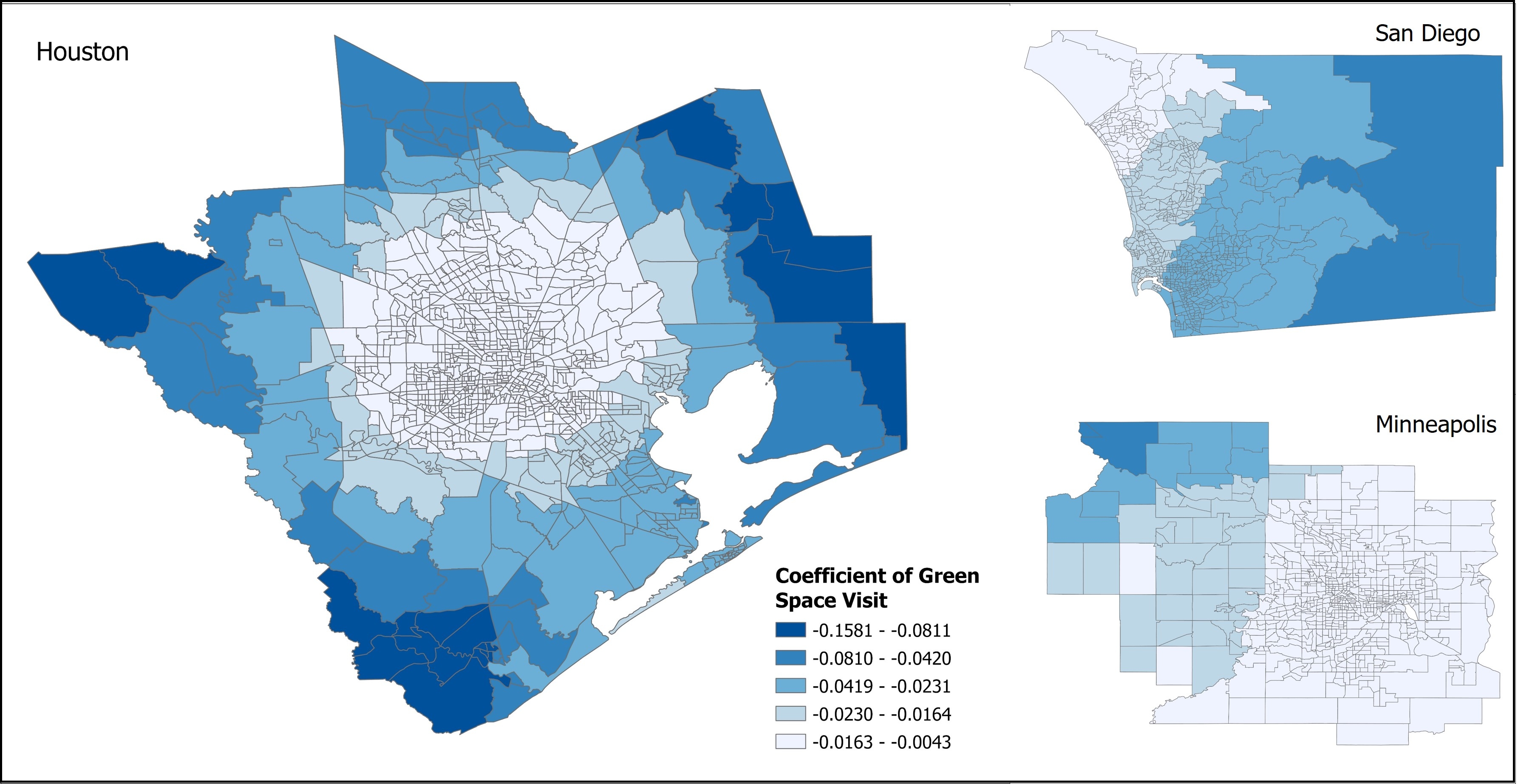
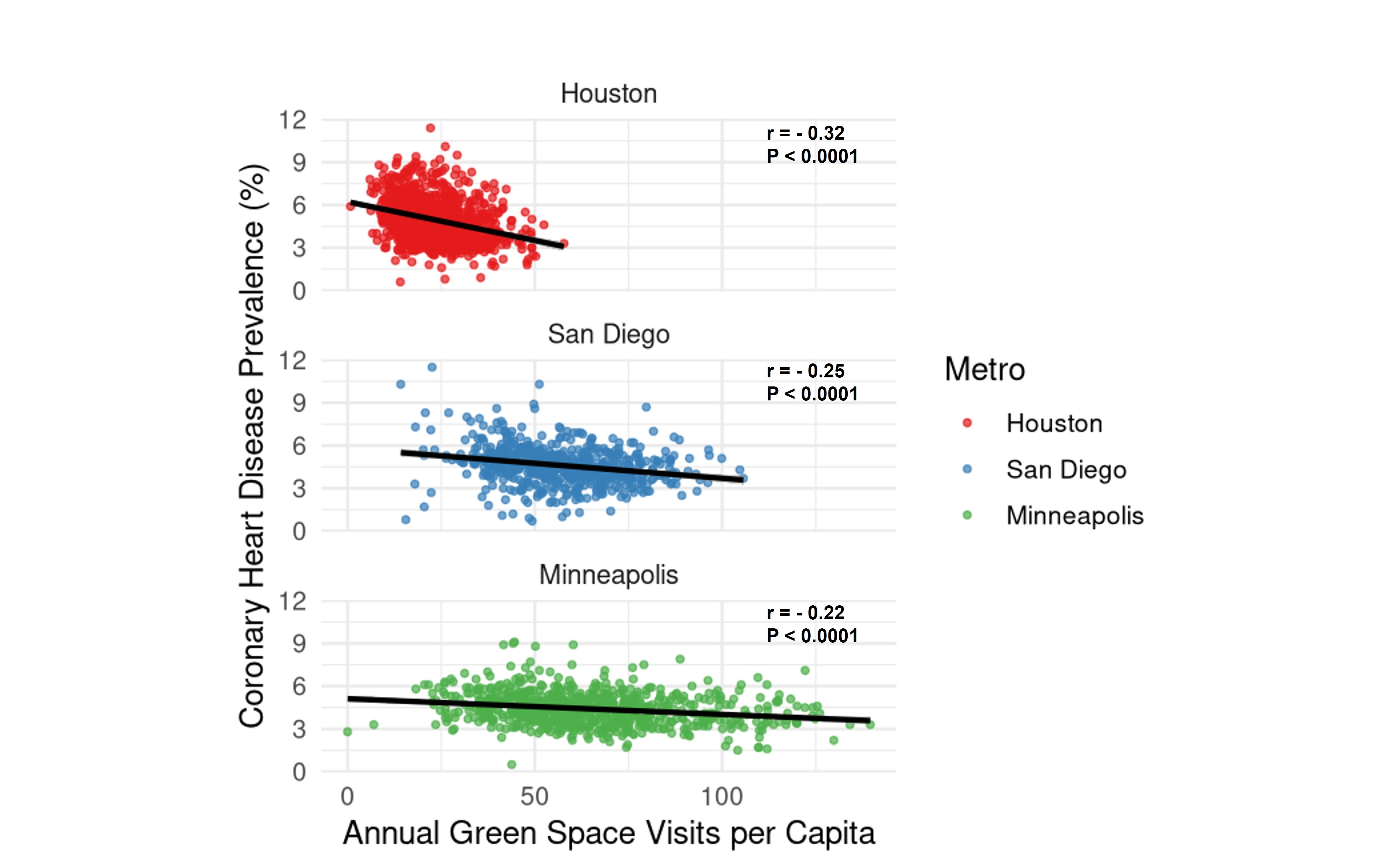
Results: Houston had the lowest green space visitation rates, while Minneapolis had the highest (Figure 1). Across all three cities, higher green space visits were associated with lower CHD prevalence (Houston: r = –0.32; San Diego: r = –0.25; Minneapolis: r = –0.22; all p < 0.001). Notably, the association was strongest in Houston despite its lowest visit rate, suggesting that barriers like low availability of green space or extreme heat may limit usage, but for those who do access green spaces, the cardiovascular benefit is substantial. GWR revealed spatial variation in effect strength, with suburban areas consistently showing stronger protective associations than urban cores (Figure 2). This rural-urban gradient was most pronounced in Houston, highlighting potential inequities in green space access and its health benefits under extreme climatic conditions.
Conclusion: Behavioral exposure to green space is inversely associated with CHD prevalence across diverse climates. The stronger protective association observed in Houston underscores the potential amplified benefits of green space in environments where access may be constrained. These findings suggest targeted urban planning and climate adaptation strategies could enhance cardiovascular outcomes, particularly in heat-prone, under-visited areas.
  • Dong, Weichuan  ( Houston Methodist , Houston , Texas , United States )
  • Chandra Mouli, Sarayu  ( Houston Methodist , Houston , Texas , United States )
  • Zhang, Tong  ( Case Western Reserve University , Cleveland , Ohio , United States )
  • Ardakani, Jad  ( Houston Methodist , Houston , Texas , United States )
  • Chen, Zhuo  ( Case Western Reserve University , Copley , Ohio , United States )
  • Rajagopalan, Sanjay  ( Case Western Reserve University , Copley , Ohio , United States )
  • Nasir, Khurram  ( Houston Methodist , Houston , Texas , United States )
  • Maddock, Jay E  ( Houston Methodist , Houston , Texas , United States )
  • Al-kindi, Sadeer  ( Houston Methodist , Houston , Texas , United States )
  • Author Disclosures:
    Weichuan Dong: DO NOT have relevant financial relationships | Sarayu Chandra mouli: No Answer | Tong Zhang: DO NOT have relevant financial relationships | Jad Ardakani: DO NOT have relevant financial relationships | Zhuo Chen: DO NOT have relevant financial relationships | Sanjay Rajagopalan: No Answer | Khurram Nasir: No Answer | Jay E Maddock: DO NOT have relevant financial relationships | Sadeer Al-Kindi: DO have relevant financial relationships ; Research Funding (PI or named investigator):Ionis Pharmaceuticals:Active (exists now)
Meeting Info:

Scientific Sessions 2025

2025

New Orleans, Louisiana

Session Info:

In Plain Signt: Environmental Exposures and Cardiovascular Disease

Saturday, 11/08/2025 , 10:45AM - 12:00PM

Moderated Digital Poster Session

More abstracts on this topic:
Ambulatory QT Interval Prolongation and Reduced T-Amplitude Help Identify Veterans with Heart Disease

Shah Amit, Colon-motas Kay, De Leon Katalina, Murtala Abdulkareem, Osei Jeffery, Mourad Rama, Chang Sarah, Ko Yi-an, Zeng Zhaohua, Sheikh Shafa-at, Xu Ying, Koscova Zuzana, Kim Kain, Akoto Natalie, Santana Eric, Alexander Abigail, Suvada Kara, Roberts Tatum, Stefanos Lewam, Vaccarino Viola, Clifford Gari, Li Qiao, Sameni Reza, Bahrami Rad Ali, Karimi Sajjad, Lampert Rachel, Mathew Lejy, Alagar Nikila

A Case of Right Coronary Artery Chronic Total Occlusion in a Transplanted Heart: To Stent or Not to Stent?

Krayem Hussein, Cooke Richard, Abouzaki Nayef, Kutkut Issa

More abstracts from these authors:
Green Space Visitation Is Associated with Lower Risk of Type 2 Diabetes in a Large U.S. Healthcare System Cohort

Ardakani Jad, Rajagopalan Sanjay, Maddock Jay E, Nasir Khurram, Al-kindi Sadeer, Dong Weichuan, Shahid Izza, Gullapelli Rakesh, Bose Budhaditya, Zhang Tong, Nicolas Juan, Javed Zulqarnain, Chen Zhuo

The Impact of Artificial Intelligence-Derived Assessment of Natural and Built Environments on Cardiovascular Risk: A Moderated Mediation and Geospatial Analysis from the UK Biobank

Dazard Jean-eudes, Rajagopalan Sanjay, Chen Zhuo, Koyama Satoshi, Zhang Tong, Ponnana Sai Rahul, Sirasapalli Santosh, Moorthy Skanda, Al-kindi Sadeer, Natarajan Pradeep

You have to be authorized to contact abstract author. Please, Login
Not Available