Clinical outcomes associated with utilization of Glucagon-like Peptide-1 Receptor Agonists in heart failure patients in the United States
Abstract Body (Do not enter title and authors here): Background Current evidence recommends glucagon-like peptide-1 receptor agonists (GLP-1 RA) utilization in type 2 diabetes or obesity with cardiovascular diseases. However, GLP-1 RA utility in improving HF outcomes has been variable across studies. We sought to investigate the current practice in prescribing GLP1-RA in a large database and assess their impact on heart failure hospitalization and all-cause mortality.
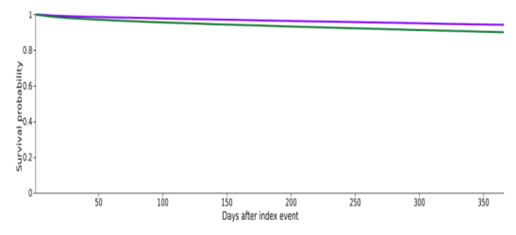
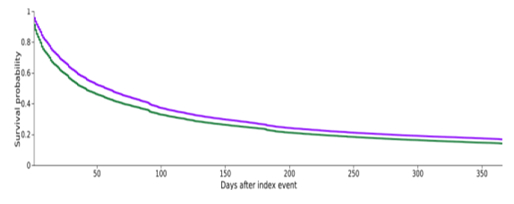
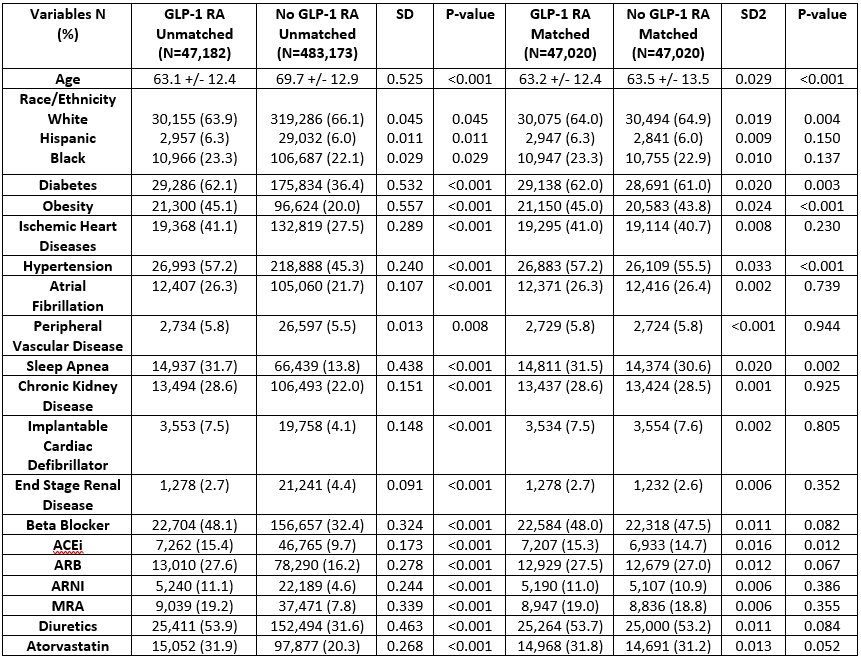
Methods We conducted a retrospective study using the TriNetX database from January 2023 through April 2024 including adults with heart failure, and either type II diabetes or obesity. Patients were excluded if they had diabetes mellitus type 1, multiple endocrine neoplasia [MEN] type IIA, malignant neoplasms of thyroid gland, or presence of ketoacidosis. Patients were divided into two groups based on the utilization of GLP1-RA. Clinical characteristics, demographics and medications use were compared using appropriate statistics. Propensity score matching (PSM) (1:1, SD<0.1) balanced the baseline characteristics. Cox regression and Kaplan–Meier survival curves evaluated clinical outcomes of heart failure hospitalization and 1 year all-cause mortality.
Results Out of 530,355 heart failure patients, 47,179 (8.8%) were prescribed GLP-1 RA. Mean age in GLP-1 RA group was 63 ±12 years and 46.7% were female. The GLP1-RA group patients were younger, had significantly higher proportions of type II diabetes, obesity, obstructive sleep apnea, ischemic heart disease, chronic kidney disease, hypertension, atrial fibrillation, and more likely to receive guideline directed medical therapy. Using propensity score matching, 47,020 patients on GLP-1 RA were matched with 47,020 patients in the control group. GLP1-RA utilization was significantly associated with lower 1 year all-cause mortality [HR 0.56 (0.53-0.59)], heart failure hospitalization [HR 0.86 (0.85-0.87)] and the composite outcome of all-cause mortality and heart failure hospitalization [ 0.85 (0.84-0.87)].
Conclusion Our study showed that utilizing GLP-1 RA in heart failure patients with either type II DM or obesity was associated with lower all-cause mortality and heart failure hospitalization at 1 year follow up.
Loghin, Andrei
(
University of Texas-Medical Branch
, Galveston , Texas , United States )
Bashir, Zubair
(
University of Texas-Medical Branch
, Galveston , Texas , United States )
Saxena, Ritika
(
University of Texas-Medical Branch
, Galveston , Texas , United States )
Gaalema, Diann
(
University of Texas-Medical Branch
, Galveston , Texas , United States )
Chatila, Khaled
(
University of Texas medical branch
, League city , Texas , United States )
Khalife, Wissam
(
University of Texas Medical Branch
, Friendswood , Texas , United States )
Albaeni, Aiham
(
University of Texas Medical Branch
, Galveston , Texas , United States )
Author Disclosures:
Andrei Loghin:DO NOT have relevant financial relationships
| Zubair Bashir:DO NOT have relevant financial relationships
| Ritika Saxena:No Answer
| Diann Gaalema:DO NOT have relevant financial relationships
| Khaled Chatila:No Answer
| Wissam Khalife:DO NOT have relevant financial relationships
| Aiham Albaeni:DO NOT have relevant financial relationships