
Logo

American Heart Association

  18
  0


Final ID: MP1571

Risk of Arrhythmia Persists Throughout Acute and Chronic Phases of Autonomic Dysreflexia following Spinal Cord Injury: A Rodent Model Study

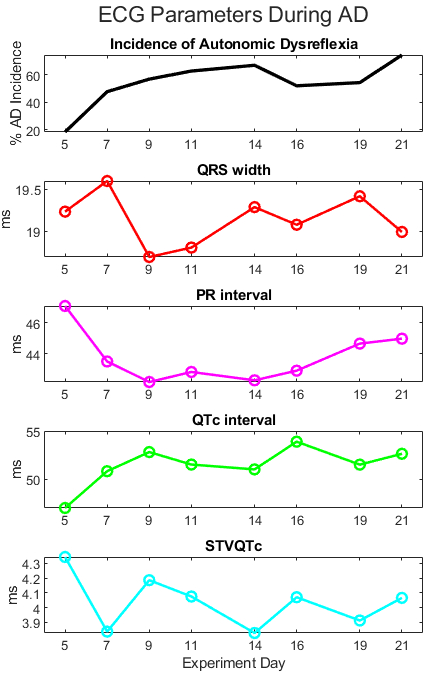
Abstract Body (Do not enter title and authors here): Autonomic Dysreflexia (AD) is a potentially life-threatening overreaction of the sympathetic nervous system that commonly occurs in individuals with spinal cord injuries at or above the T6 level. This uncoordinated response to noxious stimuli below the level of injury triggers episodes of severe hypertension that persist until the stimulus is removed. Although arrhythmias such as atrial fibrillation have been identified as complications of AD, little is known about the long-term risk of arrhythmia across both the acute and chronic phases of AD. To model AD, ten Sprague-Dawley rats underwent spinal cord compression injury at the T3 level. For each animal, three trials of colorectal distension (CRD) were conducted to induce AD on days 5, 7, 9, 11, 14, 16, 19, and 21 post-injury. Implanted radio telemetry devices and surface electrodes collected blood pressure and electrocardiogram (ECG) signals. Trials were classified as AD if systolic blood pressure increased by ≥ 15 mmHg relative to baseline. ECG parameters were analyzed to assess arrhythmia risk. During AD, there was a significantly shortened PR interval (p = 0.00286), decreased QRS width (p < 0.001), decreased corrected QT (QTc) interval (p <0.001), and increased short-term variability of the QTc (STVQTc) (p < 0.001). No significant changes in RR interval were observed. Baseline STVQTc was significantly higher during the chronic phase (days 14-21) compared to the acute phase (days 5-11) (p = 0.0107). Arrhythmias such as premature ventricular contractions (PVC) and atrial flutter were observed in seven of ten rats. Temporal analysis revealed the same significant changes in ECG parameters during AD across the study period. Notably, increased baseline STVQTc during the chronic phase suggests elevated vulnerability even outside of active AD. Additionally, ECG parameter trends mirror AD incidence. Trends shift around day 14, marking the onset of the chronic phase of AD (see figure). Risk of arrhythmia associated with AD is not limited to hypertensive episodes but reflects persistent vulnerability over time. Because RR intervals remained unchanged, the observed ECG fluctuations are unlikely due to heart rate and instead indicate the potential contribution of AD to altered cardiac electrophysiology. As ECG dynamics reflect the trajectory of AD incidence, future investigations should explore the mechanisms linking sympathetic overreaction and cardiac electrophysiology.
  • Dye, Molly  ( Purdue University , Lafayette , Indiana , United States )
  • Everett, Thomas  ( Indiana University School of Med , Indianapolis , Indiana , United States )
  • Duerstock, Bradley  ( Purdue University , Lafayette , Indiana , United States )
  • Author Disclosures:
    Molly Dye: DO NOT have relevant financial relationships | Thomas Everett: DO NOT have relevant financial relationships | Bradley Duerstock: No Answer
Meeting Info:

Scientific Sessions 2025

2025

New Orleans, Louisiana

Session Info:

Frontiers in Electrophysiology and Arrhythmogenesis: From Cells to Systems

Sunday, 11/09/2025 , 09:15AM - 10:30AM

Moderated Digital Poster Session

More abstracts on this topic:
A machine learning model for individualized risk prediction of ischemic heart disease in people with hypertension in Thailand

Sakboonyarat Boonsub, Poovieng Jaturon, Rangsin Ram

A Novel Composite Artificial Intelligence-Electrocardiography Risk Score Is Independently Associated with Mortality in Chronic Tricuspid Regurgitation

Ciobanu Andrea, Pellikka Patricia, Kane Garvan, Pislaru Sorin, Anand Vidhu, Naser Jwan, Wood Julia, Friedman Paul, Vinereanu Dragos, Nkomo Vuyisile, Pislaru Cristina, Lara-breitinger Kyla, Thaden Jeremy

More abstracts from these authors:
β-1 Adrenoceptor is Responsible for the Apamin-Sensitive Small Conductance Ca2+-Activated K+ Current Activation in Female Rabbit Ventricles

Yang Minjing, Zhang Liyang, Kote Anxhela, Tisdale James, Chen Zhenhui, Everett Thomas, Chen Peng-sheng, Liu Xiao

You have to be authorized to contact abstract author. Please, Login
Not Available