
Logo

American Heart Association

  21
  0


Final ID: MP2247

Social Vulnerability and Outcomes Among Patients Hospitalized for Heart Failure with Reduced Ejection Fraction

Abstract Body (Do not enter title and authors here): Background: Deprivation indices are composite scores that capture regional variation in social determinants of health (SDH) and have been independently linked to healthcare disparities. The social vulnerability index (SVI) is unique among these indices as it can be split into four unique themes for granular analysis. The purpose of this study is to assess whether SVI and SVI theme are independently associated with in-hospital outcomes and discharge prescription patterns of adults admitted to the hospital with heart failure with reduced ejection fraction (HFrEF).
Methods: This study included participants aged ≥18 years old hospitalized for HFrEF and eligible for guideline directed medical therapy (GDMT) in the Get With The Guidelines–Heart Failure (GWTG-HF) quality improvement (QI) program between June 5, 2013 and January 4, 2024. The primary outcomes were in-hospital mortality, GDMT at discharge, and length of stay. Hierarchical multivariable regression models with clustering by facility were used: (1) with SVI / SVI theme as the predictor, (2) partial adjustment for demographics, and (3) full adjustment for demographics and medical comorbidities.
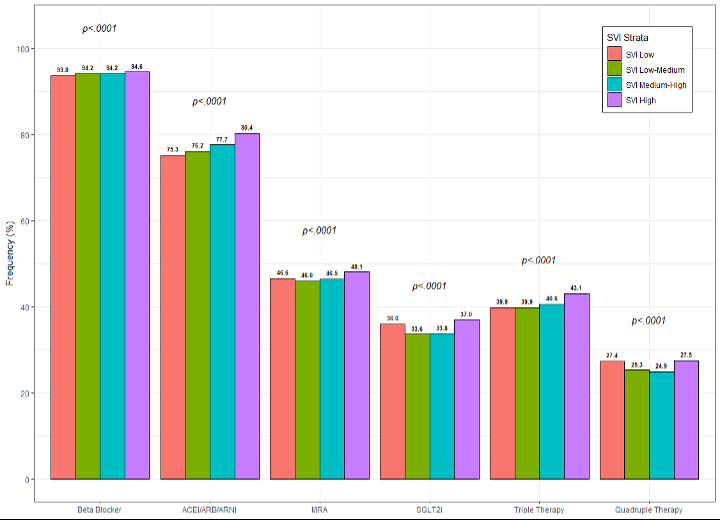
Results: Among 186,928 patients with HFrEF without contraindication to any GDMT, 30,733 (16.4%) were from the lowest SVI quartile (least vulnerable) and 58,108 (31.1%) were from the highest SVI quartile (most vulnerable). Presented odds ratios (ORs) compare highest vs lowest SVI quartile. In-hospital mortality ORs decreased with increased SVI (unadjusted OR: 0.79, 95% CI 0.74-0.84), but were not statistically significant in fully adjusted models. GDMT rates at discharge were higher with higher SVI (unadjusted OR for ACE/ARB/ARNI: 1.14, 95% CI 1.11-1.18; for beta blocker: 1.12, 95% CI 1.05-1.19; for MRA: 1.12, 95% CI 1.09-1.16; for SGLT2i: 1.07, 95% CI 1.01-1.13), but were not statistically significant in fully adjusted models. Length of stay was significantly longer with higher SVI, including after adjustment (fully adjusted OR: 1.01, 95% CI 1.01-1.02). Replacing SVI with each SVI theme yielded similar results.
Conclusions: Among patients hospitalized for HFrEF at GWTG-HF hospitals, regional vulnerability defined by SVI was not associated with in-hospital mortality or GDMT at discharge after adjustment for individual demographics and medical comorbidities. Findings suggest that participation in QI programs such as GWTG-HF may help reduce the influence of regional SDH on care quality and in-hospital outcomes.
  • Brownell, Nicholas  ( UCLA , Los Angeles , California , United States )
  • Klomhaus, Alexandra  ( UCLA , Los Angeles , California , United States )
  • Inkelas, Moira  ( UCLA , Los Angeles , California , United States )
  • Lewsey, Sabra  ( Johns Hopkins University , Baltimore , Maryland , United States )
  • Yancy, Clyde  ( NORTHWESTERN UNIVERSITY , Chicago , Illinois , United States )
  • Ziaeian, Boback  ( UCLA , Los Angeles , California , United States )
  • Fonarow, Gregg  ( UCLA MEDICAL CENTER , Los Angeles , California , United States )
  • Author Disclosures:
    Nicholas Brownell: DO NOT have relevant financial relationships | Alexandra Klomhaus: DO NOT have relevant financial relationships | Moira Inkelas: No Answer | Sabra Lewsey: DO NOT have relevant financial relationships | Clyde Yancy: DO NOT have relevant financial relationships | Boback Ziaeian: No Answer | Gregg Fonarow: DO have relevant financial relationships ; Consultant:AstraZeneca:Active (exists now) ; Consultant:Bayer:Active (exists now) ; Consultant:Novartis:Active (exists now) ; Consultant:Pfizer:Active (exists now) ; Consultant:Merck:Active (exists now)
Meeting Info:

Scientific Sessions 2025

2025

New Orleans, Louisiana

Session Info:

Social Determinants and Disparities: How Social Factors Shape Cardiovascular Outcomes

Monday, 11/10/2025 , 09:15AM - 10:15AM

Moderated Digital Poster Session

More abstracts on this topic:
Active Screening in Black, Hispanic/LatinX, Asian/Pacific Islander, and Native American Individuals Reduces Racial Disparities in Abdominal Aortic Aneurysm Diagnosis

Miner Grace, Govindarajulu Usha, Smolock Christopher, Faries Peter, Marin Michael

Applying a comprehensive cardiometabolic risk prediction model to real-world primary care patient data

Howell Carrie, Tanaka Shiori, Burkholder Greer, Mehta Tapan, Herald Larry, Garvey William, Cherrington Andrea

More abstracts from these authors:
You have to be authorized to contact abstract author. Please, Login
Not Available