Perioperative Serum Creatinine Trajectories and 1-Year Survival After Coronary Artery Bypass Grafting
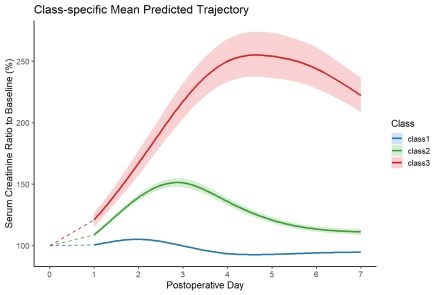
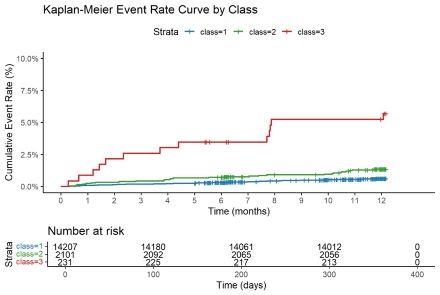
Abstract Body (Do not enter title and authors here): Background Acute kidney injury (AKI) is a common complication following coronary artery bypass grafting (CABG). The Kidney Disease: Improving Global Outcomes (KDIGO) criteria effectively stratify the prognosis of CABG patients with moderate to severe AKI (stage ≥2). However, it primarily focuses on peak creatinine levels while overlooking dynamic changes in serum creatinine over time. We hypothesise that perioperative serum creatinine trajectories provide prognostic information beyond conventional AKI staging. Objective To identify high-risk serum creatinine trajectories and evaluate their prognostic significance in CABG patients. Methods This retrospective cohort study included 16,539 patients who underwent isolated CABG at a single centre from 2014 to 2021. Serum creatinine levels were normalised to baseline and tracked over the first 7 postoperative days to analyze trajectory patterns. Latent class mixed model (LCMM) was applied to identify distinct creatinine trajectory classes, with model selection based on both goodness-of-fit and discrimination ability. One-year all-cause mortality was analyzed across trajectory classes using Cox proportional hazards models, adjusting for KDIGO-defined AKI (stage 2–3) and other baseline covariates. Results Three distinct perioperative serum creatinine trajectory classes were identified: Class 1 (N = 14,207, 85.9%): Stable creatinine levels, serving as the reference group. Class 2 (N = 2,101, 12.7%): Peak creatinine at postoperative day (POD) 3, followed by a gradual return to baseline by POD 7. Class 3 (N = 231, 1.4%): Progressive creatinine elevation over the first 4 postoperative days, remaining persistently high at POD 7. One-year all-cause mortality was significantly higher in both Class 2 (HR = 2.2 [95% CI, 1.4–3.4], P < 0.001) and Class 3 (HR = 9.7 [95% CI, 5.4–17.3], P < 0.001). After adjusting for KDIGO-defined AKI (stage 2–3) and baseline covariates, Class 2 (aHR = 1.66 [95% CI, 1.04–2.66], P = 0.033) and Class 3 (aHR = 2.39 [95% CI, 1.02–5.63], P = 0.045) remained independently associated with increased mortality risk. Conclusions A three-class perioperative serum creatinine trajectory model identified distinct patterns of renal function changes following CABG, demonstrating prognostic significance beyond traditional AKI criteria. These findings suggest that creatinine trajectory patterns provide valuable clinical insights, highlighting a subset of high-risk patients who may not be fully captured by KDIGO staging.
Jiao, Zhongyu
(
Fuwai Hospital
, Beijing , China )
Wang, Peng
(
Fuwai Hospital
, Beijing , China )
Zheng, Zhe
(
Fuwai Hospital
, Beijing , China )
Author Disclosures:
Zhongyu Jiao:DO NOT have relevant financial relationships
| Peng Wang:No Answer
| Zhe Zheng:No Answer