
Logo

American Heart Association

  15
  0


Final ID: Su3121

Impact of Percutaneous Mitral Valve Repair on Atrial Fibrillation Burden in Patients with Mitral Regurgitation

Abstract Body (Do not enter title and authors here): Introduction: Transcatheter Edge to Edge Repair (TEER) of the mitral valve is offered to severely symptomatic patients with mitral regurgitation (MR) and high or prohibitive surgical risk. Chronic MR promotes atrial dilation and electrical remodelling, raising the risk of atrial fibrillation (AF). However, it remains unclear whether correcting MR via TEER reduces AF burden in patients who already have AF.

Research Question: What is the effect of percutaneous repair of MR on AF burden and characteristics one year after the procedure in patients with AF undergoing TEER?

Methods: We performed a retrospective single-center study where 73 patients were identified who had a diagnosis of AF and underwent TEER for MR between January 2021 and December 2023. The AF characteristics and burden are identified from chart review and reviewing EKG, Holter monitors, loop recorders, or already implanted device interrogations. A descriptive and comparative analysis of AF characteristics pre- and 1 year post-procedure is then performed.

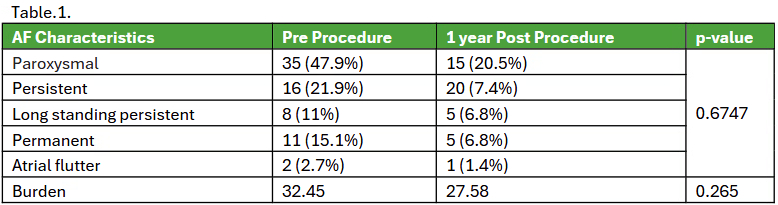
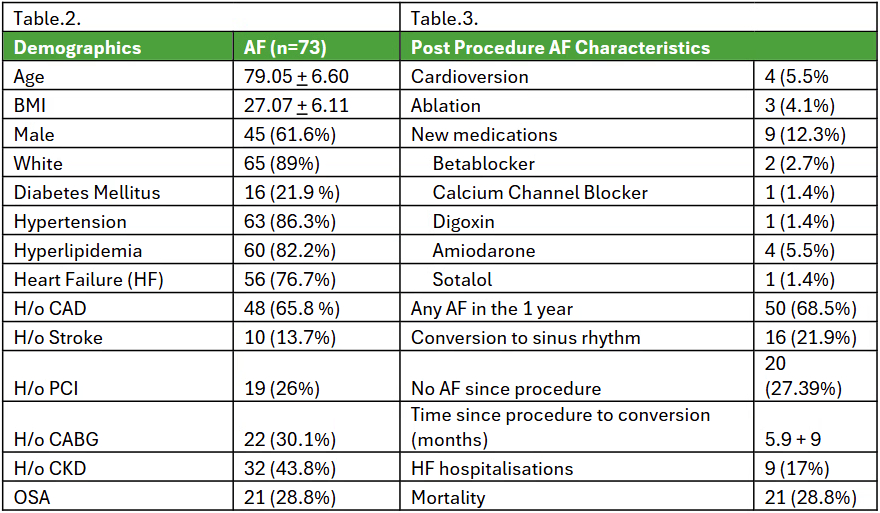
Result: The Mean age of this cohort was 79 + 6.6 years, with a 61% male and 89% white population. About 28.8% and 15% of patients had a pre-TEER history of cardioversion and ablation. Post procedure 68% (n=50) still had AF at least once during follow-up. A total of 20 patients had no AF noted since the procedure, corresponding to a 27.4 % relative risk reduction in AF persistence and an NNT of 4. About 22% of patients were noted to convert to sinus rhythm in 5.9 + 9 months and maintain it through the first year. During the follow-up, 5.5% and 4.1% underwent repeat cardioversion and ablation, respectively. New rhythm control agents were started in 6.8% of the total population. A total of 21 patients had quantified AF burden documented before and after the procedure. The burden numerically dropped from 32.45% to 27.58%, with a p=0.265.

Conclusion: Our study indicates a possible numerical decrease in burden and shift in AF subtype distribution, which is comparable to the results of a prior study. This was not statistically significant given small sample size, retrospective nature. Although TEER alone would not reliably eliminate AF, it achieved a 27.4 % relative reduction in AF persistence (NNT = 4), suggesting a clinically meaningful benefit in reducing AF burden and promoting sinus rhythm. Prospective studies with larger cohorts and systematic rhythm monitoring are needed to clarify the true impact of MR correction on AF dynamics.
  • Pulipati, Yochitha  ( Allegheny Health Network , Pittsburgh , Pennsylvania , United States )
  • Slifer, Damian  ( Allegheny Health Network , Pittsburgh , Pennsylvania , United States )
  • Saleh, Saleh  ( Allegheny Health Network , Pittsburgh , Pennsylvania , United States )
  • Mian, Irfan-ud-din  ( Allegheny Health Network , Pittsburgh , Pennsylvania , United States )
  • Aggarwal, Pushan  ( Allegheny General Hospital , Pittsburgh , Pennsylvania , United States )
  • Tuli, Ritika  ( Allegheny Health Network , Pittsburgh , Pennsylvania , United States )
  • Mcgregor, Walter  ( Allegheny Health Network , Pittsburgh , Pennsylvania , United States )
  • Farah, Victor  ( Allegheny General Hospital , Pittsburgh , Pennsylvania , United States )
  • Author Disclosures:
    Yochitha Pulipati: DO NOT have relevant financial relationships | Damian Slifer: DO NOT have relevant financial relationships | Saleh Saleh: No Answer | Irfan-Ud-Din Mian: No Answer | Pushan Aggarwal: DO NOT have relevant financial relationships | Ritika Tuli: DO NOT have relevant financial relationships | Walter Mcgregor: No Answer | Victor Farah: No Answer
Meeting Info:

Scientific Sessions 2025

2025

New Orleans, Louisiana

Session Info:

Mitral Valve Repair and Replacement: Evolving Surgical and Transcatheter Techniques

Sunday, 11/09/2025 , 03:15PM - 04:15PM

Abstract Poster Board Session

More abstracts on this topic:
A Deep Learning Digital Biomarker for Mitral Valve Prolapse using Echocardiogram Videos

Al-alusi Mostafa, Khurshid Shaan, Sanborn Danita, Picard Michael, Ho Jennifer, Maddah Mahnaz, Ellinor Patrick, Lau Emily, Small Aeron, Reeder Christopher, Shnitzer Dery Tal, Andrews Carl, Kany Shinwan, Ramo Joel, Haimovich Julian

Acute Severe Mitral Regurgitation Due to Flail Posterior Leaflet without Chordal Rupture Following Myosin Inhibitor Treatment of Hypertrophic Obstructive Cardiomyopathy

Patel Shreyan, Taha Israa, Elmi Daniel, Shirani Jamshid

More abstracts from these authors:
Preexisting Atrial Fibrillation as an Adverse Predictor of Outcomes After Transcatheter Edge-to-Edge Repair of the Mitral Valve: A Single-Center Study

Pulipati Yochitha, Saleh Saleh, Slifer Damian, Mian Irfan-ud-din, Aggarwal Pushan, Tuli Ritika, Mcgregor Walter, Farah Victor

Surviving sudden cardiac arrest during pregnancy: strategic planning for maternal and fetal outcomes

Aggarwal Pushan, Tuli Ritika, Poornima Indu

You have to be authorized to contact abstract author. Please, Login
Not Available