A Multi-Center Clinic Site Comparison of Patient-level factors Affecting Oral Anticoagulation Prescription for Atrial Fibrillation
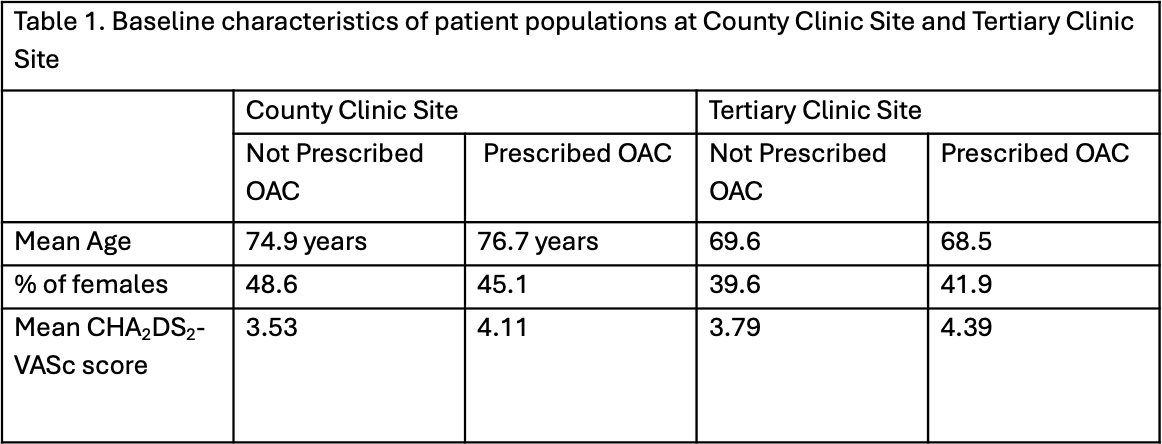
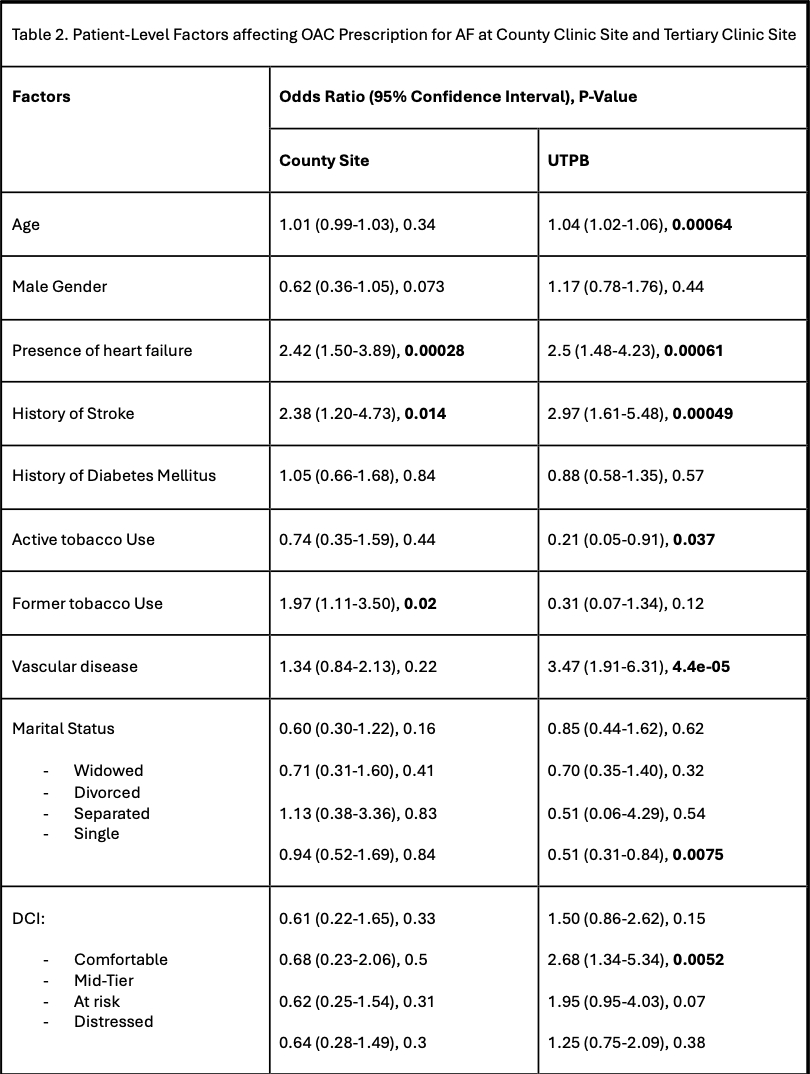
Abstract Body (Do not enter title and authors here): Introduction Stroke remains a major cause of morbidity and mortality in patients with atrial fibrillation (AF). Although rates of oral anticoagulation (OAC) use have been improving following the advent of direct acting oral anticoagulants (DOACs), they remain suboptimal with a need for further investigation into contributing factors. We aimed to assess the association of patient-level factors with prescription of OAC for AF at a large, diverse county clinical site and a tertiary care clinical center. Methods A retrospective analysis was performed to identify patients with AF over the age of 65 who met criteria for anticoagulation initiation per current AF guidelines between January 1st, 2022, and December 31st, 2022, at both centers. The distressed communities index (DCI) was used for stratification of patient residence into tiers. A binary logistic regression was used for multivariate analysis. Results A total of 1629 patients, at county site, and 6538 patients, at tertiary care site, were included. Table 1 shows the mean age, percentage of females and mean CHA2DS2-VASc scores at the two sites. At county site, 1528 (93.8%) patients and at tertiary care site, 6178 (94.5%) patients were prescribed OAC. There was no statistically significant difference in anticoagulation rates between the two sites, χ2 = 1.052, p = 0.305. Heart failure, history of stroke and vascular disease, higher age and mid-tier DCI were all positively associated with prescription of OAC, while single marital status was associated with lower odds of OAC prescription, at tertiary clinic site, Table 2. At county site, former tobacco use, history of stroke and presence of heart failure were all positively associated with OAC prescription, Table 2. Conclusion We found no difference in adherence to OAC prescription guidelines in AF patients based on clinical practice settings. However, patient-specific clinical factors such as history of heart failure, Stroke and older age were found to be positively associated with OAC prescription. Social Determinants of Health (SDOH) such as mid-tier DCI, single marital status and active tobacco use also impacted OAC prescription. These findings highlight that while clinical factors play major roles in OAC prescribing, certain SDOH factors also play a significant role and may contribute to health inequity. It is necessary to address these factors broadly to improve guideline driven practices for stroke prevention in AF patients.
Iqbal, Fatima
(
University of Texas at Houston
, Houston , Texas , United States )
Hoang, Kenneth
(
University of Texas at Houston
, Houston , Texas , United States )
Chiadika, Simbo
(
University of Texas Health- Houston
, Sugar land , Texas , United States )
Author Disclosures:
Fatima Iqbal:DO NOT have relevant financial relationships
| Kenneth Hoang:No Answer
| Simbo Chiadika:DO have relevant financial relationships
;
Advisor:BridgeBio:Past (completed)
; Research Funding (PI or named investigator):Amgen:Active (exists now)
; Consultant:Pfizer:Expected (by end of conference)