

Feasibility of automated, deep learning-based segmentation of the Fontan aorta in 4D Flow MRI: A Fontan Outcome Registry using Cardiac Magnetic Resonance Examination (FORCE) Study
Abstract Body (Do not enter title and authors here): Background: In patients who have undergone Fontan palliation, suboptimal geometry of the reconstructed aorta may contribute to abnormal aortic blood flow patterns, ventriculo-vascular decoupling, and worse clinical outcomes. 4D Flow magnetic resonance imaging (MRI) enables detailed hemodynamic assessment, but large-scale studies are hindered by labor-intensive image analysis. Deep learning models have successfully automated aortic segmentation in single-center adult cohorts with bicuspid aortic valve or conventional anatomy but perform poorly in patients with complex congenital heart disease. Training on 4D Flow data from Fontan patients may improve performance in this heterogeneous population.
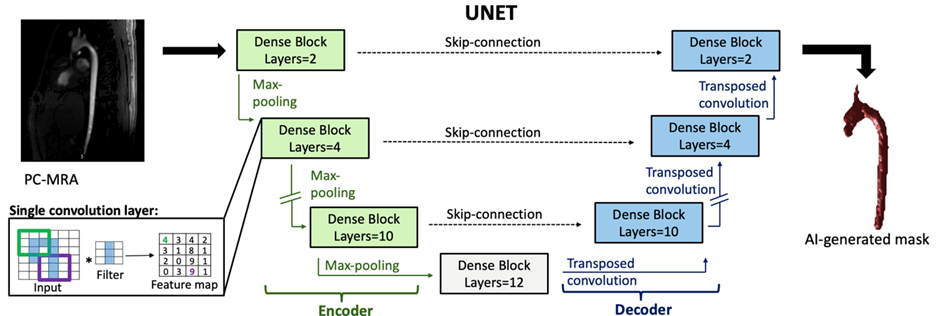
Methods: We compiled 215 4D Flow CMR studies (200 unique patients from 17 centers) from the Fontan Outcomes Registry Using Cardiac Magnetic Resonance Examination (FORCE). Manual aortic segmentation was performed on a subset of 78 studies (n=63 training, n=15 testing). Studies with metallic artifact obscuring the aorta, aortic cropping, or non-sagittal image orientation were excluded. A convolutional neural network with 3D U-Net architecture incorporating dense blocks was used to generate 3D aortic segmentations from the 4D Flow data. Segmentation accuracy was evaluated using dice similarity coefficients (DSCs).
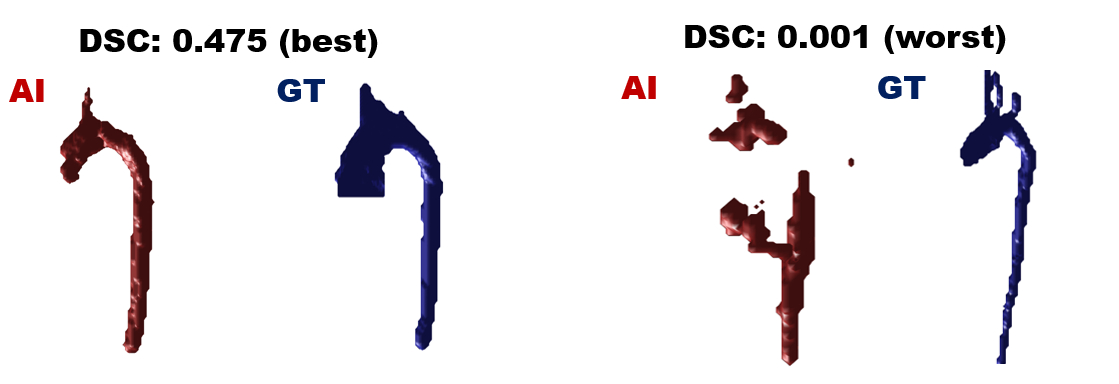
Results: The mean age at MRI was 17.7 ± 8.8 years. The most common diagnoses were hypoplastic left heart syndrome (33%), double outlet right ventricle (16.6%), and tricuspid atresia (12%). Segmentation performance was variable, with DSCs ranging from 0.001 to 0.47 (mean=0.20). Modeling was likely challenged by the heterogeneity of Fontan anatomy as well as variation in imaging protocols across the 17 contributing centers.
Conclusions: Anatomical and imaging variability across centers likely contributed to poor model performance compared to more uniform, single-center adult studies. To mitigate this, we plan to standardize images and segmentations to a uniform voxel size and field of view. We will also apply data augmentation techniques, including spatial transformations and intensity perturbations, to synthetically increase dataset size and expose the model to a wider range of anatomical and imaging variability. This approach may improve generalizability and robustness in the setting of a small, non-uniform training dataset. Future efforts will also include k-fold cross-validation and expansion of the training cohort to further enhance model performance.
Mines, Ellen
( Duke School of Medicine
, Chicago
, Illinois
, United States
)
Desai, Lajja
( Lurie Children's Hospital
, Evanston
, Illinois
, United States
)
Rigsby, Cynthia
( Lurie Children's Hospital
, Chicago
, Illinois
, United States
)
Robinson, Joshua
( Lurie Children's Hospital
, Evanston
, Illinois
, United States
)
Berhane, Haben
( Northwestern University
, Chicago
, Illinois
, United States
)
Johnson, Ethan
( Northwestern University
, Chicago
, Illinois
, United States
)
Markl, Michael
( Northwestern University
, Chicago
, Illinois
, United States
)
Ward, Kendra
( Lurie Children's Hospital
, Evanston
, Illinois
, United States
)
Wang, Alan
( Lurie Children's Hospital
, Evanston
, Illinois
, United States
)
Lemley, Bethan
( Lurie Children's Hospital
, Chicago
, Illinois
, United States
)
Ohalloran, Conor
( Lurie Children's Hospital
, Chicago
, Illinois
, United States
)
Husain, Nazia
( Lurie Children's Hospital
, Chicago
, Illinois
, United States
)
Author Disclosures:
Ellen Mines:DO NOT have relevant financial relationships
| Lajja Desai:DO NOT have relevant financial relationships
| Cynthia Rigsby:DO NOT have relevant financial relationships
| Joshua Robinson:DO NOT have relevant financial relationships
| Haben Berhane:No Answer
| Ethan Johnson:DO have relevant financial relationships
;
Employee:Third Coast Dynamics, Inc:Active (exists now)
| Michael Markl:DO have relevant financial relationships
;
Research Funding (PI or named investigator):Siemens:Active (exists now)
; Ownership Interest:Third Coast Dynamics:Active (exists now)
; Research Funding (PI or named investigator):Circle Cardiovascular Imaging:Active (exists now)
| Kendra Ward:DO NOT have relevant financial relationships
| Alan Wang:DO NOT have relevant financial relationships
| Bethan Lemley:DO NOT have relevant financial relationships
| Conor Ohalloran:DO NOT have relevant financial relationships
| Nazia Husain:DO NOT have relevant financial relationships