Logo

American Heart Association

  15
  0


Final ID: Mo1024

Artificial Intelligence Prediction of Atrial Fibrillation Using Pre-Cannulation Electrocardiograms in Patients Undergoing Veno-Venous Extracorporeal Membrane Oxygenation

Abstract Body (Do not enter title and authors here): Background
Atrial fibrillation (AF) is a common complication following veno-venous extracorporeal membrane oxygenation (VV-ECMO), leading to further complications from anticoagulation or stroke. The Artificial Intelligence AF Prediction Dashboard developed at Mayo Clinic generates two predictive outputs: (1) a continuous probability score and (2) a binary threshold-based signal to predict the likelihood of AF at an individual level after 12-lead electrocardiogram (ECG) is obtained. Using both continuous risk (%) and binary (yes/no) likelihood, we present a novel method to understand AF risk after VV-ECMO cannulation based on pre-ECMO 12-lead ECG.

Methods
We reviewed a total of 147 patients on ECMO between 2018 and 2024, from which 85 VV-ECMO patients with complete data were included. AI Dashboard outputs were quantified as binary (1/0) or percent likelihood for AF. R was utilized for statistical analysis.

Results
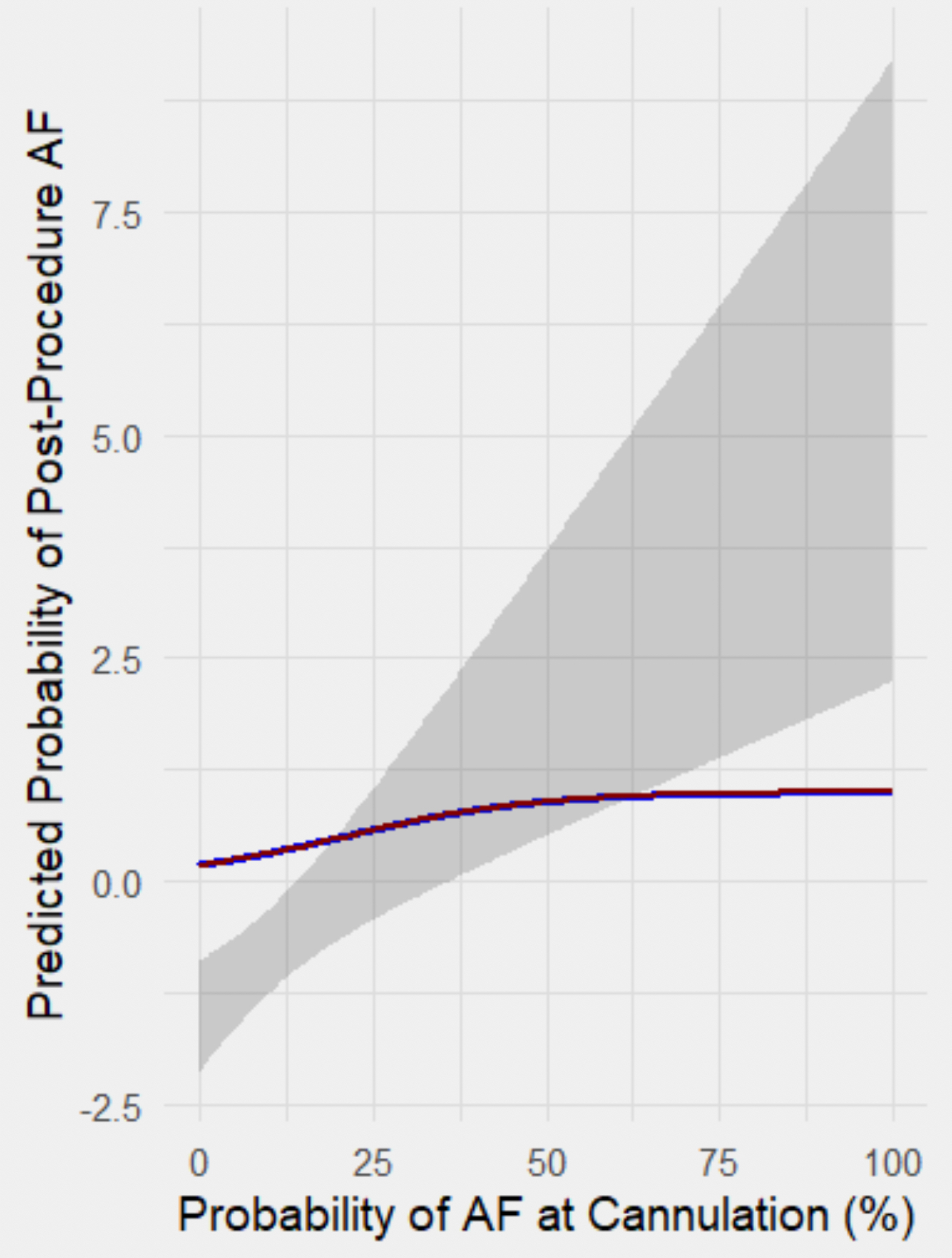
85 patients met our inclusion criteria from which AF after cannulation occurred in 31 (36%). 17 patients had a history of AF prior to VV-ECMO initiation. The mean age of our cohort was 49 years with a mean BMI of 29.3. Baseline AI Dashboard continuous assessment identified 39 patients (46%) compared to the binary assessment identifying 31 patients (36%). Logistic regression in the binary assessment demonstrated an odds ratio of 1.08 (95% CI 1.04 – 1.12) with a p value of <0.001.

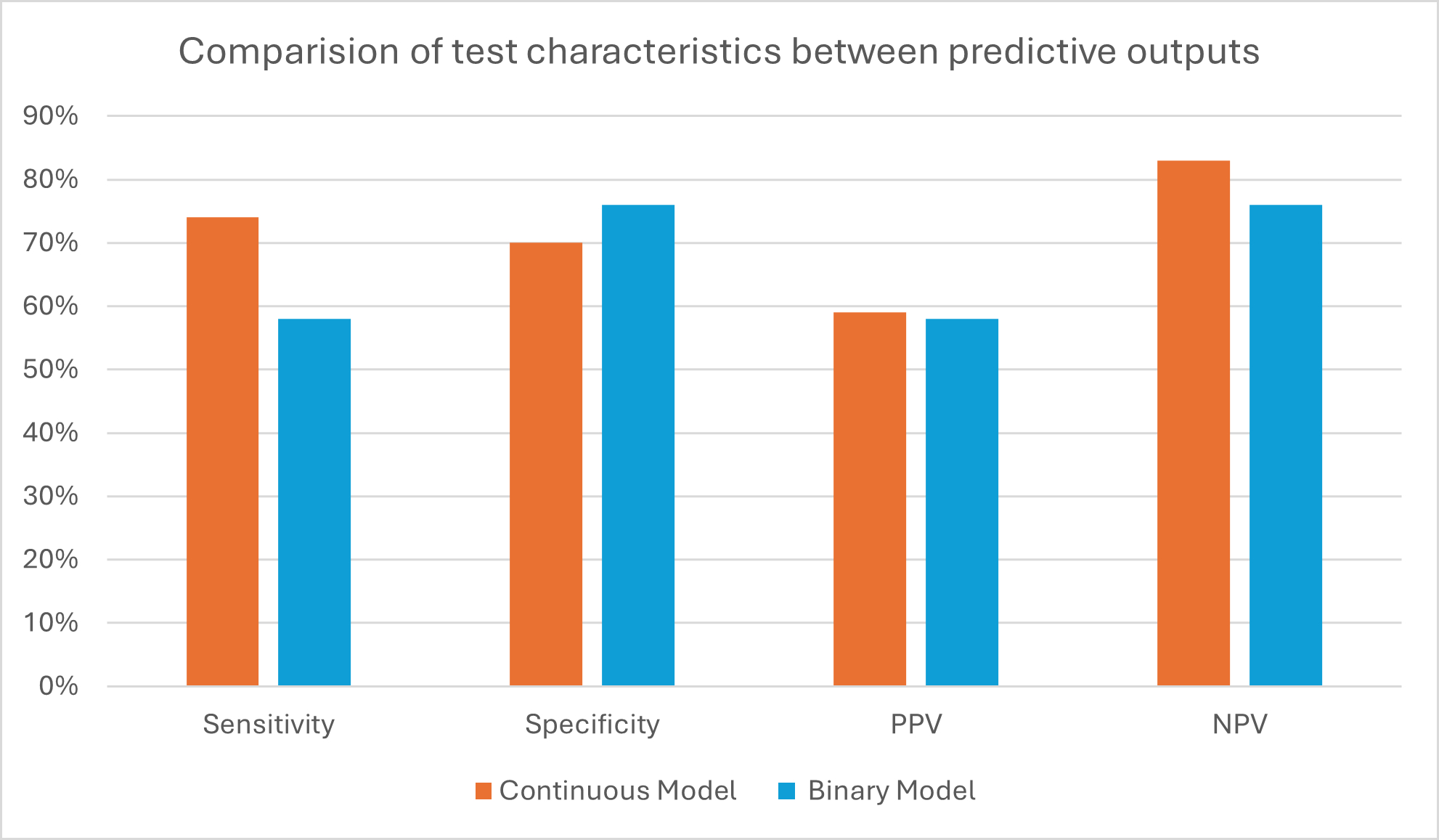
The binary AF Prediction yielded a 58% sensitivity, 76% specificity, 58% PPV, and 76% NPV, with an accuracy of 67%. The continuous AF Probability score achieved 72% balanced accuracy with sensitivity 74%, specificity 70%, PPV 59% and NPV 83%, indicating fair overall performance and suggesting good utility for ruling out AF in low-risk patients. Although both outputs provided moderate predictive accuracy, the continuous score reported before ECMO cannulation demonstrated stronger overall performance with fewer false negatives and higher rule-out value.

Conclusions
We demonstrate the novel use of an AI predictive model in the VV-ECMO population for the prediction of AF risk with both continuous and binary risk cutoffs from baseline ECG. This data highlights the need for further development in ECMO-specific AI models to help mitigate risk after the onset of atrial arrhythmias. As AI-driven tools become increasingly integrated into care, their performance must be continuously validated and recalibrated for specific populations to ensure their safe and effective use.
  • Corro, Rosa  ( Mayo Clinic Florida , Jacksonville , Florida , United States )
  • Goswami, Rohan  ( Mayo Clinic Florida , Jacksonville , Florida , United States )
  • Moreno Franco, Pablo  ( Mayo Clinic Florida , Jacksonville , Florida , United States )
  • Khanijo, Aditya  ( Mayo Clinic Florida , Jacksonville , Florida , United States )
  • Ghosh, Saptarshi  ( Mayo Clinic Florida , Jacksonville , Florida , United States )
  • Desai, Aarti  ( Mayo Clinic Florida , Jacksonville , Florida , United States )
  • Vergara-sanchez, Carlos  ( Mayo Clinic Florida , Jacksonville , Florida , United States )
  • Olivero, Lorenzo  ( Jacobi Medical Center , Bronx , New York , United States )
  • Menser, Terri  ( Mayo Clinic Florida , Jacksonville , Florida , United States )
  • Chaudhary, Sanjay  ( Mayo Clinic Florida , Jacksonville , Florida , United States )
  • Guru, Pramod  ( Mayo Clinic Florida , Jacksonville , Florida , United States )
  • Author Disclosures:
    Rosa Corro: DO NOT have relevant financial relationships | Rohan Goswami: No Answer | Pablo Moreno Franco: DO NOT have relevant financial relationships | Aditya Khanijo: DO NOT have relevant financial relationships | Saptarshi Ghosh: No Answer | Aarti Desai: DO NOT have relevant financial relationships | Carlos Vergara-Sanchez: No Answer | Lorenzo Olivero: DO NOT have relevant financial relationships | Terri Menser: No Answer | Sanjay Chaudhary: DO NOT have relevant financial relationships | Pramod Guru: No Answer
Meeting Info:

Scientific Sessions 2025

2025

New Orleans, Louisiana

Session Info:

Heart in Crisis: Cutting-Edge Tools and Trends in Cardiogenic Shock Management

Monday, 11/10/2025 , 10:30AM - 11:30AM

Abstract Poster Board Session

More abstracts on this topic:
Cardiopulmonary Bypass and Aortic Cross-Clamp Times as Predictors of Outcomes in ECMO-Supported Cardiotomy Patients

Banker Himanshi, Sarangi Swapna, Jena Anek, Seelhammer Troy, Bohman John, Haney John, Chaudhary Sanjay, Guru Pramod

Anatomic Physiological Scoring is a Comparable Predictor of Adult Congenital Operative Morbidity and Mortality

La Brenda, Taylor-fishwick Jon, Macbeth Morgan, Soohoo Megan

More abstracts from these authors:
Troponin Elevation Identifies High-Risk Septic ICU Patients Without Prior Cardiac Disease

Khanijo Aditya, Fernandez Chrystinne, Tohyama Takeshi, Ganupa Sneha, Menser Terri, Goswami Rohan, Bhattacharyya Anirban, Moreno Franco Pablo, Chaliki Hari, Ghosh Saptarshi, Corro Rosa, Desai Aarti, Vergara Carlos, Galeano Santiago, Forrest Marion, Chapman Anthony, Eklund Selma

Post-Impella Creatinine as a Predictor of Length of Stay Outcomes in Patients Undergoing Heart Transplant After Impella 5.5 Support

Mautong Hans, Chaudhary Sanjay, Goswami Rohan, Desai Aarti, Alak çetin, Wlodkowski Peter, Ruiz Jose, Leoni Juan, Nativi-nicolau Jose, Patel Parag, Shapiro Anna

You have to be authorized to contact abstract author. Please, Login
Not Available