Two-Hit Model of JAK1–STAT1 Immune Amplification by Clonal Hematopoiesis in Immune Checkpoint Inhibitor-Associated Myocarditis
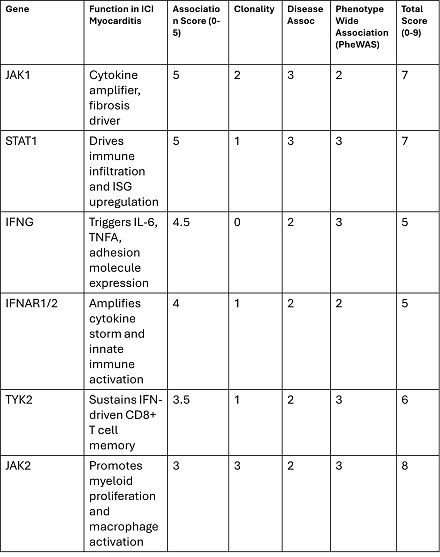
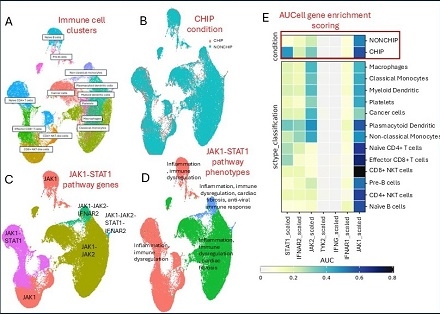
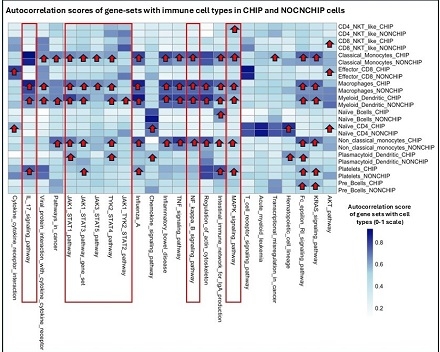
Abstract Body (Do not enter title and authors here): Background: Clonal hematopoiesis of indeterminate potential (CHIP) affects over 10% of older adults and is enriched in cancer patients, where it independently predicts cardiovascular mortality. Immune checkpoint inhibitor (ICI) therapy, though life-extending, can trigger fulminant myocarditis—a complication with up to 50% mortality. We have shown that CHIP more than doubles ICI-myocarditis risk, yet the mechanisms remain unresolved. Hypothesis: We propose a novel two-hit model in which ICI therapy initiates inflammatory priming (Hit 1), while CHIP acts as a second hit, amplifying JAK1–STAT1-mediated immune activation that culminates in myocardial infiltration, cytokine storm, and fibrosis. Methods: We performed single-cell RNA sequencing on PBMCs from six ICI-myocarditis patients—three CHIP-positive (TET2/DNMT3A mutations) and three CHIP-negative. Data were processed using Seurat (Louvain clustering, CCA integration), annotated via ScType, and subjected to pathway enrichment with AUCell and VISION. Pathways evaluated included JAK–STAT, interferon, TNF, and NF-κB signaling axes. Results: CHIP+ patients showed significant upregulation of pro-inflammatory and fibrotic gene programs across myeloid and lymphoid cells, including JAK1, STAT1, IFNG, TYK2, and JAK2 (Figure 1). AUCell enrichment (AUC > 0.75, p < 0.01) highlighted activation of JAK1–STAT1 and chemokine pathways in monocytes and dendritic cells, accompanied by elevated expression of fibrosis-linked genes (e.g., COL1A1, FN1). CHIP+ immune clusters also exhibited NF-κB, IL17, and MAPK pathway amplification (Figure 2). A gene-level association matrix incorporating clonality, disease relevance, and PheWAS links (Table 1) prioritized JAK1, STAT1, and JAK2 (scores ≥7/9) as key transcriptional amplifiers of immune injury, with STAT1 acting as the central effector and JAK2 contributing CHIP-specific clonal expansion and IL-6–driven myeloid skewing. Conclusion: Our findings support a two-hit immune model in ICI myocarditis, in which CHIP amplifies ICI-induced immune signaling through a JAK1–STAT1–centered axis. This synergistic mechanism promotes pro-inflammatory gene expression and fibrotic remodeling, particularly within monocytes and dendritic cells. Our CHIP-enhanced gene scoring framework may enable risk stratification and therapeutic targeting in cardio-oncology. Future directions include pseudotime modeling of CHIP clone trajectories, integration with cardiac MRI phenotypes, and multi-center validation.
Manchanda, Nancy
(
YALE UNIVERSITY
, New Haven , Connecticut , United States )
Jha, Alokkumar
(
Weill Cornell Medicine
, New York , New York , United States )
Kwan, Jennifer
(
YALE UNIVERSITY
, New Haven , Connecticut , United States )
Author Disclosures:
Nancy Manchanda:DO NOT have relevant financial relationships
| Alokkumar Jha:DO NOT have relevant financial relationships
| Jennifer Kwan:DO have relevant financial relationships
;
Consultant:Ekohealth:Expected (by end of conference)