Vitamin E is Differentially Associated with Cardiometabolic Risk and Metabolic Syndrome in Brazilian and U.S. Hispanic/Latino Populations
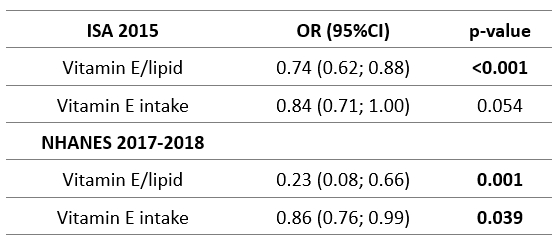
Abstract Body (Do not enter title and authors here): Introduction: Vitamin E (α-tocopherol) is a lipid-soluble antioxidant with anti-inflammatory effects, studied for its role in managing metabolic syndrome (MetS). This is especially important for vulnerable groups such as Hispanics/Latinos, who have higher cardiometabolic risk and often insufficient vitamin E intake. Significant heterogeneity within these populations may impact health outcomes. This study investigates associations between vitamin E intake and nutritional status with cardiometabolic profiles and MetS among Brazilians and U.S. Hispanic/Latino individuals. Hypothesis: We hypothesize that the relationships between vitamin E (intake and plasma/serum levels) and cardiometabolic markers and MetS differ between these populations. Methods: This cross-sectional study used data from the 2015 Health Survey of São Paulo (ISA) and the 2017–2018 NHANES focusing on Hispanic/Latino participants. Dietary intake was measured by two 24-hour recalls. Plasma/serum vitamin E concentrations were normalized by blood lipids (vit E/lipid). Cardiometabolic profile included total cholesterol, HDL-c, LDL-c, non-HDL-c, triglycerides, glucose, blood pressure, BMI, and waist circumference. MetS was defined by International Diabetes Federation criteria. Associations were evaluated with generalized linear models (p < 0.05). Results: In ISA and NHANES, adults composed 66.8% and 83.3% of participants; females were 47.2% and 50.3%. Median vit E/lipid was 2.74 mg/g (ISA) and 3.84 mg/g (NHANES), with inadequacy rates of 99.99% and 96.89%. MetS prevalence was 35.8% (ISA) and 65.5% (NHANES). In ISA, vit E/lipid was inversely associated with total cholesterol, LDL-c, non-HDL-c, and triglycerides. In NHANES, vit E/lipid was inversely associated with BMI, waist circumference, triglycerides, and directly with HDL-c. Vitamin E intake inversely related to triglycerides in both groups. MetS was inversely associated with vit E/lipid and intake in NHANES, and with vit E/lipid in ISA. Conclusions: Vitamin E intake and plasma concentrations are associated with cardiometabolic outcomes, showing different patterns by population. ISA data showed stronger links with plasma levels, while NHANES emphasized intake associations. These findings highlight the need for tailored strategies addressing vitamin E status and cardiometabolic health in diverse populations.
Costa, Marcela
(
University of Sao Paulo
, Sao Paulo , Brazil )
Mattei, Josiemer
(
HARVARD CHAN SCHOOL PUBLIC HEALTH
, Boston , Massachusetts , United States )
Duarte Batista, Lais
(
University of Sao Paulo
, Sao Paulo , Brazil )
Hermes Sales, Cristiane
(
University of Sao Paulo
, Sao Paulo , Brazil )
Mori Sarti, Flavia
(
University of Sao Paulo
, Sao Paulo , Brazil )
Macedo Rogero, Marcelo
(
University of Sao Paulo
, Sao Paulo , Brazil )
Mara Fisberg, Regina
(
University of Sao Paulo
, Sao Paulo , Brazil )
Author Disclosures:
Marcela Costa:DO NOT have relevant financial relationships
| Josiemer Mattei:DO NOT have relevant financial relationships
| Lais Duarte Batista:DO NOT have relevant financial relationships
| Cristiane Hermes Sales:No Answer
| Flavia Mori Sarti:DO NOT have relevant financial relationships
| Marcelo Macedo Rogero:No Answer
| Regina Mara Fisberg:No Answer