Prospective Study of Changes in High-Molecular-Weight Multimers of von Willebrand Factor During Initiation and Weaning of Temporary Mechanical Circulatory Support
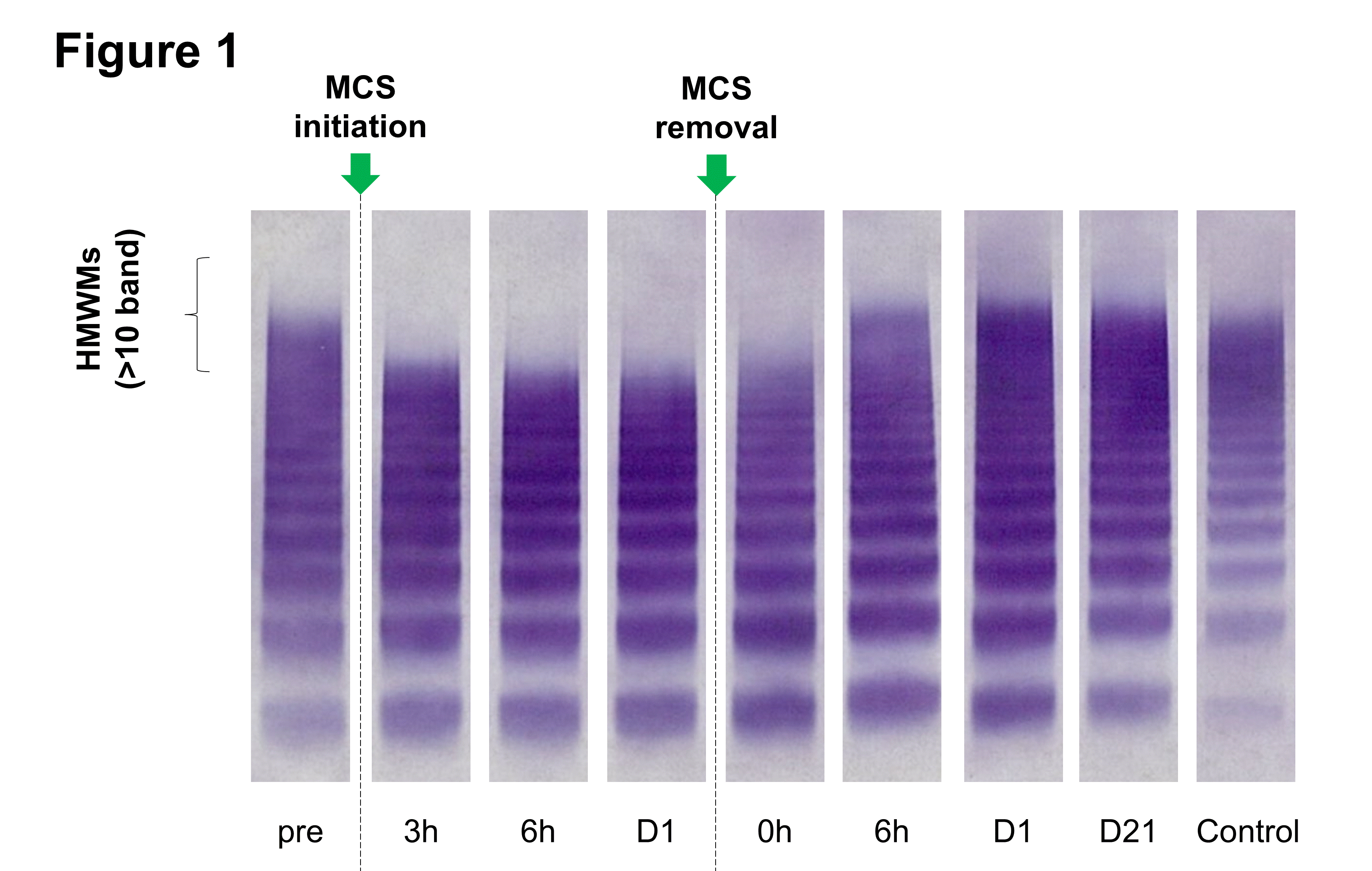
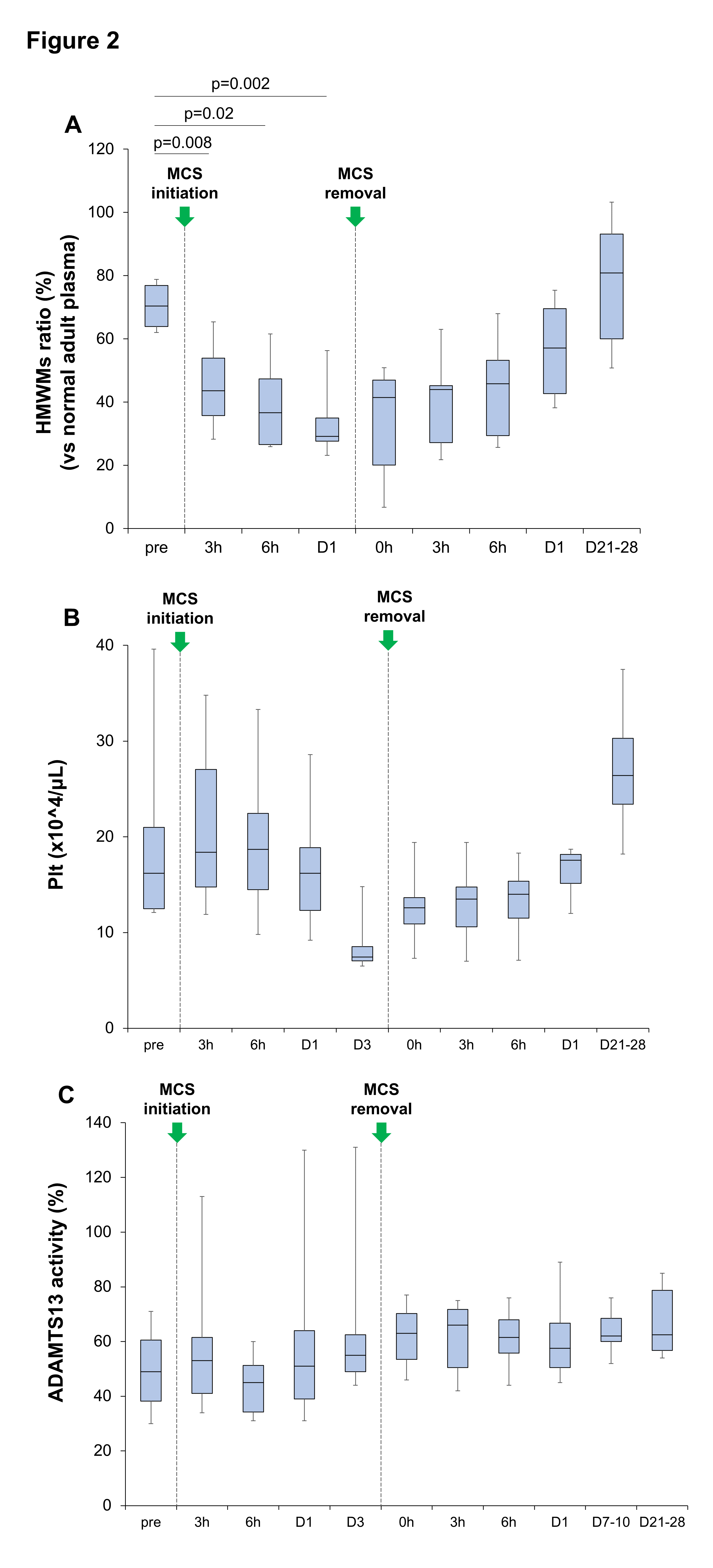
Abstract Body (Do not enter title and authors here): Background: Mechanical circulatory support (MCS) improves outcomes in patients with end-stage heart failure (HF) refractory to medical therapy. However, bleeding is the most common complication associated with continuous-flow MCS (CF-MCS), affecting up to 50% of patients. Supraphysiological shear stress from CF-MCS induces acquired von Willebrand factor (vWF) deficiency, which contributes to bleeding. Despite its clinical relevance, temporal changes in vWF profiles during MCS, particularly immediately after initiation and withdrawal, remain poorly understood. Aims: This study aimed to characterize the temporal profile of vWF in patients receiving temporary MCS. Methods: This prospective study enrolled patients aged 20–90 years who received temporary MCS at Tohoku University Hospital between July 2022 and September 2024. vWF multimer analysis was performed by gel electrophoresis using blood samples collected at 12 predefined time points: before MCS initiation; 3 hours, 6 hours, day 1, and day 3 after initiation; immediately before and after weaning; and 3 hours, 6 hours, 24 hours, day 7–10, and day 21–28 after weaning. High-molecular-weight multimers (HMWMs) were defined as those >10 bands. Platelet count and ADAMTS13 activity were also measured. Results: Eight patients (mean age 54 years; 6 males) were enrolled. MCS devices included Impella (n=2), veno-arterial extracorporeal membrane oxygenation (V-A ECMO) (n=2), and a combination of both (n=4). Seven patients were successfully weaned from MCS after a mean duration of 7 days; one patient was transitioned to ventricular assist device therapy. Figure 1 displays a representative serial gel analysis of plasma vWF multimers from one patient, with a healthy volunteer as control. HMWMs declined rapidly after MCS initiation but recovered following device removal (Figure 2A). Platelet counts remained stable on day 1 but decreased by day 3 (Figure 2B), while ADAMTS13 activity remained unchanged throughout the study period (Figure 2C). Six patients developed BARC type 3 or 5 bleeding within 72 hours of MCS initiation, coinciding with the early reduction in HMWMs. Conclusion: In this prospective study, a rapid decline in HMWMs was observed shortly after MCS initiation, with recovery following device removal. These findings suggest that early bleeding events after MCS initiation could be linked to reductions in HMWMs, although the extent of this association warrants further investigation.
Adachi, Ayumi
(
Tohoku University Graduate School of Medicine
, Sendai , Japan )
Oyama, Kazuma
(
Tohoku University Graduate School of Medicine
, Sendai , Japan )
Takahashi, Jun
(
Tohoku University Graduate School of Medicine
, Sendai , Japan )
Funaki, Takahiro
(
Tohoku University Graduate School of Medicine
, Sendai , Japan )
Shindo, Tomohiko
(
Tohoku University Graduate School of Medicine
, Sendai , Japan )
Shiroto, Takashi
(
Tohoku University Graduate School of Medicine
, Sendai , Japan )
Hayashi, Hideka
(
Tohoku University Graduate School of Medicine
, Sendai , Japan )
Suzuki, Hideaki
(
Tohoku University Graduate School of Medicine
, Sendai , Japan )
Takahama, Hiroyuki
(
Tohoku University Graduate School of Medicine
, Sendai , Japan )
Yasuda, Satoshi
(
Tohoku University Graduate School of Medicine
, Sendai , Japan )
Author Disclosures:
Ayumi Adachi:DO NOT have relevant financial relationships
| Satoshi Yasuda:No Answer
| Kazuma Oyama:No Answer
| Jun Takahashi:No Answer
| Takahiro Funaki:No Answer
| Tomohiko Shindo:No Answer
| Takashi Shiroto:No Answer
| Hideka Hayashi:No Answer
| Hideaki Suzuki:DO NOT have relevant financial relationships
| Hiroyuki Takahama:No Answer