
Logo

American Heart Association

  29
  0


Final ID: MP1100

Increased SIRT1 Expression in Internal Mammary Artery Vascular Smooth Muscle Cells Prevents Pro-Inflammatory Phenotype

Abstract Body (Do not enter title and authors here): Background: Atherosclerosis (AS) is a chronic inflammatory disease that predominantly affects the coronary vascular bed, while sparing select vascular territories such as the internal mammary arteries (IMA), which is a key graft in coronary artery bypass graft surgery in patients with coronary artery disease. IMA is used widely in bypass grafting for coronary artery disease because of its resistance to atherosclerotic obstruction. Vascular smooth muscle cells (VSMCs) play a pivotal role in atherosclerosis development and progression.
Hypothesis: Sirtuin 1 (SIRT1) expression provides protection in IMA VSMCs against the pro-inflammatory phenotype seen in coronary VMSCs, which results in elevated risk of atherosclerosis in coronary VSMCs.
Methods: Using qPCR and Western blot, phenotypic expression of cytokines and regulators of inflammation were assayed in VSMCs derived from healthy human donor coronary and internal mammary arteries.
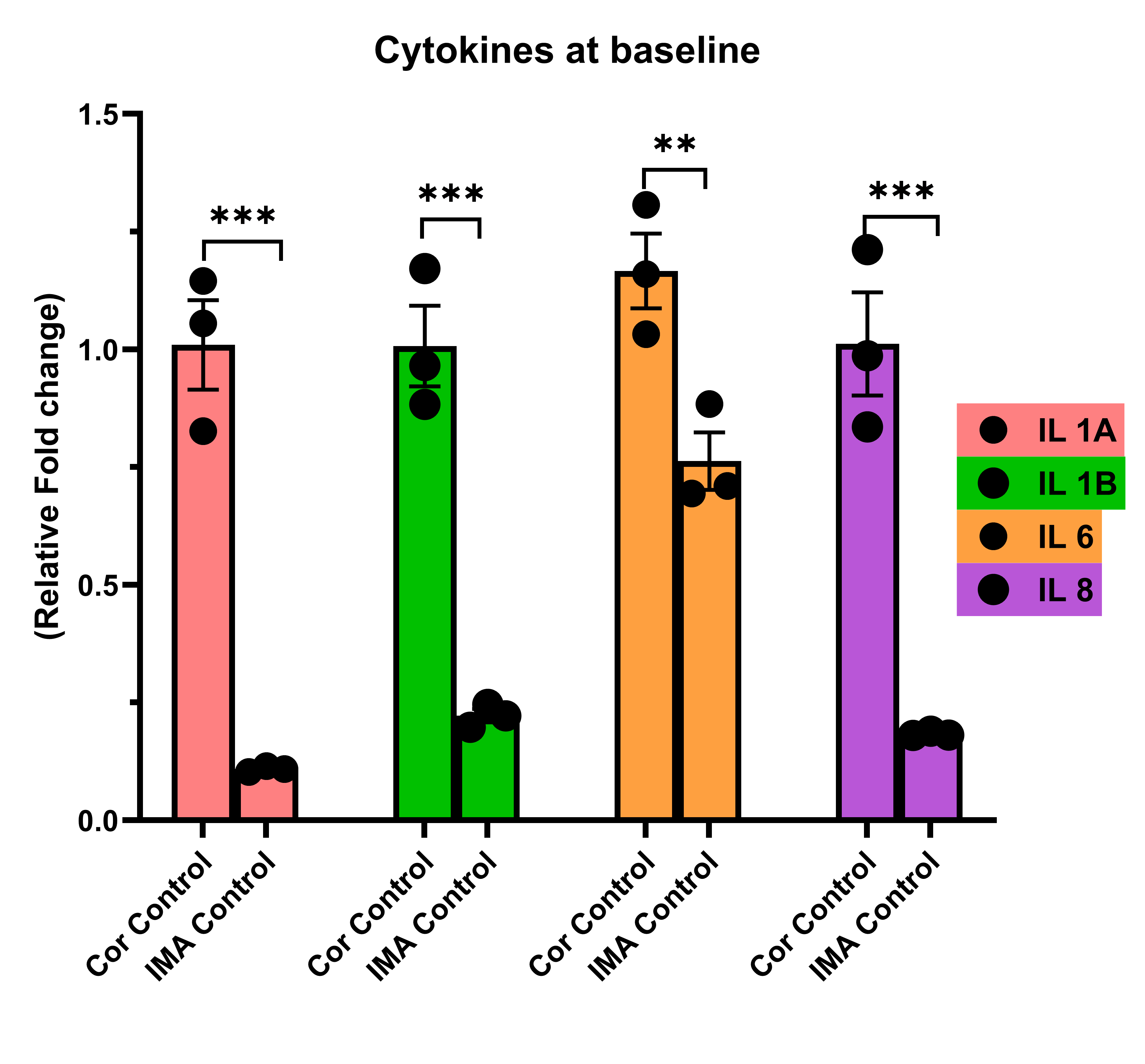
Results: Coronary VSMCs significantly higher baseline expression of pro-inflammatory cytokines, (IL-1α p value=0.0003; IL-1β p value= 0.0004; IL-6 p value= 0.0078; and IL-8 p value= 0.0008), compared to IMA VSMCs. SIRT1 was identified with significantly differential gene expression in coronary vs IMA VSMCs, with IMA having higher expression. SIRT1 is a potent deacetylase and prevents senescence by modulating senescence-associated secretory phenotype (SASP). SASP is defined by the expression of many pro-inflammatory cytokines, similar to the profile observed in coronary VSMCs. Using siRNA-mediated knockdown of SIRT1, IMA were shown to revert to a phenotype closer to that of baseline coronary VSMCs, with significant elevation of inflammatory cytokines.
Conclusions: The present work demonstrates that SIRT1 expression is protective against a SASP-like phenotype in IMA VSMCs. Lack of SIRT1 expression results in SASP-like expression in coronary VSMCs, suggesting a role of vascular senescence as a precursor risk of atherosclerosis. The lack of SIRT1 allows priming of the coronary VMSCs that results in “inflammaging” resulting in propensity of atherosclerosis. Future studies of SIRT1 in VSMCs may provide insights into its use as a molecular therapeutic and role in preventative therapy.
  • Sarkar, Avik  ( Tulane Univestiy School of Medicine , New Orleans , Louisiana , United States )
  • Sutton, Lazarus  ( Tulane Univestiy School of Medicine , New Orleans , Louisiana , United States )
  • Morison, Doree  ( Tulane Univestiy School of Medicine , New Orleans , Louisiana , United States )
  • Thannickal, Victor  ( Tulane Univestiy School of Medicine , New Orleans , Louisiana , United States )
  • Pandey, Amitabh  ( Tulane Univestiy School of Medicine , New Orleans , Louisiana , United States )
  • Author Disclosures:
    Avik Sarkar: DO NOT have relevant financial relationships | Lazarus Sutton: No Answer | Doree Morison: No Answer | Victor Thannickal: No Answer | Amitabh Pandey: DO NOT have relevant financial relationships
Meeting Info:

Scientific Sessions 2025

2025

New Orleans, Louisiana

Session Info:

Emerging Pathways in Smooth Muscle Cell Biology and Macrophages

Saturday, 11/08/2025 , 03:15PM - 04:30PM

Moderated Digital Poster Session

More abstracts on this topic:
84 Immune checkpoint profiling in major aortic diseases leads to identification of potential roles of CD155-CD206 pathway in suppressing inflammation and immune responses

Shao Ying, Saaoud Fatma, Xu Keman, Lu Yifan, Jiang Xiaohua, Wang Hong, Yang Xiaofeng

Additive Value of Lipoprotein(a), Remnant Cholesterol, and Inflammation for Risk Stratification of Myocardial Infarction: Evidence from the UK Biobank

Kazibwe Richard, Schaich Christopher, Kingsley Jeffrey, Rikhi Rishi, Namutebi Juliana, Chevli Parag, Mirzai Saeid, Shapiro Michael

More abstracts from these authors:
You have to be authorized to contact abstract author. Please, Login
Not Available