
Logo

American Heart Association

  17
  0


Final ID: MP741

Core lab versus computer: Pediatric echocardiogram measurement agreement between expert human and AI readers

Abstract Body (Do not enter title and authors here): Background: Deep learning algorithms for automated echocardiographic measurements have demonstrated strong performance in adult populations; however, their utility in pediatric echocardiography remains unclear. We evaluated the agreement between an FDA-approved software for automated adult echocardiogram measurements by Us2.ai and a pediatric core lab reader in assessing left ventricular (LV) size and function.
Methods: We analyzed a retrospective dataset of pediatric echocardiogram DICOM files from 5 pediatric centers and corresponding core lab measurements collected from childhood cancer survivors under 21 years of age. The automated software processed the DICOM files, and agreement with core lab measurements for 17 2D and Doppler measurements was assessed using mean difference and intraclass correlation coefficient (ICC; two-way random effects, absolute agreement, single measures).
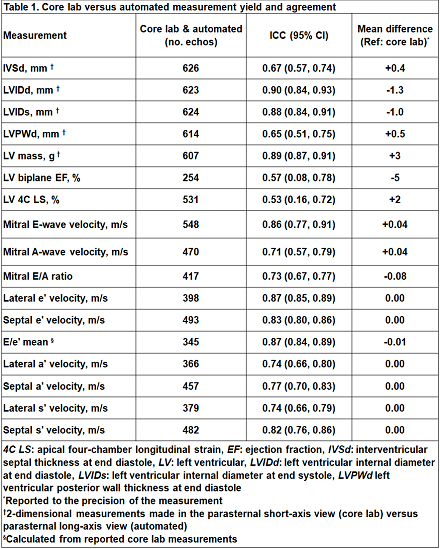
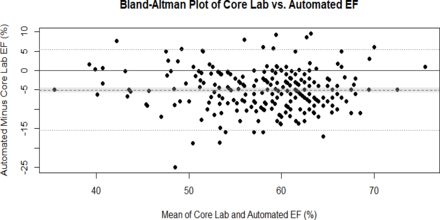
Results: A total of 652 echocardiograms from 153 childhood cancer survivors were included. Median age at time of study was 13.4 (Q1 - Q3: 9.5 - 16.3) years, and 16% of studies showed depressed LV systolic function by core lab measurements (LV shortening fraction ≤28% or ejection fraction [EF] ≤50%). Table 1 summarizes the mean difference and ICC between the automated and core lab reader. Agreement was at least moderate (ICC > 0.5) across all variables. On average, the automated software underestimated biplane EF by 5 percentage points compared to the core lab reader with greater mean differences observed at higher EFs (-1 for core lab EF ≤ 50% and -5 for EF >50%; Figure 1).
Conclusions: Independent validation of an automated echocardiographic measurement software in a pediatric dataset demonstrated at least moderate agreement of all measurements with gold-standard core lab measurements. The software exhibited a bias toward lower ejection fraction values; however, ICC for ejection fraction was comparable to previously reported interobserver variability among human pediatric readers.
  • Edwards, Lindsay  ( Duke University School of Medicine , Durham , North Carolina , United States )
  • Meacham, Lillian  ( Emory University School of Medicine , Atlanta , Georgia , United States )
  • Nathan, Paul  ( The Hospital for Sick Children , Toronto , Ontario , Canada )
  • Narasimhan, Shanti  ( University of Minnesota , Minneapolis , Minnesota , United States )
  • Sachdeva, Ritu  ( Emory University School of Medicine , Atlanta , Georgia , United States )
  • Sadak, Karim  ( University of Minnesota , Minneapolis , Minnesota , United States )
  • Stratton, Kayla  ( Fred Hutchinson Cancer Center , Seattle , Washington , United States )
  • Vemulapalli, Sreekanth  ( Duke University School of Medicine , Durham , North Carolina , United States )
  • Chow, Eric  ( Fred Hutchinson Cancer Center , Seattle , Washington , United States )
  • Sharma, Surbhi  ( University of Washington , Seattle , Washington , United States )
  • Armenian, Saro  ( City of Hope , Duarte , California , United States )
  • Bhat, Aarti  ( University of Washington , Seattle , Washington , United States )
  • Blythe, Nancy  ( Fred Hutchinson Cancer Center , Seattle , Washington , United States )
  • Border, William  ( Emory University School of Medicine , Atlanta , Georgia , United States )
  • Boyle, Patrick  ( University of Washington , Seattle , Washington , United States )
  • Leger, Kasey  ( University of Washington , Seattle , Washington , United States )
  • Leisenring, Wendy  ( Fred Hutchinson Cancer Center , Seattle , Washington , United States )
  • Author Disclosures:
    Lindsay Edwards: DO NOT have relevant financial relationships | Lillian Meacham: DO NOT have relevant financial relationships | Paul Nathan: DO NOT have relevant financial relationships | Shanti Narasimhan: No Answer | Ritu Sachdeva: DO NOT have relevant financial relationships | Karim Sadak: DO NOT have relevant financial relationships | Kayla Stratton: No Answer | Sreekanth Vemulapalli: DO have relevant financial relationships ; Consultant:Abbott Vascular:Active (exists now) ; Advisor:Boehringer-Ingelheim:Past (completed) ; Advisor:Astra Zeneca:Past (completed) ; Consultant:Medtronic:Active (exists now) ; Advisor:Edwards Lifesciences:Past (completed) ; Speaker:Edwards Lifesciences:Past (completed) ; Research Funding (PI or named investigator):Edwards LIfesciences:Active (exists now) | Eric Chow: DO NOT have relevant financial relationships | Surbhi Sharma: DO NOT have relevant financial relationships | Saro Armenian: DO NOT have relevant financial relationships | Aarti Bhat: DO NOT have relevant financial relationships | Nancy Blythe: DO NOT have relevant financial relationships | William Border: No Answer | Patrick Boyle: DO NOT have relevant financial relationships | Kasey Leger: No Answer | Wendy Leisenring: DO NOT have relevant financial relationships
Meeting Info:

Scientific Sessions 2025

2025

New Orleans, Louisiana

Session Info:

Smarter Systems, Better Outcomes: AI and Data-Driven Strategies in Pediatric Cardiac Care

Saturday, 11/08/2025 , 03:15PM - 04:15PM

Moderated Digital Poster Session

More abstracts on this topic:
More abstracts from these authors:
Leveraging the Target: Aortic Stenosis Program for Active Surveillance in AS

Vemulapalli Sreekanth

Socioeconomic and Geographic Factors Associated with Reduced Prenatal Diagnosis of Significant Congenital Heart Disease at a Single Regional Institution

Ittleman Benjamin, Pinto Nelangi, Studer Matthew, Young Luciana, Arya Bhawna, Howard Waylon, Virk Kathryn, Brown Nicholas, Bhat Aarti, Caris Elizabeth, Conwell Jeff, Edwards Lindsay, Lewin Mark

You have to be authorized to contact abstract author. Please, Login
Not Available